
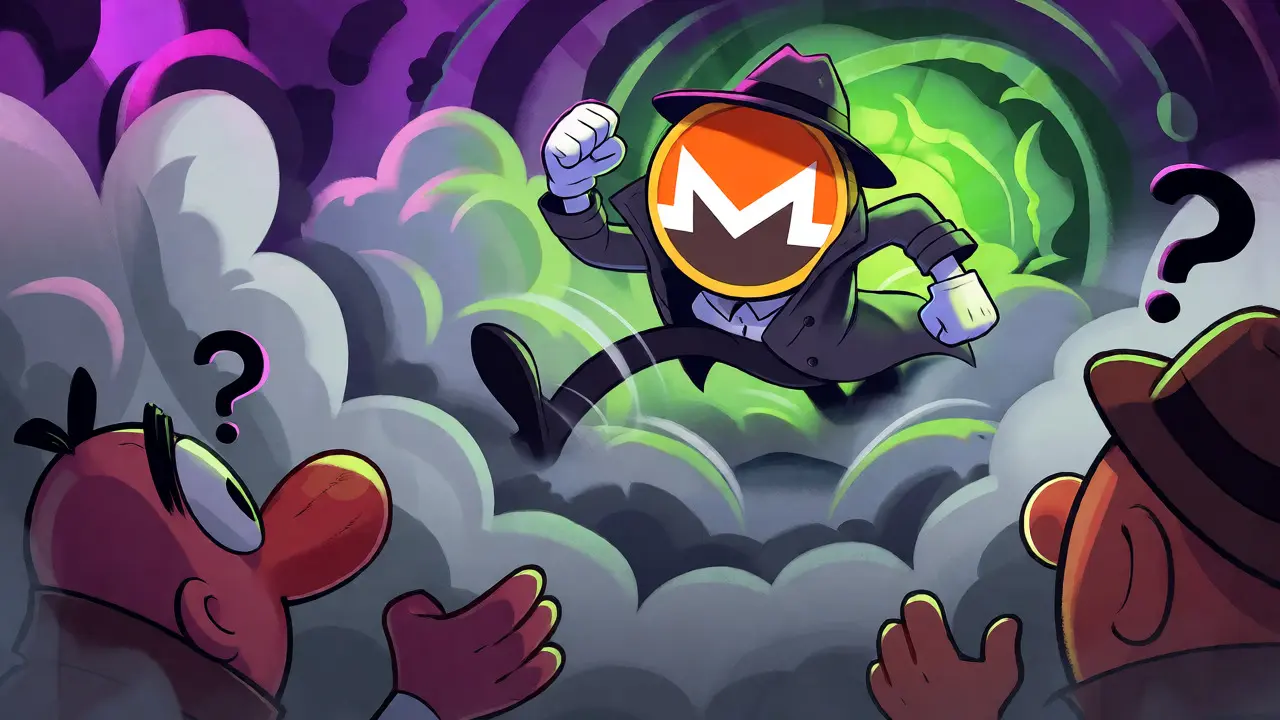
Imagine walking into a store, paying for your coffee, and having every single person in the room know exactly how much money you have left in your bank account. That’s essentially what happens with Bitcoin. Every transaction is public, permanent, and traceable. If you care about financial freedom, that lack of anonymity is a bug, not a feature. Enter Monero, the cryptocurrency that fixes this by making privacy mandatory, not optional.
Launched in 2014, Monero (XMR) has carved out a unique niche as the leading privacy coin. Unlike other cryptocurrencies where you can choose to be private or transparent, Monero hides who sent money, who received it, and how much was transferred by default. This guide breaks down why Monero matters, how its technology actually works, and whether it fits into your digital portfolio in 2026.
Why Standard Blockchains Fail at Privacy
To understand Monero, you first need to grasp the problem it solves. Most blockchains, including Bitcoin and Ethereum, operate on a transparent ledger. When you send Bitcoin, you broadcast a message to the entire network: "Address A sent 1 BTC to Address B." Anyone with an internet connection can see this. Over time, sophisticated analysis tools can link addresses to real-world identities through exchange records, IP leaks, or spending patterns.
This transparency creates two major issues:
- Lack of Fungibility: In economics, fungibility means one unit of currency is interchangeable with another. Because Bitcoin transactions are traceable, some coins get "tainted" if they were previously used in illicit activities. Merchants or exchanges might reject these coins, meaning not all Bitcoins are equal.
- Data Harvesting: Your spending habits reveal your lifestyle, health conditions, political views, and business relationships. On a public blockchain, this data is immutable and accessible to corporations, governments, and hackers forever.
Monero attacks both problems head-on. By hiding transaction details, it ensures that every XMR coin is indistinguishable from any other. You can’t tell if a specific XMR came from a drug deal or a salary payment because the history is obscured. This restores true fungibility and protects your financial data.
The Three Pillars of Monero Privacy
Monero doesn't just hide numbers; it uses three advanced cryptographic techniques working together to obscure transaction metadata. It’s complex math, but here’s the plain English version.
First, there are Ring Signatures. When you sign a transaction, Monero mixes your signature with those of other users’ past transactions. To an outside observer, it looks like any one of those people could have signed the deal. The more participants in the ring, the harder it is to guess who actually sent the funds. Currently, rings include 16 inputs, providing strong plausible deniability.
Second, Monero uses Stealth Addresses. Instead of using your public address directly, each transaction generates a unique, one-time address on the blockchain. Only you and the recipient can determine which stealth address belongs to whom. This prevents anyone from scanning the blockchain and seeing all transactions associated with your main wallet.
Third, Ring Confidential Transactions (RingCT) hides the amount being sent. Before RingCT was mandatory in 2017, amounts were visible. Now, the value is encrypted using commitments. Validators can verify that no new money was created (i.e., inputs equal outputs) without ever seeing the actual numbers.
These three layers ensure that sender, receiver, and amount are all hidden. There is no "transparent mode" in Monero. You don’t opt-in; you’re always private.
Mining Monero: CPU Power vs. ASICs
Most cryptocurrencies are mined by specialized hardware called ASICs (Application-Specific Integrated Circuits). These machines are built solely for hashing algorithms like SHA-256 (Bitcoin). They are expensive, loud, and tend to centralize mining power among large industrial farms. Monero takes a different approach with its RandomX algorithm.
RandomX is designed to be CPU-friendly. It requires significant memory bandwidth and general-purpose computing instructions, which makes it inefficient for ASICs but highly effective for standard computer processors. This design choice aims to keep mining decentralized. If you have a decent gaming PC or a server-grade CPU, you can mine Monero profitably enough to participate in the network.
For example, an AMD Ryzen 9 5950X processor can achieve roughly 18,000 hashes per second. While profitability fluctuates with price and difficulty, the barrier to entry is low. You don’t need to buy a $3,000 machine; you can start with hardware you likely already own. However, do the math on electricity costs. With US averages around $0.12/kWh, home mining is often more about supporting the network than generating massive income.
| Feature | Monero (XMR) | Bitcoin (BTC) | Zcash (ZEC) |
|---|---|---|---|
| Privacy Model | Mandatory (Default) | Pseudonymous (Public Ledger) | Optional (Shielded Pools) |
| Fungibility | High (All coins equal) | Low (Coins can be blacklisted) | Medium (Depends on usage) |
| Mining Hardware | CPU / RAM intensive | ASIC (Specialized) | GPU / ASIC hybrid |
| Block Time | ~2 Minutes | ~10 Minutes | ~75 Seconds |
| Supply Cap | Tail Emission (Infinite) | Hard Cap (21 Million) | Hard Cap (21 Million) |
Regulatory Headwinds and Market Reality
If Monero is so great, why isn’t everyone using it? The answer lies largely in regulation. Governments and financial institutions prefer transparency for anti-money laundering (AML) and counter-terrorism financing (CTF) compliance. Because Monero obscures transaction trails, it poses challenges for regulators trying to track illicit flows.
This friction has led to delistings. Major exchanges in Japan and South Korea removed Monero from their platforms between 2023 and 2024 due to strict local laws. In the US, proposed rules from FinCEN aim to restrict how exchanges handle privacy coins, potentially forcing them to maintain detailed records that defeat the purpose of using Monero. As of late 2025, global exchange availability has tightened, with fewer fiat on-ramps available compared to five years ago.
Despite this, Monero remains the undisputed king of privacy coins. Its market cap hovers around $2.8 billion, dwarfing competitors like Zcash ($1.2 billion) and Dash ($0.9 billion). Daily transaction volumes also lead the sector, indicating robust organic usage rather than just speculative trading. Users aren’t buying Monero to flip it for profit; they’re using it to spend and save privately.
How to Get Started with Monero
Ready to try it? Getting started involves downloading a wallet and securing your keys. Here is the straightforward path:
- Download a Wallet: The official Monero GUI wallet is the gold standard for desktop users. For mobile, Cake Wallet or Monerujo are popular open-source options. Avoid keeping large amounts on exchanges, as withdrawals can sometimes be slow or restricted.
- Sync the Blockchain: The full Monero blockchain is over 175GB. Syncing takes time-often 24 to 48 hours depending on your internet speed. If you want to skip this, use a lightweight wallet that connects to remote nodes, though this slightly compromises privacy.
- Generate Your Address: Create a new account. You’ll receive a long string of characters starting with '4'. This is your public address for receiving funds.
- Back Up Your Seed: Write down your 25-word recovery phrase on paper. Never store it digitally in plain text. If you lose this, your money is gone forever.
- Send Funds: Paste the recipient’s address, enter the amount, and confirm. Remember to include the Payment ID if sending to an exchange, though many now support integrated addresses.
One critical tip: Always test with a small amount first when sending to a new service. Exchange interfaces vary, and while Monero is forgiving, mistakes happen.

The Future: Lelantus and Beyond
Monero isn’t static. The development team, led by anonymous contributors and community funding, continuously upgrades the protocol. The current version, "Drummer," improved transaction sizes by reducing overhead. But the next big leap is coming.
In 2026, the network plans to integrate Lelantus Spark. This upgrade promises to shrink the blockchain size significantly by removing spent transaction data from the chain. Currently, Monero’s blockchain grows faster than Bitcoin’s because it stores more cryptographic proof data. Lelantus will help curb this bloat, making it easier for everyday users to run full nodes on modest hardware.
Additionally, the tail emission model ensures miners remain incentivized indefinitely. Unlike Bitcoin, which halves rewards until they stop, Monero emits a tiny, fixed amount of XMR per block forever. This guarantees security payments even after all initial supply is mined, preventing the network from relying solely on transaction fees.
Is Monero Right for You?
Monero appeals to a specific mindset. If you view money as a tool for freedom and believe that financial privacy is a human right, Monero is likely the best fit. It offers technical superiority in anonymity that no other major coin matches.
However, it comes with trade-offs. Liquidity is lower than Bitcoin. Volatility can be higher during regulatory scares. And the learning curve for running a full node or managing keys is steeper than using a simple app like Cash App.
For most people, holding a small percentage of their crypto portfolio in Monero serves as insurance against surveillance capitalism and potential banking restrictions. It’s not about getting rich quick; it’s about owning your financial narrative.
Is Monero illegal to use?
No, Monero itself is not illegal in most countries, including the US and EU. However, regulations regarding how exchanges list and process privacy coins vary. Some jurisdictions require exchanges to apply stricter KYC (Know Your Customer) rules to Monero transactions, and a few countries have banned its trading entirely.
Can the government track my Monero transactions?
Tracking is extremely difficult but not theoretically impossible. While the blockchain hides sender, receiver, and amount, metadata leaks (like sharing an IP address with a known entity or linking multiple inputs) can provide clues. Chain analysis firms claim to de-anonymize a small percentage of transactions, but Monero’s privacy remains far superior to Bitcoin’s.
Why is Monero’s supply unlimited?
Monero uses a "tail emission" model where a small, fixed amount of XMR (currently 0.6 XMR per block) is created forever. This ensures miners continue to secure the network via block rewards even as transaction volume fluctuates, preventing security risks associated with fee-only models.
What is the difference between Monero and Zcash?
The key difference is mandatory vs. optional privacy. Monero hides all transactions by default. Zcash offers "shielded" transactions that are private, but most users still send "transparent" transactions similar to Bitcoin. This makes Monero more fungible because every coin is equally private, whereas Zcash coins can be distinguished based on their history.
Do I need a powerful computer to mine Monero?
You need a modern multi-core CPU and sufficient RAM (at least 2GB dedicated to mining), but you do not need expensive ASIC hardware. RandomX is optimized for general-purpose CPUs, allowing gamers and hobbyists to mine effectively with existing PC components.