
Imagine trying to buy a coffee with Bitcoin. You wait ten minutes for the transaction to clear, pay a $5 fee, and hope it doesn’t get stuck in the mempool. That was the reality of Ethereum just a few years ago. Today, thanks to Layer 2 scaling solutions that are protocols built on top of Ethereum to increase transaction speed and reduce costs, you can process thousands of transactions per second for fractions of a cent. But not all Layer 2s are created equal. The two heavyweights dominating the landscape in 2026 are Optimistic Rollups and Zero-Knowledge (ZK) Rollups.
If you’re a developer choosing where to deploy your next dApp, or an investor trying to understand where the market is heading, this distinction matters. One assumes honesty until proven wrong; the other proves correctness mathematically before moving forward. They solve the same problem-Ethereum’s congestion-but they take radically different paths. Let’s break down exactly how they work, what they cost, and which one actually fits your needs.
How Optimistic Rollups Work: Trust but Verify Later
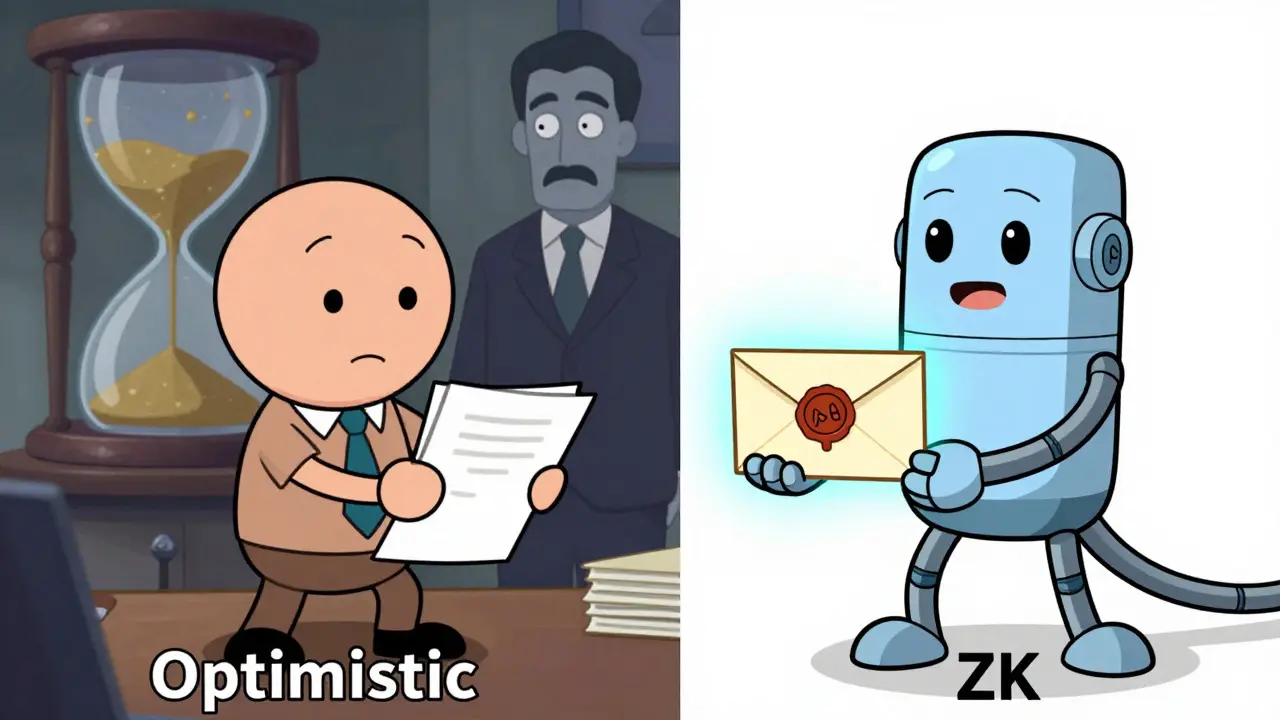
Optimistic Rollups are scaling solutions that assume transactions are valid by default and only verify them if challenged operate on a simple premise: most people don’t cheat. When a batch of transactions is processed off-chain, the rollup operator posts the results to Ethereum mainnet without any proof of validity. It’s "optimistic" because it trusts the data is correct.
So, what stops someone from stealing funds? The threat of a fraud proof. There is a seven-day challenge period. During this week, anyone can look at the data, run the computation themselves, and submit a "fraud proof" if they spot an error. If a fraud proof is submitted, the invalid transaction is reverted, and the dishonest operator is slashed. If no one challenges it after seven days, the state transition is considered final.
This approach has massive advantages for developers. Because Optimistic Rollups like Arbitrum is a leading Optimistic Rollup network compatible with the Ethereum Virtual Machine and Optimism is an Optimistic Rollup platform known for its OP Stack and EVM equivalence are fully EVM-equivalent, you can copy-paste your Solidity code and deploy it instantly. No rewriting, no new languages. According to Dune Analytics data from early 2025, these networks hold over $28 billion in Total Value Locked (TVL), largely because DeFi protocols migrated there easily.
The catch? That seven-day wait. If you want to withdraw money back to Ethereum mainnet, you have to sit tight for 168 hours. For a casual user buying an NFT, that’s annoying. For a high-frequency trader, it’s unacceptable. This "withdrawal friction" remains the biggest user experience hurdle for Optimistic Rollups.
How ZK-Rollups Work: Prove It Mathematically
ZK-Rollups are scaling solutions that use cryptographic zero-knowledge proofs to validate transactions instantly take the opposite approach. Instead of assuming validity, they prove it. Before any transaction data hits Ethereum, the rollup generates a cryptographic receipt-a zero-knowledge proof-that mathematically guarantees every transaction in the batch followed the rules.
This relies on complex cryptography, specifically zk-SNARKs (Succinct Non-interactive Arguments of Knowledge) or zk-STARKs. Think of it like a sealed envelope. The verifier (Ethereum) doesn’t need to open the envelope and read every letter (transaction). They just check the wax seal (the proof). If the seal is intact, the contents are guaranteed to be correct.
The result is instant finality. Once the proof is verified on Ethereum, your funds are yours to move immediately. No waiting weeks. Networks like zkSync Era is a ZK-Rollup solution developed by Matter Labs offering full EVM compatibility and StarkNet is a ZK-Rollup platform using STARKs and the Cairo programming language lead this space. StarkNet uses Cairo, a custom language designed for provability, while zkSync has achieved full EVM compatibility, making it easier for traditional Ethereum devs to join.
The downside? Complexity and cost. Generating these proofs requires serious computing power. We’re talking high-end GPUs and specialized hardware. In late 2024, running a ZK node could cost upwards of $1,200 a month, compared to $300 for an Optimistic validator. This centralization risk is real-if only a few powerful entities can afford to generate proofs, who guards the network?
Head-to-Head Comparison: Speed, Cost, and Security
| Feature | Optimistic Rollups | ZK-Rollups |
|---|---|---|
| Withdrawal Time | 7 Days (Challenge Period) | Minutes to Hours (Instant Finality) |
| Transaction Fees | $0.10 - $0.50 (Lower computational overhead) | $0.20 - $1.50 (Higher proof generation cost) |
| Developer Experience | Native Solidity/EVM (Easy migration) | Mixed: Cairo (Hard) or zkEVM (Moderate) |
| Privacy | Low (Data exposed on L1) | High (Cryptographic obfuscation possible) |
| Security Model | Economic Incentives (Fraud Proofs) | Cryptographic Validity (Mathematical Proof) |
| Market Share (TVL) | ~58% ($28.7B) | ~42% ($20.6B) |
Let’s talk numbers. As of Q4 2024, Optimistic Rollups still dominate in total value locked, holding nearly 60% of the Layer 2 market. Why? Because liquidity follows ease of use. Developers moved their apps to Arbitrum and Optimism first because it was easy. Users followed the apps.
However, momentum is shifting. ZK-Rollups grew 120% year-over-year in 2024, outpacing Optimistic growth. Why? Because institutions care about privacy and auditability. Under regulations like the EU’s MiCA framework, ZK-Rollups offer better compliance tools because the cryptographic proofs provide undeniable evidence of transaction validity without exposing sensitive user data. Traditional finance firms entering DeFi prefer ZK for this reason.
Cost-wise, Optimistic is currently cheaper for simple transfers. A basic ETH transfer might cost you $0.10 on Optimism versus $0.30 on zkSync. But for complex smart contract interactions, the gap narrows. Berkeley researchers found that ZK-Rollups become 25% more cost-efficient for heavy computation tasks because the verification cost on Ethereum is fixed and tiny, regardless of complexity.
Which One Should You Choose?
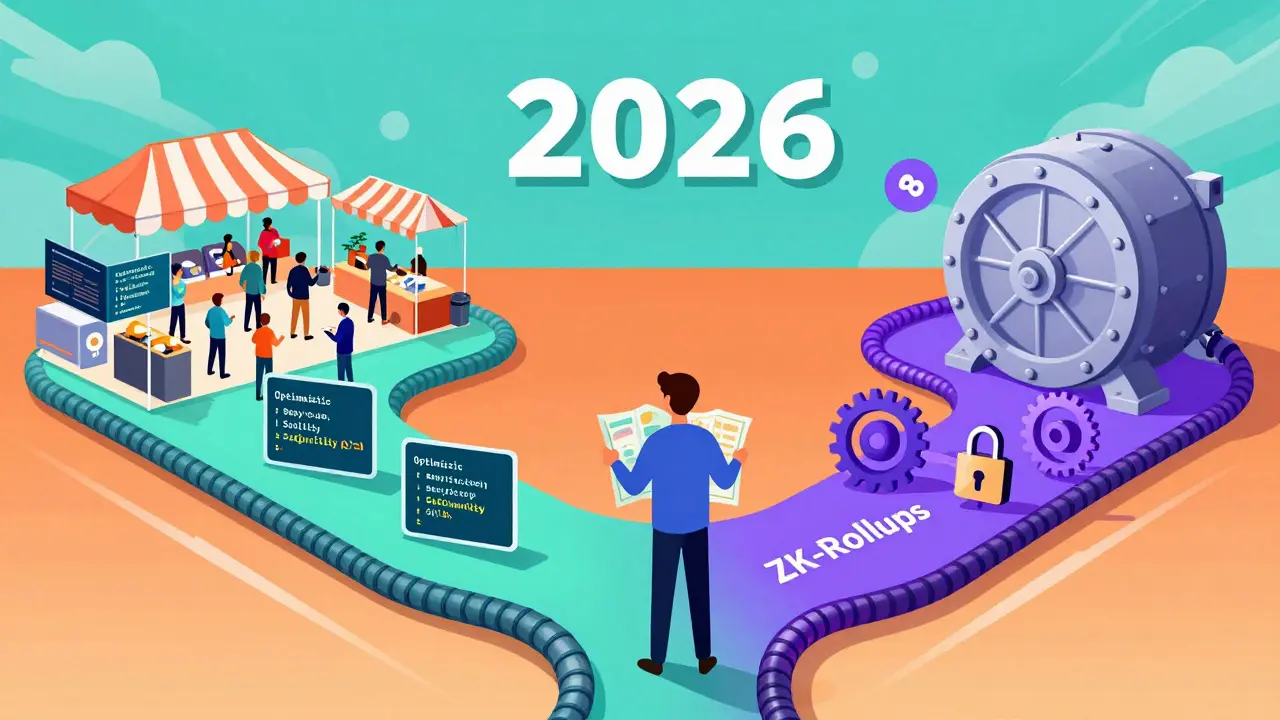
Your choice depends entirely on what you’re building or doing.
Choose Optimistic Rollups if:
- You are building a standard DeFi application (lending, swapping) and need immediate access to existing Solidity libraries.
- Your users are retail traders who prioritize low fees over instant withdrawals.
- You want to leverage the largest existing liquidity pools on Arbitrum or Optimism.
Choose ZK-Rollups if:
- You are building gaming, identity, or enterprise applications where privacy and fast finality are non-negotiable.
- You need institutional-grade auditability and regulatory compliance.
- You believe in the long-term thesis that cryptographic security will replace economic incentives as the gold standard.
Vitalik Buterin himself has stated that while Optimistic Rollups provide "crucial immediate relief," ZK-Rollups represent the "long-term scaling solution." The industry is converging. Optimistic projects are working on "fault proofs" to shrink the 7-day window to hours. ZK projects are optimizing hardware to slash costs. By 2027, experts predict ZK will capture 60% of the market share as proof generation becomes cheaper and faster.
Common Pitfalls to Avoid
Don’t ignore the withdrawal time. If your app requires users to bridge funds back to mainnet quickly, Optimistic Rollups will frustrate them. Many users abandon withdrawals during the 7-day wait, citing "archaic" delays in community forums.
Don’t underestimate the learning curve for ZK. While zkSync offers EVM compatibility, true ZK development often involves understanding constraint systems or using languages like Cairo. If your team is small, stick to Optimistic unless you have dedicated crypto-engineers.
Watch out for centralization risks in ZK. Currently, proof generation is expensive. If only three companies can afford the hardware to generate proofs for a network, that network is centralized. Always check the number of active sequencers and verifiers before committing.
Are ZK-Rollups more secure than Optimistic Rollups?
Yes, cryptographically. ZK-Rollups rely on mathematical proofs, meaning a transaction is invalid unless the math fails (which is extremely rare). Optimistic Rollups rely on economic incentives; security depends on honest validators watching the network. If all validators go offline or collude, Optimistic security degrades. However, both are considered highly secure in practice today.
Why do Optimistic Rollups have a 7-day withdrawal period?
The 7-day window is a "challenge period." Since the rollup assumes transactions are valid, it gives anyone a week to inspect the data and submit a fraud proof if something is wrong. Only after this period expires is the withdrawal finalized on Ethereum mainnet. Newer upgrades aim to reduce this time significantly.
Can I use Solidity on ZK-Rollups?
It depends on the specific ZK-Rollup. StarkNet uses Cairo, a custom language. However, zkSync Era and Scroll offer full EVM compatibility, allowing you to deploy standard Solidity contracts with minimal changes. The performance may vary slightly due to the underlying proof system, but functionality is largely preserved.
Which Layer 2 is best for NFTs?
ZK-Rollups are increasingly preferred for NFTs, especially gaming assets, because they offer instant finality and better privacy. Projects like Immutable X use ZK technology to handle thousands of NFT transactions per second with near-zero gas fees. Optimistic Rollups are also popular for general-purpose NFT marketplaces due to lower initial deployment friction.
Will Optimistic Rollups disappear?
Unlikely in the short term. They hold significant market share and liquidity. However, they are evolving. Features like "fault proofs" and liquidity networks for instant withdrawals are bridging the gap. Experts predict a hybrid future where both technologies coexist, serving different use cases, rather than one completely replacing the other.