
The rules for running a cryptocurrency business have changed completely in the last two years. If you are still using the old playbook from 2023, you are likely breaking the law. The landscape is no longer about wild west experimentation; it is about strict adherence to frameworks like the Payment Services Act and its global counterparts. Whether you are operating in Singapore, Japan, or the European Union, regulators have drawn hard lines. Missing these deadlines means shutting down your platform immediately.
As of mid-2026, the major jurisdictions have finalized their stances. Singapore passed its final deadline. Europe has moved into the enforcement phase of MiCA and PSD2 integration. The United States has established clearer jurisdictional boundaries with the CLARITY Act. This guide breaks down exactly what these provisions mean for your operations, so you can stay compliant without guessing.
Singapore's Final Deadline: No Grace Periods
If you operate in Asia, Singapore’s Monetary Authority (MAS) sets the gold standard for strictness. The Financial Services and Markets Act (FSMA) replaced older frameworks, and the clock stopped ticking on June 30, 2025. That date was not a suggestion. It was an absolute cutoff. Any platform providing digital token services without a proper license had to cease operations instantly. There were no extensions. There were no grace periods.
Why does this matter for you right now? Because the regulatory pressure has shifted from getting licensed to maintaining that license under intense scrutiny. MAS updated consumer protection regulations in September 2024 to close loopholes. These updates target how you talk to customers. You cannot use misleading marketing. You cannot sell high-risk products to inexperienced investors.
The most painful change for many businesses? The ban on credit card purchases of cryptocurrencies. If your payment gateway still allows users to buy Bitcoin or Ethereum with Visa or Mastercard, you are out of compliance. You must switch to bank transfers or other approved methods. Additionally, you need to implement rigorous customer suitability assessments. You have to prove that every user understands the risks before they trade. This adds friction to your signup process, but it keeps your license intact.
Another critical piece is the Travel Rule. This requires you to share customer information when processing transfers above specific thresholds. Both the sender and the receiver must collect and exchange detailed data about the transaction parties. It does not matter which blockchain technology you use. The rule applies universally. Your compliance team needs automated systems to flag these transactions and transmit the required data to the receiving platform. Failure to do so results in heavy fines or license revocation.
Europe's PSD2 and MiCA Integration: The March 2026 Shift
In the European Union, the relationship between traditional banking rules and crypto rules has finally been clarified. For years, there was confusion about whether moving crypto counts as a payment service. The European Banking Authority (EBA) issued a definitive No Action letter to clear this up. As of March 2, 2026, National Competent Authorities (NCAs) require Payment Services Directive 2 (PSD2) authorization for certain crypto activities.
This creates a dual-regulation environment. You might already be authorized as a Crypto-Asset Service Provider (CASP) under the Markets in Crypto-Assets (MiCA) regulation. However, if you offer transfer services that qualify as payment services, you now need PSD2 approval too. The good news is that NCAs are supposed to streamline this process. They should maximize the use of information you provided during your CASP application. You should not have to start from scratch.
Once you have your PSD2 authorization, some old rules relax. NCAs are advised not to prioritize supervision of safeguarding requirements, charge disclosures, or execution times for these specific crypto-payment activities. However, do not get comfortable. There are non-negotiable areas where PSD2 rules apply strictly:
- Strong Customer Authentication (SCA): You must enforce SCA for accessing custodial wallets that qualify as payment accounts. This also applies when initiating Electronic Money Token (EMT) transfers.
- Fraud Reporting: You must report payment fraud incidents just like a traditional bank would.
- Own Funds Calculation: You must calculate your capital requirements cumulatively. This ensures you have enough buffer to protect consumers, regardless of whether they hold euros or stablecoins.
Keep in mind that MiCA explicitly excludes "exchange of crypto-assets for funds" and "exchange of crypto-assets for other crypto-assets" from the definition of payment services. If you only run an exchange and do not facilitate payments, PSD2 may not apply to those specific functions. But if you enable users to pay merchants with crypto, you fall under PSD2. Check your product features carefully.

Japan's Payment Services Act: Cold Storage and Licensing Tiers
Japan has been regulating crypto since 2016, but its Payment Services Act continues to evolve. The 2019 Amendment changed the terminology from "virtual currency" to "crypto assets" and tightened security rules. The most famous requirement? Mandatory cold wallet storage. You must keep user assets in offline cold storage. Hot wallets are only allowed for immediate trading needs. This protects users if your exchange gets hacked.
In March 2025, the Japanese Cabinet approved new amendments to the Payment Services Act. While detailed implementation guidelines are still rolling out, the direction is clear. The focus is on adapting to new technologies while preventing unfair practices. Japan uses a three-tier licensing system for payment services:
| License Type | Transaction Limit | Scope of Business |
|---|---|---|
| Type 1 | Under ¥5 million per year | Basic remittance and small-scale crypto transfers |
| Type 2 | Up to ¥5 billion per year | Larger scale transfers and broader crypto asset handling |
| Type 3 | No limit | Full-scale payment services including large institutional flows |
You must choose the right tier based on your projected volume. Applying for a lower tier than you need will force you to reapply later, wasting time and money. Also, note the advertising rules. You cannot solicit investments aggressively. If you issue tokens that promise profit distribution, those fall under the Financial Instruments and Exchange Act (FIEA), not just the Payment Services Act. This distinction is crucial for ICOs and new token launches.
United States: The CLARITY Act and Jurisdictional Clarity
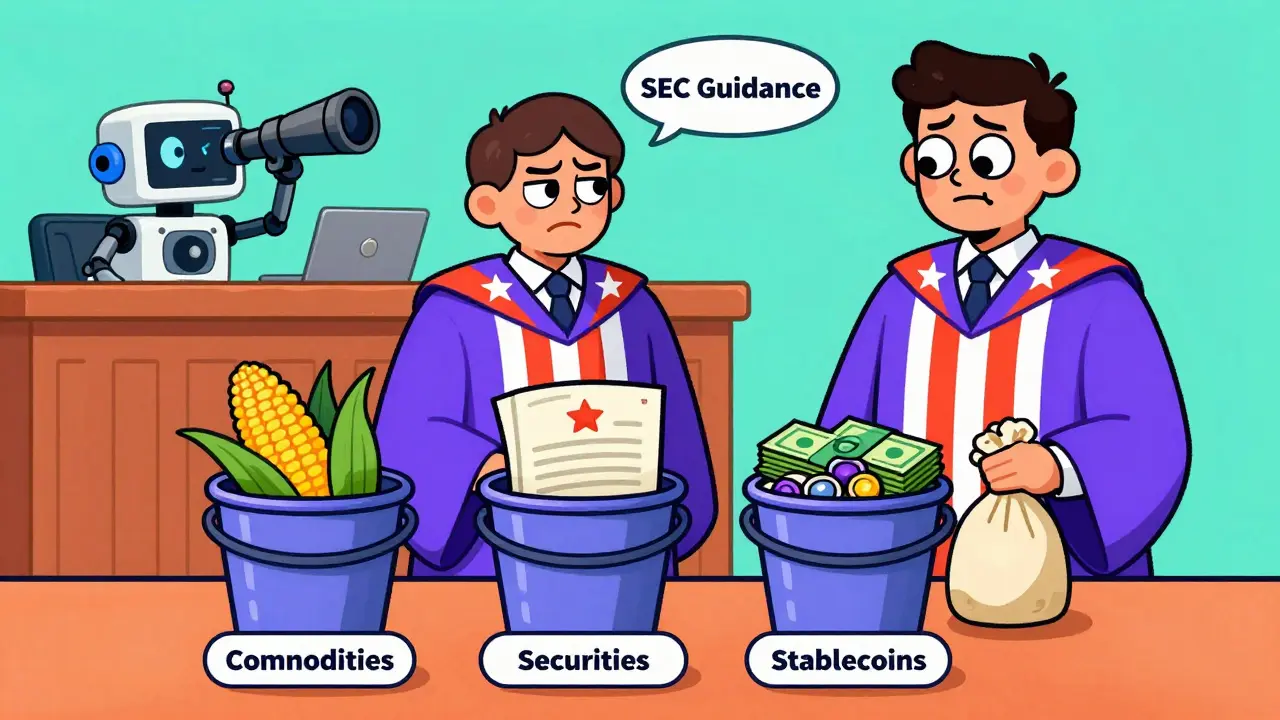
The United States has historically suffered from "regulation by enforcement." Agencies like the SEC and CFTC often clashed over who controlled which tokens. The CLARITY Act (Clarifying Law Around Intent of Congress To Regulate Your Assets) aims to fix this by categorizing crypto assets into three buckets:
- Digital Commodities: Regulated primarily by the Commodity Futures Trading Commission (CFTC). These are decentralized assets that do not function as investment contracts.
- Investment Contract Assets: Regulated by the Securities and Exchange Commission (SEC). These tokens pass the Howey test, meaning they represent an investment in a common enterprise with expected profits from others' efforts.
- Permitted Payment Stablecoins: A special category for stablecoins designed for payments, subject to specific reserve and transparency requirements.
This classification determines your regulator. If you handle digital commodities, you deal with the CFTC. If you handle securities-like tokens, you deal with the SEC. The Act prevents the SEC from banning broker-dealers from trading digital commodities just because they also trade securities. This opens doors for traditional financial institutions to enter the crypto space.
For platforms, this means you need robust internal classification systems. You cannot treat all tokens the same. Each asset must be analyzed against the Howey test criteria. The Act also modernizes recordkeeping. Broker-dealers and exchanges can now use blockchain technology for books and records, provided they meet security standards. This reduces the burden of maintaining parallel paper trails.
Decentralized Finance (DeFi) faces a unique path. The Act directs the SEC to consider exemptions for certain DeFi activities, recognizing that traditional intermediary rules do not fit code-based protocols. However, this is discretionary. Do not assume your DeFi protocol is exempt. Monitor SEC guidance closely as they draft specific rules.
Cross-Jurisdictional Compliance: Managing the Complexity
Running a global crypto business means juggling all these rules at once. Singapore demands no credit cards and strict Travel Rule compliance. Europe requires PSD2 authorization for payment functions alongside MiCA licensing. Japan mandates cold storage and tiered licenses. The US requires precise asset classification.
The biggest challenge is technical implementation. You need different compliance engines for different regions. For example, your KYC (Know Your Customer) process in Singapore must include suitability assessments. In Europe, it must integrate with Strong Customer Authentication systems. In Japan, it must verify your ability to segregate assets into cold storage.
Start by mapping your services to each jurisdiction. Identify which parts of your business trigger which regulations. Then, build modular compliance layers. Do not try to create one global policy. Instead, create region-specific modules that plug into your core platform. This approach reduces risk and makes audits easier.
Hire local legal counsel in each major market. Remote advice is rarely enough when dealing with nuanced interpretations of laws like the Payment Services Act or MiCA. Local experts know how regulators actually enforce the rules, not just how they are written.
What happens if I miss the Singapore FSMA deadline?
You must cease all digital token services immediately. MAS stated there are no extensions or grace periods. Operating without a license after June 30, 2025, leads to severe penalties, potential criminal charges, and permanent bans from the industry.
Do I need both MiCA and PSD2 licenses in Europe?
It depends on your services. If you only exchange crypto for crypto, MiCA is likely sufficient. However, if you facilitate payments (transferring value to third parties), you need PSD2 authorization starting March 2, 2026. The EBA advises authorities to streamline the process, but both approvals are required for payment functions.
Can I still accept credit cards for crypto in Singapore?
No. MAS regulations prohibit credit card purchases of cryptocurrencies to protect retail investors from debt and impulsive buying. You must use bank transfers or other approved funding methods.
How does the CLARITY Act affect DeFi protocols?
The Act gives the SEC discretion to exempt certain DeFi activities from traditional intermediary rules. However, this is not automatic. Protocols must monitor SEC guidance and potentially apply for exemptions. Decentralization alone does not guarantee immunity from regulation.
What is the Travel Rule requirement?
The Travel Rule requires crypto platforms to share sender and receiver information for transactions above specific thresholds. This applies globally in jurisdictions like Singapore and helps prevent money laundering. You must implement systems to collect and transmit this data securely.