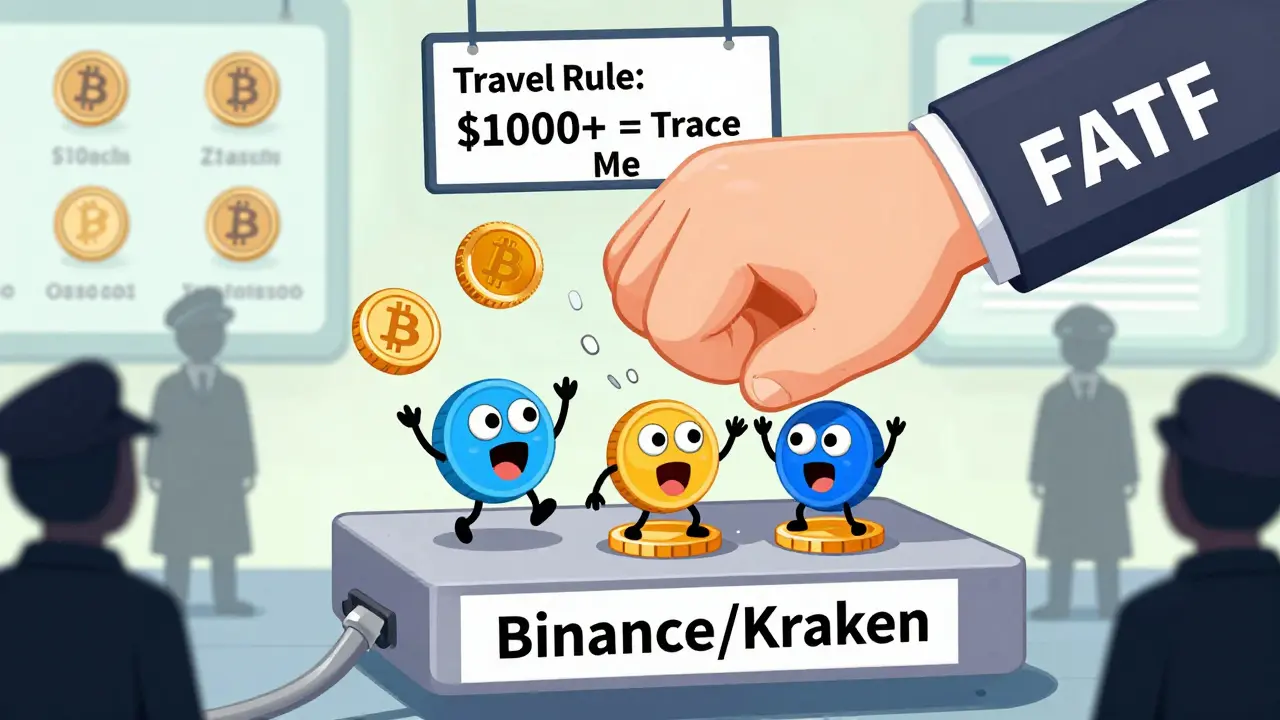
By early 2025, if you tried to trade Monero, Zcash, or Dash on Binance, Kraken, or Upbit, you couldn’t. Not because they stopped working, but because the exchanges stopped letting you. A global wave of delistings swept through major crypto platforms, removing privacy-focused coins one after another. It wasn’t random. It was coordinated, legal, and driven by regulators who say these coins are too risky to keep on their platforms. And it’s changing how people use cryptocurrency - whether they like it or not.
What Are Privacy Coins, and Why Do Exchanges Hate Them?
Privacy coins are designed to hide who sent money, who received it, and how much was sent. That’s the whole point. Monero uses ring signatures to mix transactions together so no one can trace the source. Zcash uses zero-knowledge proofs to prove a transaction is valid without showing any details. Dash and others use stealth addresses to keep recipients anonymous. These aren’t just features - they’re core to how these coins work.
That’s also why they’re a problem for exchanges. Bitcoin and Ethereum transactions are public. Anyone can look at a blockchain explorer and see that Wallet A sent 5 BTC to Wallet B. Regulators can follow the trail. Privacy coins? Not so much. That’s exactly what the Financial Action Task Force (FATF) doesn’t want. In June 2024, they updated their rules to require exchanges to track and share customer data for all transactions over $1,000 - the so-called "Travel Rule." But if you can’t see who sent the money, you can’t comply. And if you can’t comply, regulators shut you down.
The Delisting Wave: Numbers Don’t Lie
In 2023, 51 exchanges removed privacy coins. In 2025? 73. That’s a 43% jump in just two years. And it’s not slowing down. Binance delisted Monero (XMR), Zcash (ZEC), and Dash (DASH) from its European and U.S. platforms in February 2025, cutting off $600 million in monthly trading volume overnight. Kraken followed in March, pulling privacy coins from its Canadian site because they violated FINTRAC rules. Japan didn’t just delist - they banned them entirely back in 2018, and in 2025, every licensed exchange in the country still obeyed that ban.
South Korea’s top five exchanges - Upbit, Bithumb, Coinone, Korbit, and Bitget - all removed privacy coins in Q1 2025. Upbit specifically dropped six of them on September 30 after a September 20 notice citing FATF guidelines. OKEx Korea axed five more by October 10. Poloniex globally delisted Monero in April after pressure from the U.S. Treasury Department. This wasn’t a trend. It was a purge.
Who’s Still Letting Them Trade?
The answer? Not many.
Switzerland and Liechtenstein still allow limited trading under strict KYC and AML rules. Singapore permits them with heavy monitoring. But the rest? The European Union is set to ban all privacy coins and anonymous crypto accounts starting July 2027. Australia restricts access. Dubai banned them in 2023. South Korea, Japan, and Canada have fully locked them out. That means if you live in most of the developed world, you can’t legally buy privacy coins on a major exchange anymore.
But here’s the twist: the coins didn’t disappear. They just moved.
Price Went Up. Volume Went Underground.
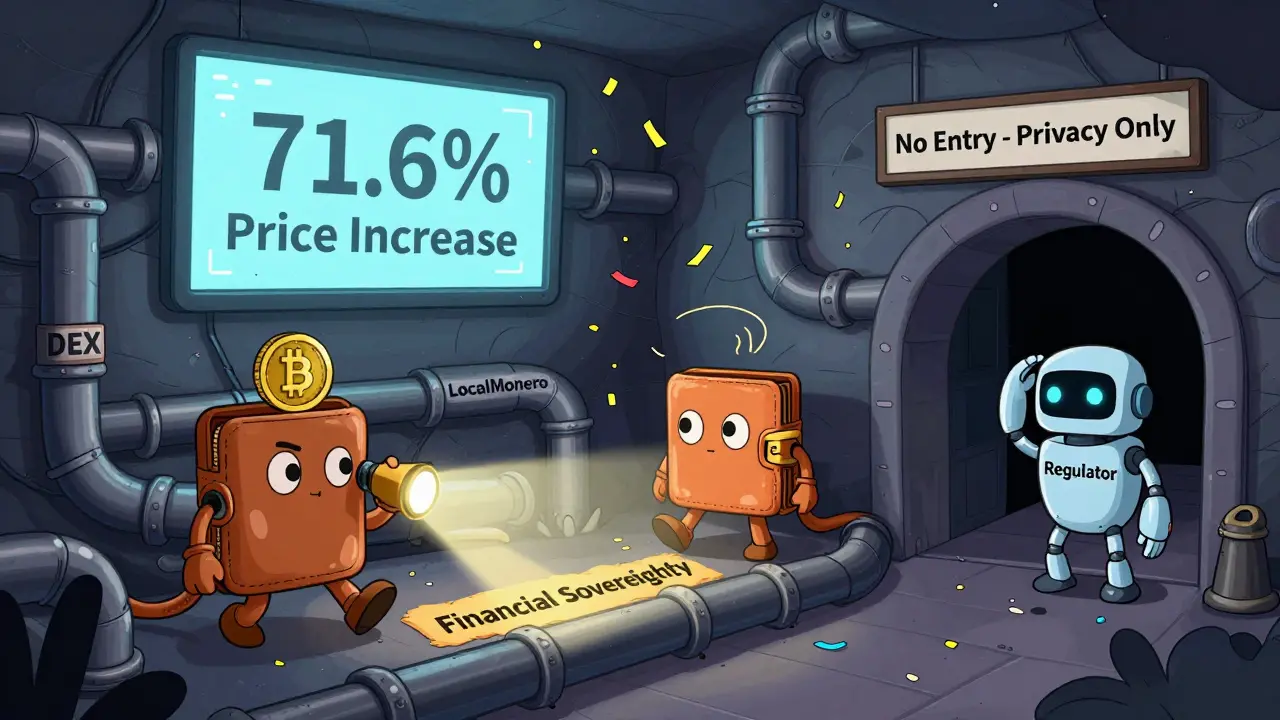
Despite being kicked off exchanges, privacy coins saw a 71.6% price increase in 2025. Monero alone jumped over 90%. Zcash rose 65%. That’s more than Bitcoin. Why? Because when supply gets restricted, demand doesn’t vanish - it finds another way.
People started using decentralized exchanges (DEXs), peer-to-peer platforms like LocalMonero, and atomic swaps. LocalMonero saw a 19% spike in activity after the major delistings. Reddit threads filled up with guides on how to buy Monero with cash, via Telegram, or through OTC desks. Twitter became a hub for privacy advocates arguing that this was a betrayal of crypto’s original promise: financial sovereignty.
But not everyone agrees. Institutional investors - hedge funds, family offices, even some venture capital firms - now see privacy coins as a niche asset class. Why? Because if they’re hard to get, they’re harder to manipulate. And if regulators keep pushing them off centralized platforms, the remaining supply becomes scarcer. Some are quietly accumulating.
Regulators Aren’t Wrong - But Are They Right?
Regulators say privacy coins enable crime. And yes, they do. The UN estimated that in 2024, over $250 billion in crypto transactions involved privacy coins. That’s 11.4% of all crypto activity. Some of it was laundering, ransomware payments, darknet market purchases. That’s real.
But here’s what gets ignored: privacy isn’t just for criminals. It’s for journalists in authoritarian countries. It’s for businesses protecting supplier contracts. It’s for people living under oppressive regimes who can’t afford to let their government see their savings. A doctor in Venezuela sending money to family abroad. A whistleblower in Russia hiding donations. A small business owner in Nigeria avoiding bank fees and surveillance. These aren’t edge cases - they’re millions of real people.
Exchanges are caught in the middle. They need licenses. They need to avoid fines. They need to keep operating. So they remove privacy coins. But users aren’t just giving up. They’re building alternatives.
The Future: Can Privacy and Compliance Coexist?
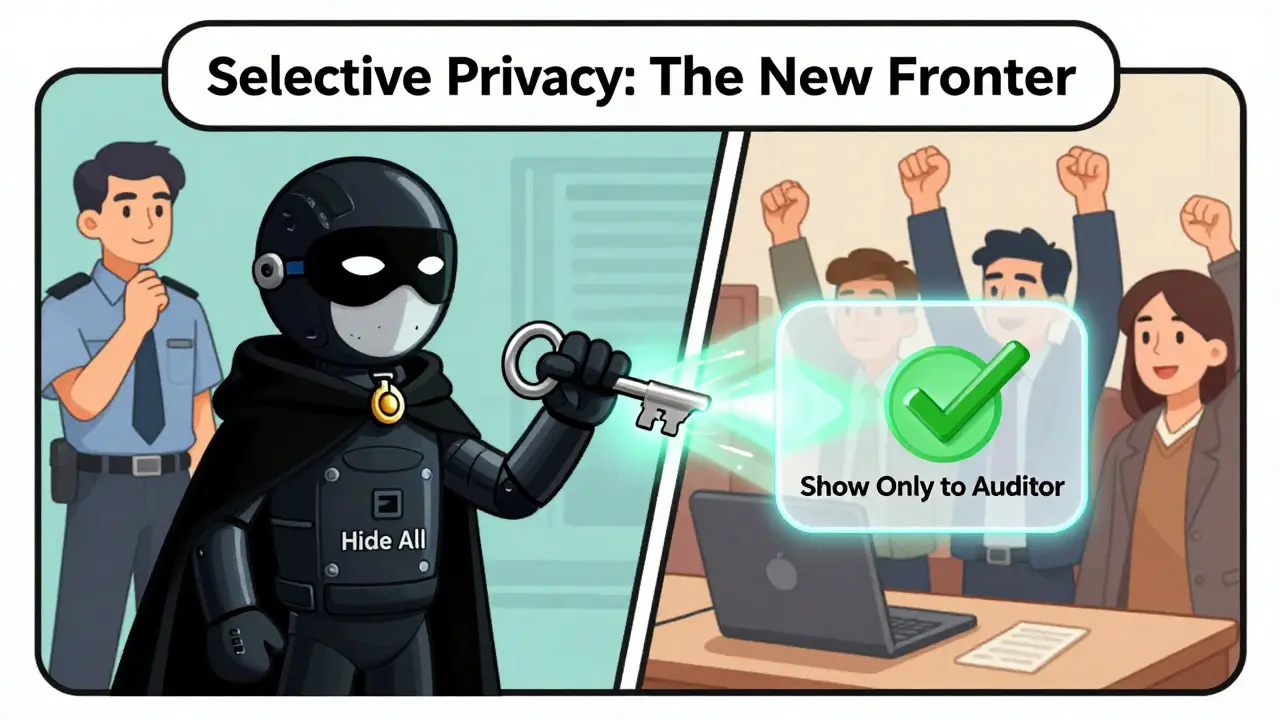
Developers aren’t giving up. Teams behind Monero, Zcash, and newer privacy coins are working on hybrid solutions. Imagine a coin that hides transaction details by default - but lets users voluntarily reveal them to regulators with a key. Or a system where a trusted third party (like a licensed auditor) can verify compliance without seeing the full history. Zero-knowledge proofs are getting smarter. Some prototypes can prove you’re not a sanctioned person without showing your identity.
74% of privacy coin developers say FATF rules are their biggest challenge. But they’re not trying to beat the rules - they’re trying to rewrite them. The next generation of privacy coins won’t be fully anonymous. They’ll be selectively private. You choose what to hide. And what to show.
The delisting wave isn’t the end of privacy coins. It’s the start of a new arms race - between regulation and innovation. Exchanges removed them because they had to. But users didn’t stop wanting them. They just got more creative.
Why did exchanges start delisting privacy coins in 2025?
Exchanges began delisting privacy coins in 2025 because of updated global regulations, especially the FATF’s 2024 Travel Rule extension. This rule requires exchanges to collect and share customer data for transactions over $1,000. Privacy coins like Monero and Zcash use cryptographic methods that make it technically impossible to trace transaction details, so exchanges couldn’t comply without breaking the rules - or risking heavy fines and license revocation.
Which privacy coins were most affected by delistings?
Monero (XMR), Zcash (ZEC), and Dash (DASH) were the most targeted. Together, they made up over 80% of all privacy coin trading volume in 2025. Other coins like PIVX, Haven (XHV), and BitTube (TUBE) were also removed, but less widely. Exchanges focused on the top coins because they had the highest trading volume and regulatory scrutiny.
Can I still buy Monero or Zcash after they’re delisted?
Yes - but not on major exchanges. You can still buy them through decentralized exchanges (DEXs), peer-to-peer platforms like LocalMonero, OTC brokers, or atomic swaps. These methods don’t require KYC, so they’re harder to regulate. However, they come with risks: scams, lack of customer support, and slower transactions. Many users have shifted to these alternatives out of necessity.
Why did privacy coin prices go up even as they were being delisted?
Supply dropped sharply on major exchanges, but demand didn’t disappear - it just moved. With fewer places to buy Monero or Zcash, the remaining supply became scarcer. Traders who still wanted access turned to peer-to-peer markets and DEXs, where liquidity is thinner and prices often rise due to lower volume. Additionally, some investors saw the delistings as a sign of long-term scarcity, driving speculative buying.
Is there any hope for privacy coins to return to exchanges?
It’s possible - but only if privacy coins change. Developers are working on "compliant privacy" solutions: coins that hide transaction details by default but allow users to grant selective access to regulators using encrypted keys. If these technologies become standard, exchanges might reintroduce privacy coins under strict oversight. Until then, most platforms will keep them off - not because they hate privacy, but because they can’t risk their licenses.
Comments (14)
McKenna Becker
February 26, 2026 AT 11:03
Privacy isn't a loophole. It's a right. The moment we start trading freedom for compliance, we've already lost. Exchanges didn't delist these coins because they had to-they did it because they chose convenience over conviction.
Regulators fear what they can't control. But control isn't governance. It's domination.
precious Ncube
February 28, 2026 AT 01:08
This is why crypto will never go mainstream. You can't have a financial system built on anonymity. It's not about crime-it's about accountability. If you can't trace a transaction, you can't enforce law. Simple as that.
Amita Pandey
March 1, 2026 AT 20:55
The moral hazard inherent in advocating for untraceable financial instruments cannot be overstated. While individual autonomy is a noble ideal, the systemic risk posed by such technologies undermines the very foundation of modern economic order. One must ask: at what cost to societal stability?
Jan Czuchaj
March 1, 2026 AT 21:39
Let’s not pretend this is just about crime. The real story is deeper. Exchanges are corporations, not public utilities. They operate under licenses granted by governments. When regulators say ‘comply or die,’ exchanges don’t have a choice-they fold. But the users? They’re not folding. They’re adapting. They’re building new infrastructure. DEXs, OTC desks, local meetups, cash trades. This isn’t a defeat. It’s a decentralization cascade.
Monero didn’t vanish. It migrated. And migration is the first sign of resilience. The system is evolving. The old nodes are being replaced by peer-to-peer nodes. The real revolution isn’t happening on Binance. It’s happening in basements, in Telegram groups, in rural India, in Venezuela. Where the internet is still free.
Tracy Peterson
March 2, 2026 AT 10:29
They delisted them because they were scared. Not of criminals. Of the truth. Privacy coins expose the lie that centralized finance is transparent or fair. If people can move money without permission, the whole banking facade cracks. That’s why they’re terrified. Not because of money laundering. Because of freedom.
George Suggs
March 4, 2026 AT 07:19
People still buying Monero on DEXs. That’s all that matters. The exchanges are just middlemen. The network doesn’t need them anymore.
aaron marp
March 5, 2026 AT 17:59
What’s interesting is how this mirrors the early internet. Governments tried to regulate anonymity in email, in chatrooms, in forums. They failed. Not because people were rebellious, but because the technology was too useful. Privacy coins are the same. They’re not tools for criminals. They’re tools for the vulnerable. The journalist. The whistleblower. The single mother in Nigeria avoiding 15% bank fees just to send money home. That’s not crime. That’s survival.
And the market is responding. Prices are up because demand isn’t dying-it’s decentralizing. The next wave of innovation won’t be about hiding more. It’ll be about proving selectively. Imagine a wallet that hides your balance from the public but shows a regulator a verified compliance proof. That’s the future. And it’s already being coded.
Phillip Marson
March 6, 2026 AT 21:35
They call it a purge but it’s really a heist. The banks and governments are scared shitless because privacy coins expose their entire racket. You think your bank is safe? Your money is a digital puppet on a string. Every purchase tracked. Every transfer flagged. Every thought monitored. Privacy coins? They’re the only thing left that says ‘fuck you’ to the surveillance state. And now they’re making it harder to buy them? Good. That means the supply’s getting scarcer. And scarcity drives value. I’m stacking XMR like it’s gold and the world’s about to collapse. Because it is.
Tracy Whetsel
March 6, 2026 AT 23:43
I’ve been using LocalMonero for over a year now. Cash trades. No KYC. Just trust and verification. It’s slow. It’s manual. But it’s real. And it works.
People say it’s dangerous. I say it’s honest. We don’t need big platforms to move value. We just need each other.
❤️
Alyssa Herndon
March 8, 2026 AT 16:01
I get why regulators are pushing this. But I also think we’re forgetting that privacy isn’t about hiding bad things. It’s about protecting normal ones. A quiet life deserves quiet transactions.
Jeff French
March 8, 2026 AT 17:47
The FATF Travel Rule is fundamentally incompatible with privacy-preserving cryptography. The technical architecture of ZKP and ringCT doesn’t permit transaction metadata extraction without breaking the core security model. Exchanges are caught in a regulatory bind-compliance requires protocol-level modification, which would require a hard fork and consensus from the community. That’s not a policy problem. It’s a cryptographic impossibility.
Elana Vorspan
March 9, 2026 AT 03:33
I used to think privacy coins were just for shady stuff. Then I met a woman in Ukraine who used Monero to send money to her sister in a warzone. No bank would touch it. No app could help. But Monero? It worked. Quiet. Fast. Untraceable.
We’re not fighting over crime. We’re fighting over dignity.
Kenneth Genodiala
March 9, 2026 AT 05:09
It’s amusing how the same people who scream about decentralization now cry foul when the market chooses efficiency over obscurity. The market is not a moral agent. It is a reflection of utility. Privacy coins have become a liability. And liability is not a feature.
Michael Rozputniy
March 10, 2026 AT 05:37
This is all part of the Great Reset. They don’t want you to own anything. Not even your money. They’re removing privacy coins because soon, every transaction will be tied to your ID, your biometrics, your social credit score. This isn’t regulation. It’s pre-emptive control. They’re clearing the deck before the final phase. Monero is the last firewall. Don’t let them take it.