
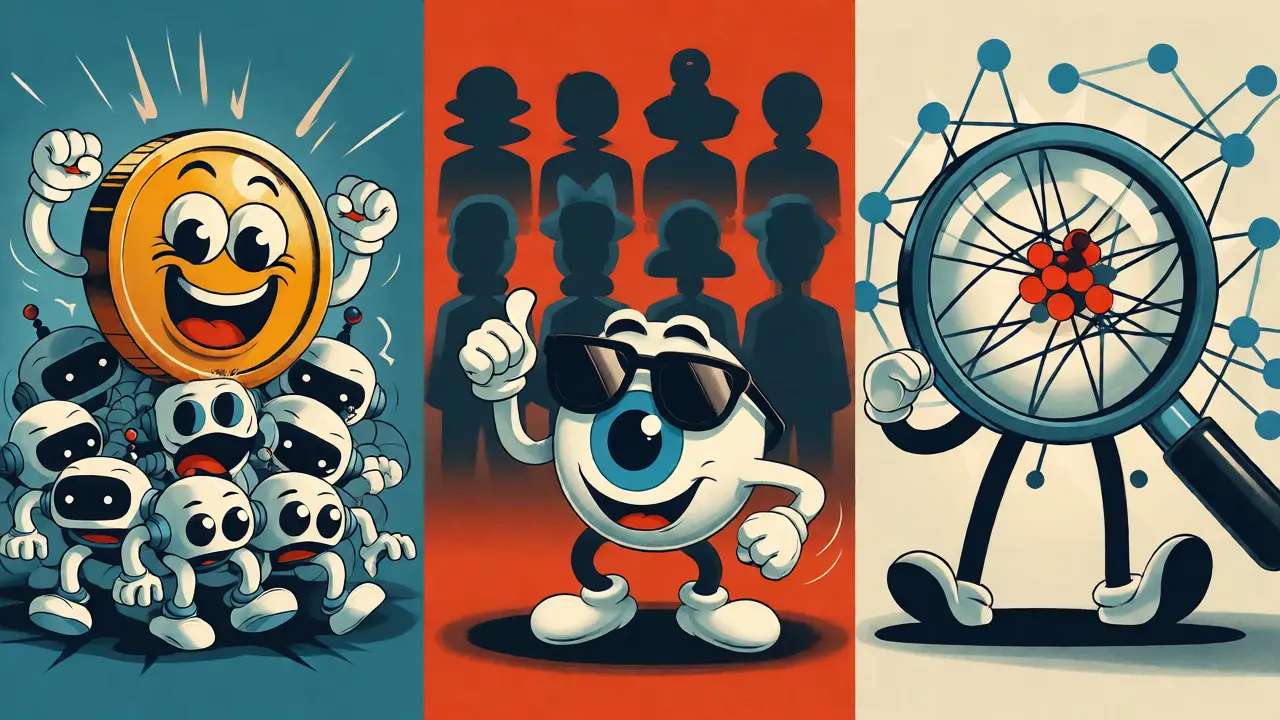
Imagine you are voting in a DAO proposal. Your vote counts for one token. But the person next to you? They just cast 10,000 votes. Did they have 10,000 tokens? No. They created 10,000 fake wallets using a script that cost them five dollars. This is the Sybil attack, a method where an attacker creates multiple fake identities to gain disproportionate influence over a network. It’s not a hypothetical threat; it’s the primary reason many early blockchain projects failed to achieve true decentralization.
If you’re building or participating in a distributed system, you face a brutal truth: without robust reputation systems and Sybil resistance, your data is garbage. Reviews can be bought. Votes can be gamed. Community metrics can be inflated by bots. The core challenge isn’t just stopping bad actors-it’s proving who is human (or at least unique) without turning your platform into a surveillance state. Let’s break down how modern networks solve this puzzle.
Why One Body Pretending to Be Many Breaks Networks
The term "Sybil" comes from a 1973 book about a woman with multiple personality disorder. In tech, it describes a single entity pretending to be many. Why does this matter? Because most decentralized systems rely on the assumption that participants are independent. If I control 51% of the nodes but only pay for one server, I can rewrite history or veto changes simply because my voice is louder than everyone else combined.
Traditional platforms like Facebook or Twitter try to fight this with moderation armies and AI filters. But they fail because their underlying model assumes account creation is cheap. You can spin up a new email address in seconds. In a permissionless blockchain, there is no gatekeeper. Anyone can generate a private key instantly. So, the defense mechanism has to change from "who let you in?" to "why should we trust you?"
Research shows that large-scale Sybil attacks are incredibly cheap. In older systems like BitTorrent Mainline DHT, researchers proved you could flood the network with fake nodes for pennies. To stop this, we need mechanisms that make creating a fake identity expensive-either in money, time, or proof of humanity.
The Three Pillars of Sybil Resistance
Effective defense doesn’t rely on one magic bullet. Successful networks layer three distinct strategies. Think of it as a security stack:
- Economic Friction: Making it costly to create identities. This is what Proof-of-Stake does. If you want to validate blocks, you lock up capital. If you act maliciously, you lose that capital (slashing). A bot farmer now needs real money to run thousands of validators, which limits scale.
- Proof of Humanity: Verifying that each identity corresponds to a unique living being. This often uses biometric scans or social verification graphs. The goal is to ensure uniqueness without necessarily revealing who you are.
- Behavioral Analysis: Using machine learning to spot patterns. Real humans sleep, make mistakes, and interact irregularly. Bots tend to act in perfect synchronicity. Monitoring transaction times and wallet activity helps flag suspicious clusters before they do damage.
Let’s look at how these pillars compare in practice:
| Mechanism | Cost to Attacker | Privacy Impact | Scalability |
|---|---|---|---|
| Proof-of-Work (PoW) | High (Energy/Hardware) | Low (Pseudonymous) | Medium (Slow finality) |
| Proof-of-Stake (PoS) | High (Capital Lock-up) | Low (Pseudonymous) | High |
| Biometric Verification | Medium (Hardware/Scan) | Medium (Data Collection) | Low (Bottleneck) |
| Social Graph Trust | Low (Social Effort) | High (Reveals Connections) | Medium |
| Zero-Knowledge Proofs | Low (Computational) | Very High (No Data Leak) | High |
Reputation Systems: Earning Trust Over Time
While Sybil resistance stops the initial flood, reputation systems maintain long-term integrity. These systems assign a score to users based on their history. Did you pay your debts? Did you provide accurate oracle data? Did you participate consistently?
Here’s the catch: Reputation must be hard to transfer. If I build a high-reputation account and then sell it to a bot, the bot inherits my good name. That defeats the purpose. Therefore, effective reputation systems tie scores to non-transferable attributes, such as:
- Time-weighted participation (you can’t rush tenure).
- On-chain behavioral consistency (your transaction style stays similar).
- Community attestations (other trusted users vouching for you).
Projects like Arcium Network use a two-tiered approach. Inside a cluster of nodes, they prevent collusion by randomly selecting independent observers. Across the whole network, they impose heavier slashing penalties if multiple nodes go offline simultaneously-a sign of coordinated attack rather than random failure. This ensures that even if someone buys a stake, they can’t easily manipulate the consensus without risking significant financial loss.
The Role of Zero-Knowledge Proofs in Privacy
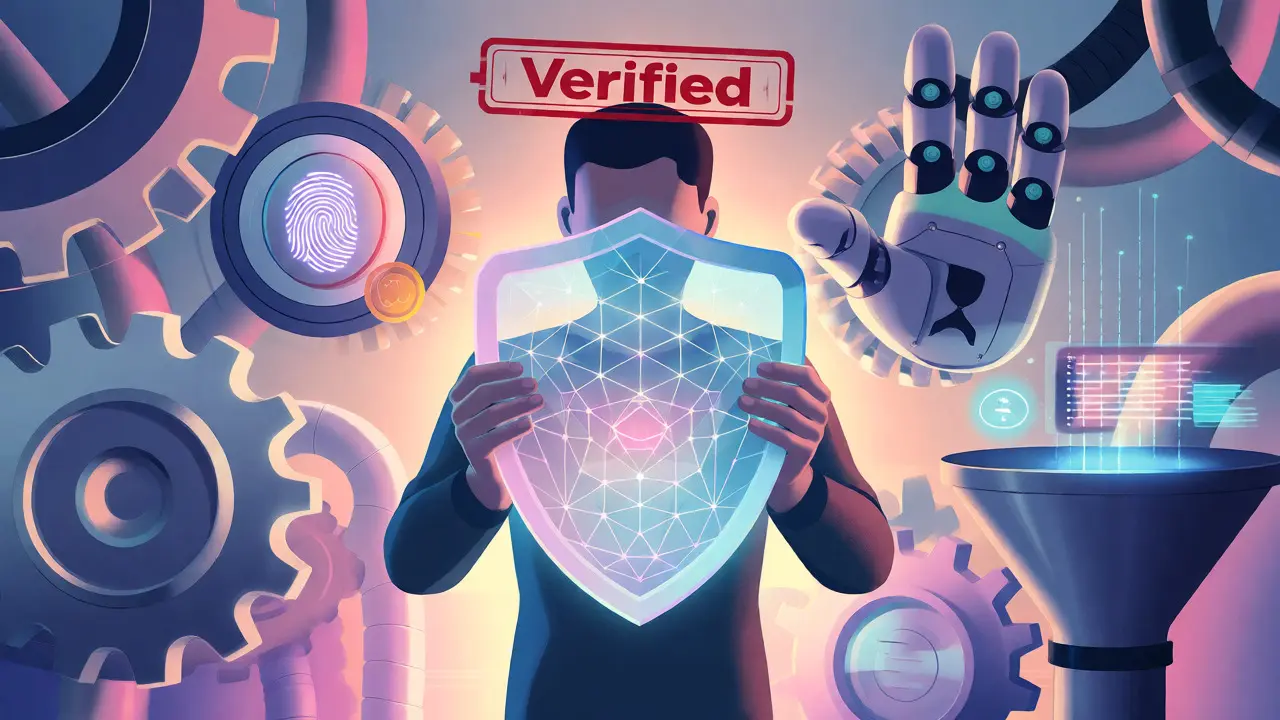
Most people hate the idea of uploading a fingerprint scan to prove they aren’t a robot. It feels invasive. And frankly, storing millions of biometric hashes creates a honeypot for hackers. This is where zero-knowledge proofs (ZKPs) come in. ZKPs allow you to prove something is true without revealing the underlying data.
For example, you can prove "I am over 18" without showing your birth date. Or "I have a valid ID" without sharing your name. In the context of Sybil resistance, ZKPs enable Web3-native identity proofs. You can demonstrate that your identity is unique within a set of verified humans, all while keeping your personal details private. This solves the paradox of needing trust without requiring transparency.
However, implementing ZKPs isn’t trivial. The computational overhead can be high, and the developer experience is still maturing. But as hardware improves, this is becoming the gold standard for privacy-preserving Sybil resistance.
Detecting the Invisible: Social Graphs and ML
Even with economic barriers, sophisticated attackers adapt. They might fund 1,000 wallets from one exchange account. How do you catch them? By looking at relationships.
Social graph analysis examines wallet interactions. Real users have messy, organic connections. They send money to friends, receive payments from clients, and interact with diverse dApps. Fake accounts often form tight, isolated clusters. If Wallet A sends funds to Wallets B through Z, and those wallets never interact with anyone else, that’s a red flag.
Machine learning models monitor these patterns in real-time. They analyze transaction timing, gas fee choices, and contract interaction types. If 500 wallets all execute the same function within the same block, the system flags them as potential Sybils. This dynamic detection complements static rules, catching attacks that evolve faster than code updates.
Practical Implementation Challenges
So, why isn’t every blockchain perfectly secure? Because balancing security, usability, and decentralization is hard.
First, there’s the user experience hurdle. Requiring a government ID or a complex hardware setup drives away casual users. Second, centralization risks creep in. If one company provides the biometric scanner or the ZKP verifier, they become a point of failure. Third, cost matters. If verifying identity costs more than the value of the transaction, the system becomes useless for micro-payments.
Experts argue that we haven’t fixed the root cause: the assumption that identity creation should be free. Until we make identity scarce again-without making it bureaucratic-we will keep playing whack-a-mole with bots. The solution lies in hybrid models. Combine economic stakes for validators, ZKPs for users, and ML monitoring for anomalies. No single tool works alone.
What This Means for Developers and Users
If you’re a developer, don’t just slap a captcha on your site. Design your incentive structures so that honesty pays. Make cheating expensive. Use non-transferable reputation badges. Integrate ZK-proofs where privacy is paramount.
If you’re a user, understand that your digital footprint is your currency. Consistent behavior builds reputation. Random, bot-like actions lower your trust score. As we move deeper into 2026, the lines between "human" and "verified participant" are blurring. The winners in Web3 won’t just be those with the best tech, but those who successfully balance open access with verified uniqueness.
What is the main difference between Sybil resistance and authentication?
Authentication verifies who you are (e.g., logging in with a password). Sybil resistance verifies that you are unique and not a duplicate identity. You can authenticate a bot; Sybil resistance aims to prevent bots from gaining equal weight to humans.
Can Proof-of-Work prevent Sybil attacks?
Yes, but imperfectly. PoW makes creating identities expensive due to energy costs. However, if an attacker controls massive mining power, they can still overwhelm smaller networks. It scales poorly compared to newer cryptographic methods.
How do zero-knowledge proofs help with privacy in Sybil resistance?
ZKPs allow users to prove they possess a unique credential (like a passport or biometric hash) without revealing the credential itself. This ensures uniqueness without exposing personal data to the public ledger or verifiers.
Are reputation systems transferable?
Ideally, no. If reputation is easily transferred, attackers buy high-reputation accounts. Most robust systems tie reputation to non-transferable factors like time-in-network or specific behavioral patterns.
Why are social graphs vulnerable to Sybil attacks?
Attackers can create dense subgraphs of fake accounts that interconnect heavily. While they lack connections to the broader honest community, local density can fool simple algorithms. Advanced analysis looks for bridges to known trusted nodes.