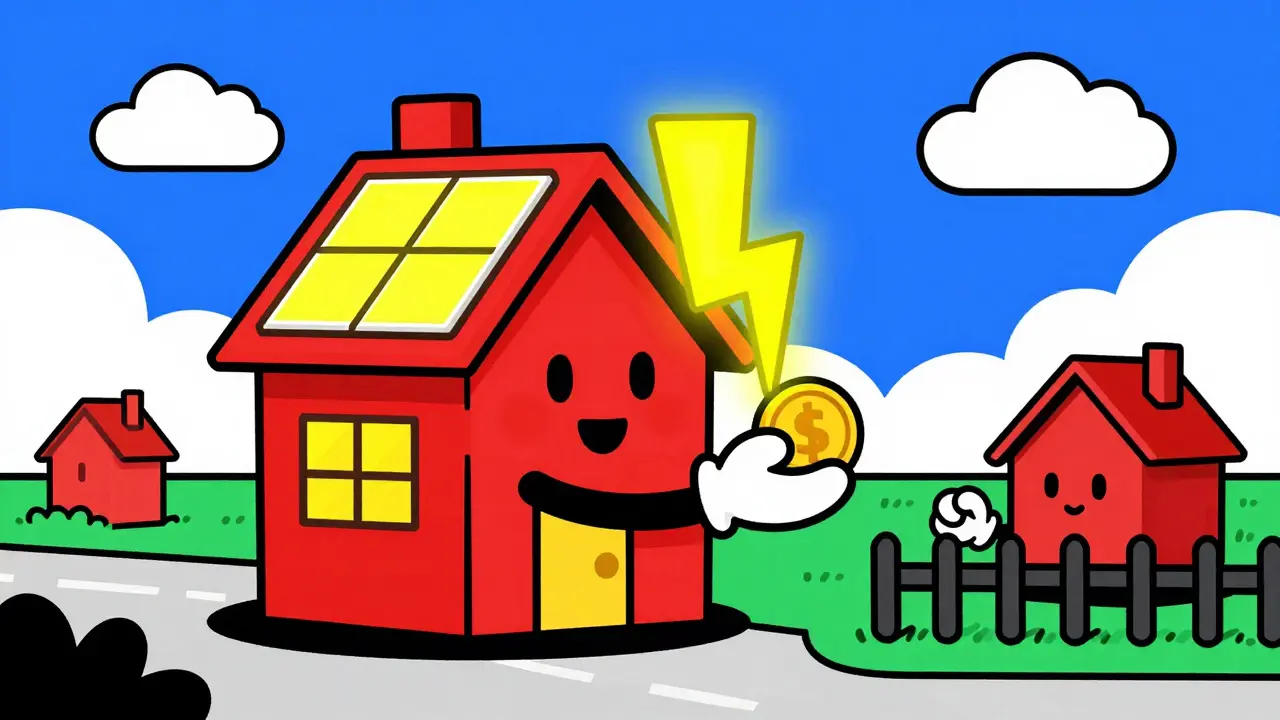
Imagine selling the extra electricity from your rooftop solar panels directly to your neighbor without a middleman taking a cut. Sounds like science fiction? It’s happening right now, but not everywhere. The traditional power grid is a one-way street: you buy from the utility, and that’s it. But as more homes generate their own power, this old model is cracking under pressure. Enter blockchain, a distributed ledger technology that enables secure, transparent, and automated transactions without central intermediaries. When you combine blockchain with smart grid infrastructure, you get a system that doesn’t just move electrons-it moves value securely, instantly, and verifiably.
This isn't just about crypto hype. Utilities are facing real problems: cybersecurity threats, inefficient billing, and the headache of tracking renewable energy certificates (RECs) to prevent fraud. Blockchain offers a solution by creating an immutable record of every kilowatt-hour traded. If you’re curious how this works in practice, why some utilities love it while others ignore it, and whether it’s ready for prime time, keep reading. We’ll break down the tech, the costs, and the reality on the ground.
Why the Old Grid Can’t Handle Modern Energy
The electrical grid was built decades ago for a simple job: take power from big plants and send it to homes. Today, that simplicity is gone. Millions of households have solar panels, batteries, and electric vehicles. These devices don’t just consume power; they produce it too. This creates a chaotic web of micro-transactions that legacy systems struggle to manage.
Traditional grids rely on centralized databases controlled by utilities. These databases are vulnerable. A single cyberattack can disrupt service for millions. Plus, when you try to track where green energy comes from, things get messy. Renewable Energy Certificates (RECs) are often double-counted or lost in bureaucratic paperwork. According to the Rocky Mountain Institute (RMI), this verification gap costs the industry around $400 million annually. You need a system that is tamper-proof, transparent, and fast enough to handle thousands of tiny trades per second. That’s where distributed ledger technology steps in.
How Blockchain Fixes the Smart Grid
At its core, blockchain acts as a shared digital notebook. Every transaction-whether it’s 5 kWh sold from House A to House B-is recorded in a block. Once added, it cannot be changed. This immutability solves the trust problem. You don’t need to trust the utility company’s accounting department; you trust the math and cryptography securing the ledger.
Here is what changes when you plug blockchain into the grid:
- Peer-to-Peer (P2P) Trading: Homeowners can sell excess solar power directly to neighbors via smart contracts. These self-executing codes automatically transfer payment when energy is delivered, cutting out billing delays and fees.
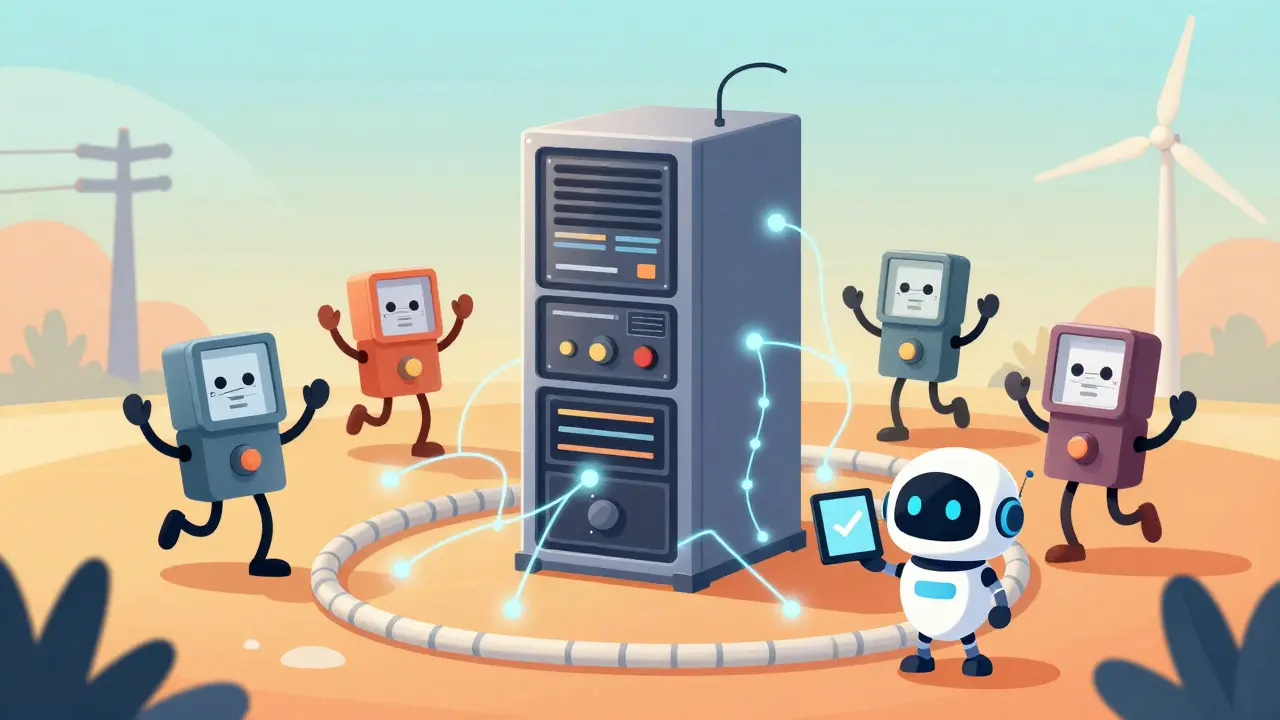
- Secure Identity for Devices: Every smart meter, battery, and EV charger gets a unique cryptographic identity. This prevents hackers from impersonating devices or injecting false data into the grid.
- Transparent REC Tracking: Each unit of renewable energy gets a digital token. When it’s used, the token is burned or transferred. This eliminates double-counting, ensuring that carbon reduction claims are accurate.
The Energy Web Foundation (EWF), a consortium founded in 2017, has been leading this charge. They developed the EWF Chain, specifically designed for energy applications. Unlike public blockchains like Bitcoin, which are slow and expensive, permissioned chains like EWF allow only verified participants (utilities, regulators, certified meters) to join. This keeps the network fast and private while maintaining decentralization benefits.
The Tech Specs: Speed, Security, and Scale
You might wonder if blockchain is too slow for the grid. After all, grid stability requires millisecond responses. Here is the hard truth: blockchain is not suitable for real-time frequency regulation. If a generator fails, you need immediate physical adjustments, not a consensus vote among nodes. However, for financial settlement, asset tracking, and P2P trading, speed matters less than accuracy and auditability.
| Metric | Hyperledger Fabric (Permissioned) | Bitcoin (Public) | Traditional SCADA/Grid DB |
|---|---|---|---|
| Transaction Throughput (TPS) | 100-500 TPS | 7 TPS | 1,000+ TPS |
| Latency per Transaction | 15-25 ms | ~60,000 ms (1 hour) | <2 ms |
| Data Immutability | High (Cryptographic) | High | Low (Centralized control) |
| Best Use Case | P2P Trading, REC Tracking | Currency Store | Real-time Load Balancing |
As the table shows, Hyperledger Fabric dominates the smart grid space, used in 68% of documented projects. It handles hundreds of transactions per second, which is plenty for daily energy settlements. But it adds a slight latency overhead. For most non-critical operations, this is acceptable. The bigger challenge is storage. A utility with 1 million customers could generate 2.3 petabytes of blockchain data annually. Managing this bloat requires careful architecture, often involving off-chain storage for historical data while keeping hashes on-chain for verification.
Real-World Successes and Failures
Theory is great, but does it work in the wild? Let’s look at Brooklyn Microgrid, one of the earliest pilots launched in 2016. Residents with solar panels could trade energy locally using a blockchain platform. The results were promising: 98.7% transaction accuracy compared to 89.3% in conventional systems. Settlement times dropped from days to minutes. Users loved the transparency-they could see exactly who bought their power.
However, user experience wasn’t perfect. About 68% of participants complained about the mobile app’s complexity. Verifying each transaction required multiple steps, which felt tedious for everyday use. This highlights a key lesson: technology must be invisible to the end-user. If Grandma has to understand cryptographic keys to sell her surplus solar, the system will fail.
On the commercial side, TenneT, a German transmission system operator, ran a pilot with Sonnen. They processed 1.2 million transactions with 99.2% settlement accuracy. Their innovation team reported a 40% reduction in reconciliation staff time. But integration took 14 months and required 27 specialized developers. That’s a steep learning curve.
Not all stories are positive. UK Power Networks spent £280,000 on a blockchain integration project only to discover their existing smart meters couldn’t handle the cryptographic signatures. Interoperability remains the biggest barrier. 57% of surveyed utilities cite incompatibility with legacy infrastructure as the primary reason for hesitation.
Challenges Holding Back Adoption
If blockchain is so powerful, why isn’t every utility using it? Several hurdles remain:
- Integration Complexity: Connecting blockchain to old SCADA (Supervisory Control and Data Acquisition) systems is difficult. It requires middleware and significant engineering effort. Most implementations take 18-24 months from planning to operation.
- Talent Shortage: You need engineers who understand both power systems and blockchain development. As of early 2023, there were only about 1,200 certified Energy Web Developers globally. Finding these experts is hard and expensive.
- Regulatory Uncertainty: Laws vary by region. In the EU, the MiCA framework established rules for energy blockchain apps starting in 2024. In the US, FERC issued guidelines permitting transactive energy but demanded reliability standards match conventional systems. Navigating this landscape requires legal expertise alongside technical skills.
- Scalability Limits: Current solutions support up to 50,000 concurrent nodes. This works for a neighborhood microgrid but falls short for national grids. Sharding and layer-2 solutions are being developed, but they add further complexity.
Security is another concern. While blockchain itself is secure, the endpoints are not. If a smart meter is compromised, bad data enters the chain. Zero-knowledge proofs, now being integrated by EWF, help preserve privacy without sacrificing auditability, reducing data breach risks by 72% in tests. But implementing these advanced features raises the technical bar even higher.
The Future: Where Do We Go From Here?
The trajectory is clear: blockchain won’t replace the core operational controls of the grid, but it will become the backbone of energy markets. By 2027, analysts predict blockchain will underpin 25% of distributed energy transactions. The focus is shifting from experimental pilots to standardized, scalable platforms.
We are seeing a consolidation of efforts. Standards like IEC 62939, published in 2023, provide the first international guidelines for blockchain in smart grids. This reduces fragmentation and makes interoperability easier. Companies like Siemens are developing hybrid systems that combine blockchain for settlement with traditional SCADA for control, offering the best of both worlds.
For homeowners and small businesses, the benefit is empowerment. You gain true ownership of your energy assets. For utilities, it’s efficiency and resilience. They reduce administrative costs, prevent fraud, and enhance cybersecurity. The question is no longer *if* blockchain will transform the grid, but *how quickly* we can overcome the integration challenges.
Is blockchain secure enough for critical infrastructure like the power grid?
Yes, for transactional and data integrity purposes. Blockchain provides cryptographic security that prevents tampering with records. However, it does not protect against physical attacks on hardware or endpoint vulnerabilities like compromised smart meters. Security must be layered, combining blockchain with robust endpoint protection and network monitoring.
Can I start selling my solar power on the blockchain today?
In most regions, not yet. While pilots exist in places like Brooklyn, Germany, and Australia, widespread consumer access depends on local regulations and utility adoption. Check if your utility supports peer-to-peer trading programs. Currently, fewer than 13% of major utilities have active blockchain deployments for customer-facing services.
What is the difference between public and permissioned blockchain in smart grids?
Public blockchains like Bitcoin allow anyone to participate, making them slow and transparent to all. Permissioned blockchains, like Hyperledger Fabric or EWF Chain, restrict participation to verified entities (utilities, regulators). This allows for higher speed, lower cost, and greater privacy, which is essential for handling sensitive grid data and high-volume transactions.
How does blockchain prevent double-counting of renewable energy credits?
Each renewable energy unit is assigned a unique digital token on the blockchain. When the energy is consumed or sold, the token is transferred or retired. Because the ledger is immutable and shared, everyone can verify that a specific unit of green energy hasn’t been claimed twice. This eliminates the fraud and errors common in centralized paper-based systems.
Will blockchain replace traditional grid management systems?
No. Blockchain is not fast enough for real-time grid stability operations, which require millisecond responses. Instead, it complements traditional systems by handling financial settlements, asset tracking, and peer-to-peer trading. Think of it as the accounting and logistics layer, while SCADA systems remain the operational control layer.