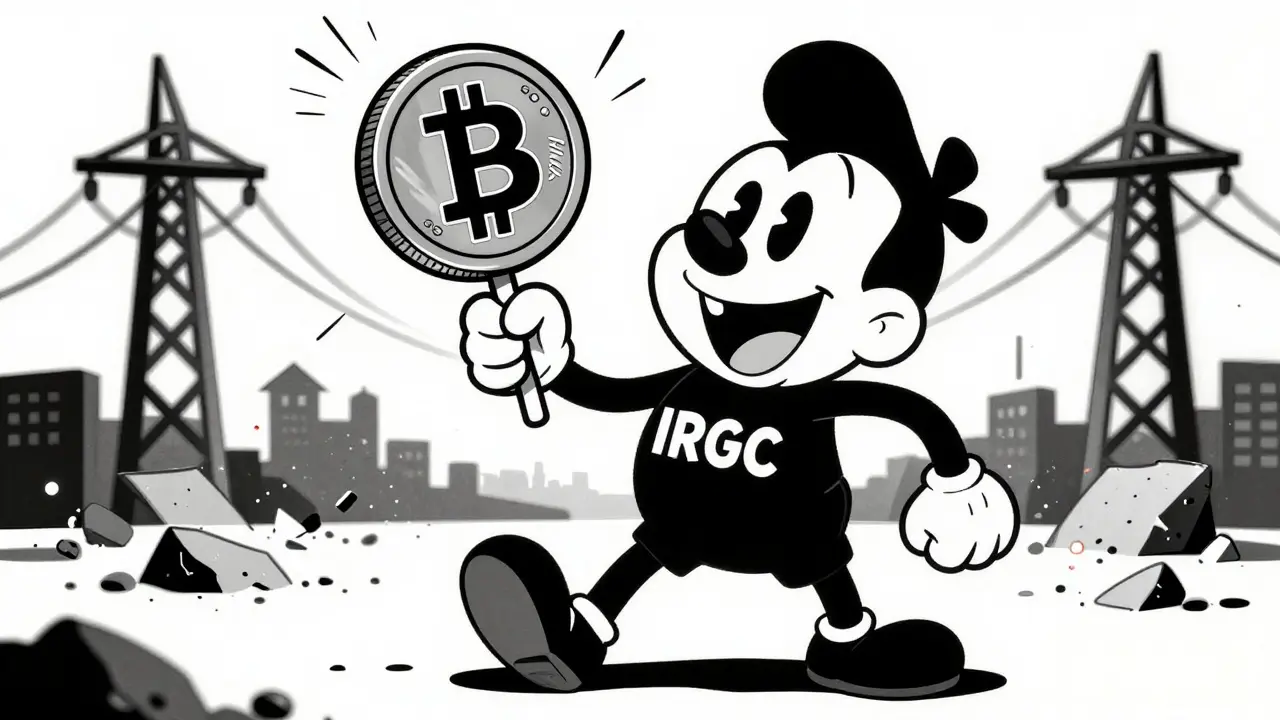
Imagine a country where the power grid is so unstable that factories shut down and hospitals struggle to keep lights on during summer heatwaves. Now imagine that this same infrastructure is being used to mine billions of dollars worth of cryptocurrency for entities that answer to no one but the state. This isn't a dystopian novel plot; it's the reality of state-controlled crypto mining in Iran.
Since 2018, Iran has transformed from a cautious observer of digital assets into a global heavyweight in Bitcoin mining. But unlike the private-sector-driven hubs in Texas or Canada, Iran’s operation is deeply intertwined with its military and political elite. The Islamic Revolutionary Guard Corps (IRGC) and organizations linked to Supreme Leader Ali Khamenei have turned crypto mining into a sophisticated tool for bypassing international sanctions, generating hard currency, and consolidating economic power. For anyone trying to understand the intersection of geopolitics, energy policy, and blockchain, Iran offers a stark and complex case study.
The Rise of State-Sponsored Mining Farms
To understand how we got here, we need to look at the timeline. In July 2018, under President Hassan Rouhani, Iran officially legalized cryptocurrency mining. The stated goal was pragmatic: bring existing underground operations into the light, regulate them, and use the resulting revenue to offset the crushing weight of U.S. sanctions that had cut off Iran from the SWIFT banking system. At the time, the Central Bank of Iran (CBI) even floated the idea of a national cryptocurrency backed by the rial to facilitate international trade.
However, the landscape shifted dramatically between 2019 and 2020. As sanctions tightened, Tehran’s most powerful power brokers-specifically the IRGC and foundations like Astan Quds Razavi-aggressively entered the sector. They didn’t just participate; they dominated. By partnering with Chinese technology firms, these state-affiliated entities established massive mining farms equipped with industrial-grade ASIC (Application-Specific Integrated Circuit) miners.
A prime example is the 175-megawatt Bitcoin farm in Rafsanjan, located in Kerman province. This facility wasn’t built by independent entrepreneurs. It was a joint venture between an IRGC-linked enterprise and Chinese investors, drawn in by electricity tariffs as low as 0.004 cents per kWh. To put that in perspective, that rate is roughly 1/50th of typical global commercial rates. With energy costs that low, profit margins become enormous, allowing these entities to convert mined Bitcoin into foreign currency outside traditional banking channels.
| Feature | Private Sector (e.g., USA, Europe) | State-Controlled (Iran) |
|---|---|---|
| Ownership | Private companies, individuals | IRGC, religious foundations, state enterprises |
| Energy Cost | Market rate ($0.05 - $0.10/kWh) | Subsidized (~$0.00004/kWh for state actors) |
| Regulatory Oversight | Tax compliance, environmental standards | Minimal scrutiny for state affiliates; strict for others |
| Primary Goal | Profit maximization | Sanctions evasion, regime survival, hard currency acquisition |
The Energy Crisis: A Hidden Tax on Citizens
The most controversial aspect of Iran’s crypto strategy is its impact on the national power grid. By early 2023, Iranian energy ministry reports estimated that total national mining capacity exceeded 1,000 megawatts. While this might sound abstract, the real-world consequences are severe. During peak summer months, when temperatures soar past 45°C (113°F), the demand for air conditioning overwhelms the already strained grid.
Here’s where the inequality becomes glaringly obvious. Investigative reports from NCRI-Iran describe a "crypto cartel" that systematically diverts national electricity resources for private profit. While ordinary citizens and small businesses face rolling blackouts lasting hours or even days, IRGC-affiliated mining operations often continue uninterrupted. These facilities frequently operate in special economic zones or on military bases with dedicated power feeds, effectively insulated from the rationing that affects the rest of the country.
Public outrage has been mounting. In May 2024, the hashtag #IranEnergyCrisis trended on social media after verified accounts reported 14-hour outages in Tehran’s District 3. Reddit discussions in the r/Iran community highlighted specific instances where factories were forced to shut down due to power cuts, while nearby mining operations continued running. The frustration boils down to a simple question: why should a mother struggling to cool her home sacrifice comfort while a state-backed entity mines Bitcoin for profit?
The discovery of a large-scale mining operation hidden in tunnels beneath the Shahid Ghorbani Sports Complex in Ahvaz further fueled public anger. Operating undetected for over two years, this facility exemplifies how state-affiliated actors can exploit their connections to avoid detection and regulation. It’s not just about energy theft; it’s about the perception of impunity among the ruling elite.
Regulatory Whiplash: Licensing, Taxes, and Surveillance
If you’re an independent miner in Iran, navigating the legal landscape is a nightmare of contradictions. On paper, cryptocurrency mining remains legal, but the rules change faster than the hash rate adjusts. As of 2025, the Ministry of Industry, Mine and Trade requires official licensing for any mining operation. However, the process is fraught with barriers:
- Licensing Delays: Obtaining a license takes approximately 6-8 weeks, during which regulatory requirements can shift.
- Hardware Restrictions: Legal operators must use government-approved hardware, which reportedly reduces mining efficiency by 15-20% compared to international standards.
- Electricity Tariffs: While state affiliates enjoy near-free power, licensed miners are charged higher tariffs, reportedly around 7 cents per kWh, making profitability difficult without subsidies.
But the regulations go beyond just mining. The government is increasingly focused on capturing tax revenue and maintaining control over financial flows. In August 2025, Iran enacted the "Law on Taxation of Speculation and Profiteering," imposing capital gains tax on cryptocurrency trading for the first time. This move formally positioned crypto alongside gold, real estate, and forex, signaling Tehran’s intent to fully integrate digital assets into the taxed economy.
Surveillance is another key component. In December 2024, the Central Bank of Iran blocked all cryptocurrency-to-rial payment gateways. Although there was a partial reversal in January 2025, it came with a catch: exchanges were required to provide government API access, granting authorities "full user data." This effectively created a surveillance system for all legal cryptocurrency transactions, allowing the state to monitor who is buying, selling, and holding digital assets.
Sanctions Evasion and International Pressure
Why does Iran invest so heavily in crypto? The answer lies in sanctions evasion. Traditional banking channels are largely closed to Iran due to U.S. and EU restrictions. Cryptocurrency offers a way to generate hard currency-specifically stablecoins like USDT (Tether)-that can be used to purchase goods, services, and weapons on the black market or through proxy networks.
However, the international community is fighting back. In July 2025, Tether executed its largest-ever freeze of Iranian-linked funds, blocking 42 cryptocurrency addresses with substantial exposure to Nobitex (Iran’s largest domestic exchange) and IRGC-affiliated wallets. This action disrupted entrenched transaction patterns and forced rapid adaptation within Iran’s crypto ecosystem.
In response, the Iranian government coordinated a push urging users to offload USDT holdings in favor of DAI via the Polygon network. This shift demonstrates Iran’s increasing sophistication in navigating financial restrictions. By moving to decentralized stablecoins and alternative networks, they aim to preserve access to liquid assets despite sanctions pressure. TRM Labs noted that these freezes mirror adaptations seen after the loss of traditional cross-border banking channels, highlighting the resilience-and adaptability-of sanctioned economies.
The Future of Iran’s Crypto Strategy
Looking ahead, Iran faces a precarious balancing act. The government wants to maintain cryptocurrency access for sanctions evasion, prevent capital flight by citizens, and capture tax revenue from a previously unregulated sector. These three objectives are inherently contradictory. Tightening controls to stop capital flight risks driving the market underground, while loosening regulations invites speculation and instability.
Expert analysis suggests that tensions between regulatory ambitions, economic necessity, and energy crises will continue to undermine the sector’s stability. Silvia Boltuc, author of SpecialEurasia’s 'Persian Files,' notes that questions remain about Iran’s long-term financial strategy. Can a country sustain a high-energy-consuming industry like Bitcoin mining while facing chronic power shortages? And can it maintain credibility in the global crypto space while its central bank blocks payment gateways and surveils users?
For now, state-controlled mining remains a critical component of the regime’s economic survival strategy. As long as sanctions persist, the incentive to use crypto for hard currency generation will remain strong. But the cost to the Iranian people-in terms of energy scarcity, economic distortion, and lack of transparency-is becoming impossible to ignore.
Is cryptocurrency mining legal in Iran?
Yes, cryptocurrency mining is technically legal in Iran, but it operates under strict regulations. Miners must obtain licenses from the Ministry of Industry, Mine and Trade, pay specific electricity tariffs, and use government-approved hardware. However, enforcement is inconsistent, and state-affiliated entities often operate with minimal scrutiny.
How does the IRGC benefit from crypto mining?
The IRGC benefits by using subsidized electricity to mine Bitcoin and other cryptocurrencies, which are then converted into foreign currency. This allows the organization to bypass international sanctions, generate hard currency for illicit activities, and consolidate economic power without relying on the traditional banking system.
What is the impact of crypto mining on Iran's energy grid?
Crypto mining consumes vast amounts of electricity, contributing significantly to Iran's national power grid instability. During peak demand periods, such as summer heatwaves, mining operations can exacerbate power outages for ordinary citizens and businesses, leading to public outrage and social unrest.
Has Tether taken action against Iranian crypto users?
Yes. In July 2025, Tether froze 42 Iranian-linked addresses, including those connected to Nobitex and IRGC-affiliated wallets. This was the largest-ever freeze of Iranian-linked funds by Tether, aimed at disrupting sanctions evasion efforts.
Are there taxes on cryptocurrency in Iran?
As of August 2025, yes. Iran enacted the "Law on Taxation of Speculation and Profiteering," which imposes capital gains tax on cryptocurrency trading. This marks a shift toward integrating digital assets into the formal taxed economy.
Comments (20)
Terry Hyland
June 15, 2026 AT 14:06
It is sickening to see the elite steal power from regular people. They don't care about anyone else. Just think of the children in hospitals without lights while these bad guys make money. It is a moral disaster and we need to stop this evil behavior now.
Monica Pathammavong
June 15, 2026 AT 19:59
actually u r missing the point here its not just about electricity its about geopolitical strategy lol. the IRGC isnt stupid they know exactly what they are doing with hash rates and ASIC efficiency. also why do ppl think sanctions work? they dont. its all a psyop by the west to control narratives. u should read more about blockchain decentralization before typing nonsense.
Tim Lefebvre
June 17, 2026 AT 15:58
hey there i can explain how the hardware works basically asic miners are super efficient for sha-256 but they generate lots of heat which is why iran uses it in summer when cooling is needed anyway well sort of. the problem is the grid cant handle the load spikes. its a technical issue mixed with politics. hope that helps clarify things a bit
Mekz Wheoki
June 18, 2026 AT 13:56
Oh look, another article pretending to be insightful about state-sponsored theft. The irony of using Bitcoin, a technology designed to escape state control, to fund a totalitarian regime is lost on everyone except the actual engineers who built the protocol. Enjoy your subsidized electricity, you parasites.
Skm Shubham
June 18, 2026 AT 18:52
The inefficiency of this model is glaring. You cannot sustain a high-hashrate operation with an unstable grid infrastructure. The downtime costs outweigh the marginal gains from cheap energy. Furthermore, the reliance on Chinese hardware creates a single point of failure for supply chain logistics. It is a fragile system built on sand.
Rob Aronson
June 20, 2026 AT 08:20
From a compliance perspective, this is a nightmare scenario for global exchanges 📉. The risk of secondary sanctions hitting any entity touching Iranian-linked wallets is immense. Tether's freeze was a necessary move to maintain their US banking relationships. The shift to DAI on Polygon is a classic evasion tactic, trying to use Layer 2 scaling solutions to obscure transaction trails. It’s clever but ultimately detectable via cluster analysis 🔍.
Kwon Bill
June 20, 2026 AT 20:07
In East Asian markets, we often discuss the concept of 'shadow banking' and how crypto fits into that paradigm. Iran is essentially creating a parallel financial ecosystem. The integration of stablecoins like USDT allows for cross-border trade without SWIFT. This mirrors strategies seen in other sanctioned jurisdictions where traditional fiat channels are blocked. The cultural acceptance of crypto as a survival tool is high.
Kenneth Riley
June 21, 2026 AT 11:45
THIS IS ABSOLUTELY RIDICULOUS! How dare they?! I mean seriously who gives them the right to do this to the people?! Its outrageous and unacceptable and frankly makes me want to scream into a pillow. The audacity of the IRGC to think they can get away with this kind of blatant theft is beyond comprehension. We need action NOW not just words!
ravi mahla
June 22, 2026 AT 19:14
Haha wow talk about a hot mess! But hey at least they are innovating right? Who needs stable grids when you have dreams and Bitcoin? Keep pushing folks! 😂
Mark Brunschwiler
June 24, 2026 AT 14:50
I feel so drained reading this. Why does everything have to be so complicated? I just want to understand why people suffer. It feels like the world is spinning out of control and no one is listening to the pain of the ordinary person. My heart hurts for those families in the dark.
Sonya O'Brien
June 24, 2026 AT 18:45
I completely agree with the sentiment expressed earlier regarding the ethical implications of this situation, and I believe that we must consider the broader socio-economic impacts on the civilian population who are left to bear the brunt of these policy decisions, which often seem to prioritize the interests of a select few over the collective well-being of society as a whole, leading to a deep sense of injustice and frustration among the general public.
Filbert Reeves
June 26, 2026 AT 12:23
Actually the real story is that the US created this problem by imposing sanctions that forced Iran to find alternative methods. People blame crypto but it is really the fault of foreign interventionists who want to destabilize the region. The government is just protecting its sovereignty against imperialist aggression. Wake up sheeple!
Nick Rice
June 28, 2026 AT 12:05
Listen up everyone. This is a clear example of how authoritarian regimes exploit technology for their own gain. We must stand firm against such practices and support transparency in all financial systems. Do not let this slide. Fight back against corruption wherever you see it.
Amit Thakur
June 28, 2026 AT 18:59
The technical architecture of these mining farms requires robust cooling systems which further strains the local grid capacity. From an engineering standpoint, the lack of redundancy in the power supply network is a critical vulnerability. I urge stakeholders to invest in renewable energy sources to mitigate these environmental and operational risks effectively.
Eric Scheinberg
June 29, 2026 AT 15:57
It is imperative to recognize the legal ambiguities surrounding state-sponsored cryptocurrency activities. The regulatory framework remains fragmented and inconsistent. Stakeholders must adhere to strict compliance protocols to avoid inadvertent violations of international law. Clarity is essential for sustainable market development.
pankaj chawla
June 29, 2026 AT 20:21
We should collaborate on finding solutions that benefit both the economy and the citizens. Assertive measures are needed to ensure fair distribution of resources. Let us work together to create a more equitable system for everyone involved in this complex landscape.
Jessica Lane
June 30, 2026 AT 07:13
I am deeply concerned about the human cost of these economic policies. How can we ensure that vulnerable populations are protected during times of crisis? We need to listen to their stories and understand their struggles better. Empathy must guide our approach to these global issues.
Charles Pawlikowski
July 2, 2026 AT 02:19
This is typical socialist greed! They take from the people and give nothing back. America would never allow this kind of theft. We need strong borders and strong laws to protect our values. Shame on them! 🇺🇸
Andrea Burd
July 2, 2026 AT 04:30
Boring article. The writing style is pedestrian and lacks depth. Clearly written by someone who doesnt understand the nuances of high finance. Typical mainstream media garbage. Yawn.
Akeem Whittaker
July 3, 2026 AT 04:47
Let us focus on constructive dialogue rather than emotional reactions. We must address the root causes of energy instability and propose viable alternatives. Assertiveness in policy-making is crucial for long-term stability. Engage with the facts and move forward positively.