Crypto Sanctions Evasion: How People Bypass Restrictions and What It Means for You
When governments try to block financial access—like freezing bank accounts or cutting off SWIFT payments—some people turn to crypto sanctions evasion, the use of cryptocurrencies to move value outside controlled financial systems. Also known as crypto circumvention, it’s not about breaking laws for fun—it’s about survival, especially in places like Iran, Russia, or Venezuela where traditional banking is restricted or collapsed. This isn’t theoretical. People are using stablecoins like DAI, peer-to-peer trades over Telegram, and mixers to protect savings from inflation or political pressure.
It’s not just individuals. OFSI compliance, the UK’s Office of Financial Sanctions Implementation, now requires crypto firms to track transactions in real time. This means exchanges and wallet providers must flag transfers linked to sanctioned entities—or face fines up to millions. But enforcement is messy. Many platforms still lack the tools to detect complex cross-chain swaps or privacy-focused coins, creating gaps that bad actors exploit. Meanwhile, cryptocurrency regulation, a patchwork of rules across countries. Also known as crypto AML, it’s trying to catch up to how fast blockchain tech moves. The UK isn’t alone. The U.S., EU, and others are tightening rules, but criminals adapt faster. They use decentralized exchanges, non-custodial wallets, and privacy layers like Tusima Network to obscure origins—all while regulators scramble to keep up.
What you’ll find in this collection isn’t a guide on how to evade sanctions. It’s a clear-eyed look at what’s happening on the ground. You’ll read about how Iranians bypass crypto bans using Polygon and VPNs, how UK firms are being forced to adopt blockchain analytics tools, and why some so-called "privacy coins" are being scrutinized not for anonymity, but for their use in hiding illicit flows. You’ll also see how regulators are using the same blockchain data to trace transactions—turning the tech against itself. These aren’t abstract debates. They’re real stories of people protecting their money, and institutions fighting to control it. The line between survival and violation is thin—and the tools used are the same ones that make crypto powerful in the first place.
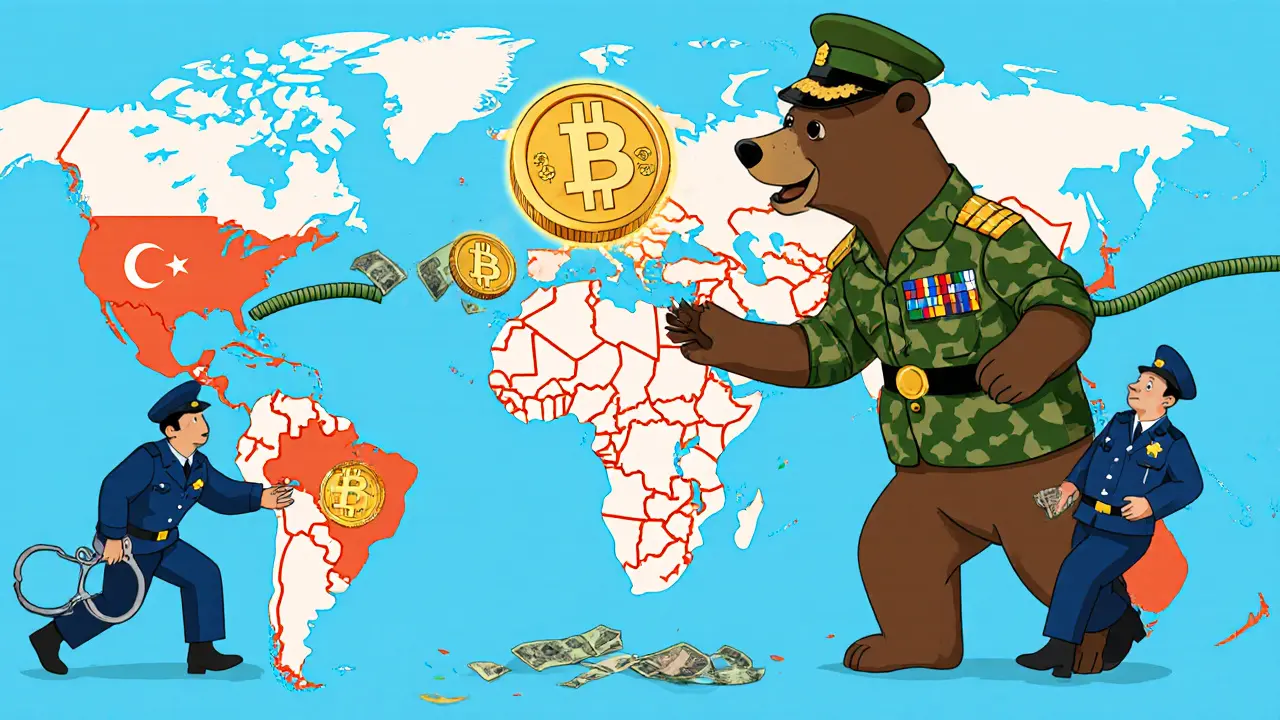
Russia has built a sophisticated crypto network using tokens like A7A5 and exchanges like Grinex to bypass Western sanctions, moving billions to fund its war effort and influence operations abroad.