Syria Sanctions and Cryptocurrency: How Crypto Bypasses Financial Restrictions
When Syria sanctions, economic restrictions imposed by the U.S., EU, and other nations to limit financial access to the Syrian government and affiliated entities. Also known as Syrian financial blockade, these measures cut off banks, payment systems, and foreign currency flows, ordinary people and businesses turned to cryptocurrency as a lifeline. With local banks frozen and international transfers blocked, crypto became one of the few ways to send money home, pay for essentials, or keep savings from collapsing. It’s not about ideology—it’s survival.
These sanctions don’t just target government officials; they ripple through daily life. A farmer in Aleppo can’t get paid for wheat because the bank won’t process USD. A family in Damascus needs medicine, but no international wire will clear. That’s where cryptocurrency, digital assets that operate outside traditional banking systems and allow peer-to-peer value transfers without intermediaries steps in. People use stablecoins like USDT and DAI to store value, trade on P2P platforms, and bypass currency controls. It’s not perfect—exchange rates are volatile, scams are common, and internet access isn’t guaranteed—but it works where banks fail. This isn’t just about Syria. It mirrors what’s happening in Iran, Venezuela, and Russia, where crypto isn’t a luxury—it’s a tool for economic continuity.
Sanctions compliance, the legal and technical process financial institutions use to detect and block transactions tied to restricted entities or countries has become a global arms race. Regulators in the UK, U.S., and EU now demand real-time blockchain monitoring. Crypto firms must flag wallets linked to Syria, Iran, or North Korea—or face fines in the millions. But blockchain’s design makes this hard: wallets are pseudonymous, transactions are global, and decentralized exchanges don’t ask for ID. That’s why tools like chain analysis and wallet clustering are now standard. Yet, as enforcement tightens, users adapt—using mixers, privacy layers, or swapping through regional exchanges that don’t ask questions. The result? A constant cat-and-mouse game between regulators and those who need to move money.
The posts below show how this plays out in practice. You’ll find deep dives into how Russia uses crypto to evade sanctions, how crypto firms in the UK are forced to track every transaction, and how blockchain tech like Merkle trees and formal verification help or hurt compliance efforts. You’ll also see warnings about fake airdrops targeting people in sanctioned regions, and how simple things like seed phrases become critical when your bank account is locked. This isn’t theoretical. These are real tools, real risks, and real people trying to survive under pressure. What you read here isn’t about politics—it’s about money, access, and who gets to control it.
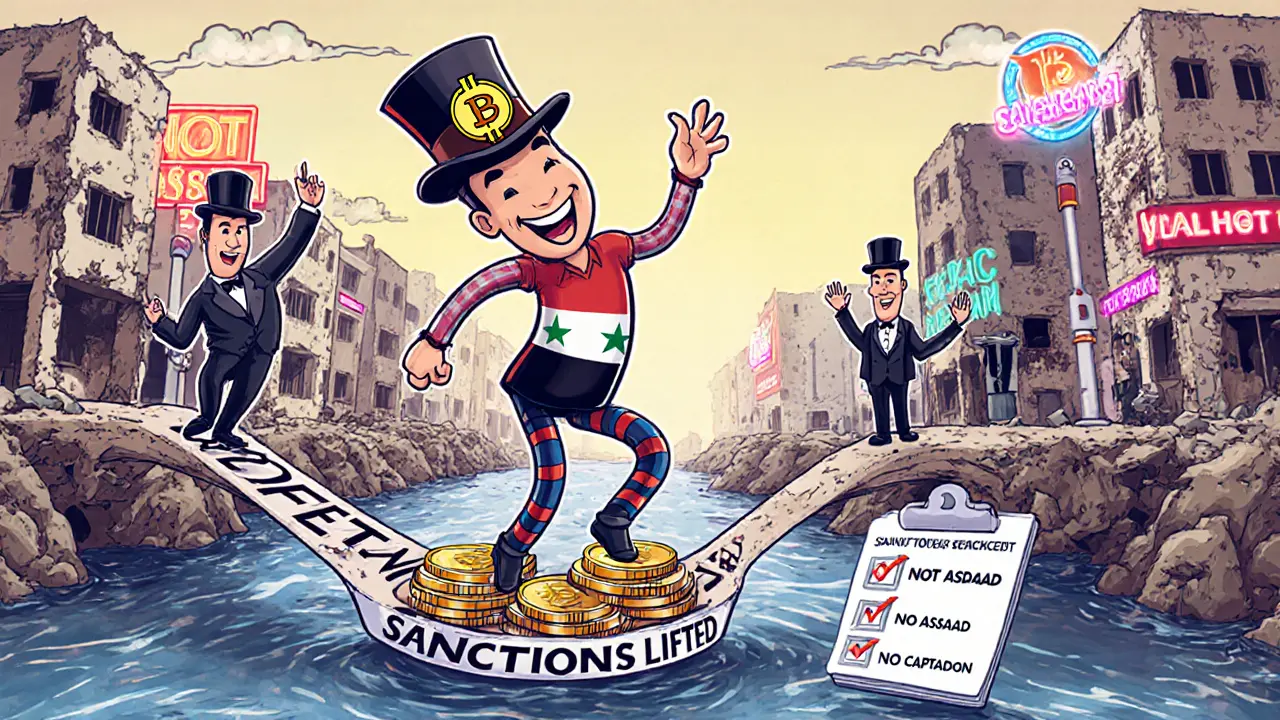
In 2025, the U.S. lifted sweeping sanctions on Syria while tightening them on Cuba. Crypto access in Syria is opening up, but legal gray areas remain. In Cuba, crypto use is growing under pressure. Here’s what it means for traders, businesses, and investors.