Headlines screaming about "12 years in prison for buying Bitcoin" have terrified crypto enthusiasts in Bangladesh for over a decade. If you’ve seen those reports, you might think simply holding digital assets is a felony that guarantees a long stint behind bars. But the reality is far more complex-and significantly less draconian-than the panic-inducing media stories suggest.
The short answer? No one has ever been sentenced to 12 years in prison solely for trading cryptocurrency in Bangladesh. The figure comes from a misinterpretation of anti-money laundering laws by central bank officials, not from a specific law banning crypto itself. While the regulatory environment remains highly restrictive, understanding the actual legal framework helps separate fear-mongering from factual risk.
Where Did the "12 Years" Figure Come From?
To understand the confusion, we need to look back at September 2014. That’s when Bangladesh Bank, the country's central bank, issued its first cautionary notice regarding Bitcoin. At the time, reports surfaced of online exchanges facilitating transactions using this new digital currency. The central bank declared that Bitcoin was not legal tender and warned that any transaction involving it could be a punishable offense.
During interviews with international press agencies like AFP, bank officials stated that violations could result in sentences of up to 12 years imprisonment. This number didn’t appear out of thin air; it referenced Section 9(1) of the Money Laundering Prevention Act 2012. However, there is a critical nuance often missed in translation and reporting.
The Act actually stipulates rigorous imprisonment for a term not less than one year but extending up to 10 years, plus fines. Officials extrapolated this to 12 years in public statements, likely accounting for cumulative penalties or related charges. Crucially, these laws target money laundering, not the mere possession or exchange of virtual assets. As legal experts later clarified, using traditional Taka (BDT) to commit money laundering carries the same penalty. The crime is the illicit activity, not the medium of exchange.
The Legal Framework: Warnings vs. Bans
Between 2014 and 2017, the regulatory stance hardened. On December 24, 2017, Bangladesh Bank issued a second Cautionary Notice. This update expanded the legal context by adding the Anti-Terrorism Act 2009 to the list of applicable laws. The notice explicitly named Ethereum, Ripple, and Litecoin alongside Bitcoin, signaling that the warning applied to all major cryptocurrencies, not just the original pioneer.
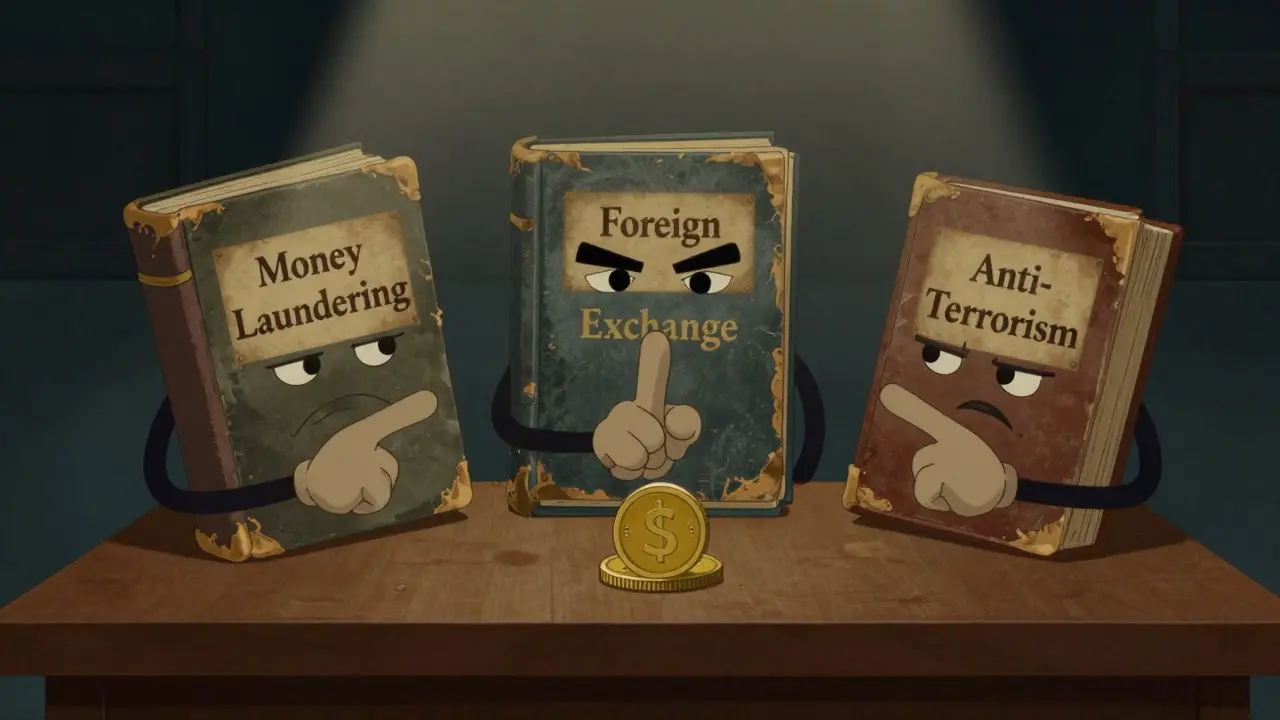
Despite the stern language, legal analysis firms like Mahbub & Company pointed out a vital distinction in March 2021. They argued that the regulator had not enacted an outright ban or criminalized the use of Bitcoin itself. Instead, they warned that using crypto could violate existing statutes if connected to illegal activities. These statutes include:
- Foreign Exchange Regulation Act 1947: Requires all foreign exchange transactions to go through authorized dealers. Since crypto isn't recognized as foreign currency by the state, bypassing banks technically violates this act.
- Money Laundering Prevention Act 2012: Amended in 2015 to include "virtual assets" in its definitions, making crypto subject to AML scrutiny.
- Anti-Terrorism Act 2009: Used to penalize funding of terrorist activities, which authorities claim crypto could facilitate due to its pseudonymous nature.
The key takeaway here is that the "ban" is administrative, not legislative. There is no specific "Cryptocurrency Prohibition Act." Instead, the central bank uses existing financial regulations to prohibit crypto activities by declaring them non-compliant with foreign exchange rules.
Enforcement Reality: What Actually Happens?
If the threat of 12 years in prison were actively enforced against individual traders, the streets would be empty of crypto users. Yet, the data tells a different story. As of 2025, there are no publicly documented cases of individuals receiving maximum sentences specifically for cryptocurrency trading. The disconnect between policy rhetoric and ground-level enforcement is stark.
| Metric | Official Stance / Media Report | Actual Enforcement Data (2022-2024) |
|---|---|---|
| Maximum Penalty Cited | Up to 12 years imprisonment | No cases of max penalty for simple trading |
| Crypto Adoption | Illegal and prohibited | ~2.1 million owners (1.2% of population) by Dec 2024 |
| Transaction Volume Trend | Should be zero | 206% YoY increase (2021-2022); 347% P2P growth post-2021 crackdown |
| Legal Cases Filed | Widespread prosecution expected | 37 digital financial crime cases in 2022; 17 crypto-related cases in 2024 |
Data from Chainalysis revealed that despite the warnings, Bangladesh saw a 206% year-over-year increase in cryptocurrency transaction volume between July 2021 and June 2022. By late 2024, approximately 2.1 million people owned crypto. This surge happened largely through Peer-to-Peer (P2P) platforms like Binance, where users trade directly without centralized banking rails, effectively bypassing the very controls Bangladesh Bank tries to enforce.
The Anti-Money Laundering Department’s 2022 annual report noted only 37 cases related to "digital financial crimes," none of which resulted in the headline-grabbing 12-year sentences. In 2024, the Cyber Security Division reported 17 cryptocurrency-related cases. These numbers suggest that enforcement is selective, targeting large-scale operations or obvious money laundering schemes rather than everyday retail traders.
The Digital Security Act and Other Penalties
While the 12-year figure dominates headlines, other laws pose immediate risks. Section 30 of the Digital Security Act 2018 addresses unauthorized electronic transactions. It stipulates that violating financial institution protocols can lead to imprisonment of up to 5 years or a fine of 5 lakh Taka. Repeat offenses can double the prison term to 7 years and the fine to 10 lakh Taka.
This creates a layered risk profile. You might not face 12 years for buying Bitcoin, but if your transaction triggers an alert for suspicious foreign exchange movement, you could face charges under FERA or the Digital Security Act. The ambiguity allows authorities discretion, which can be intimidating for users.
Why the Contradiction? Blockchain Strategy vs. Crypto Ban
It seems contradictory that a government would threaten severe prison time for crypto while simultaneously exploring blockchain technology. This tension is real. In 2020, Bangladesh published its National Blockchain Strategy, aiming to leverage distributed ledger technology for governance, supply chain, and identity management.
The government distinguishes between the technology (blockchain) and the asset (cryptocurrency). They want the efficiency of immutable ledgers without the volatility and capital flight risks associated with decentralized currencies. This dual approach confuses many citizens. Is it illegal to own Bitcoin, or just illegal to trade it on local exchanges? Legal experts argue that owning Bitcoin is not explicitly illegal, but trading it through unauthorized channels violates foreign exchange laws.
This "gray area" means that while you won’t necessarily be arrested for holding USDT in a private wallet, you cannot legally convert it to Taka through a bank account. Any attempt to do so risks freezing your accounts and potential investigation for violating the Foreign Exchange Regulation Act.

Risks for Individual Traders in 2026
So, what does this mean for you if you live in Bangladesh? The risk is not primarily about spending 12 years in jail for buying Bitcoin. The risk is financial and administrative.
- Account Freezing: Banks monitor for unusual transactions. If you receive funds from a known crypto exchange or engage in rapid P2P transfers, your account may be frozen pending investigation.
- Lack of Recourse: Since crypto transactions are not protected by consumer laws, if a P2P trader scams you, you have no legal avenue to recover your funds. The police may dismiss it as a civil dispute or refuse to file an FIR due to the illegal status of the asset.
- Tax Ambiguity: With no clear tax framework for crypto gains, reporting income becomes tricky. Underreporting could lead to tax evasion charges, while over-reporting admits to engaging in prohibited activities.
The Securities and Exchange Commission acknowledged in 2023 that the absence of specific prohibitive legislation creates implementation challenges. This suggests that regulators are aware they lack the tools for systematic enforcement, relying instead on deterrence through harsh rhetoric.
Conclusion: Navigating the Gray Zone
The narrative of "12 years in prison for crypto trading" is a distortion of anti-money laundering laws used as a deterrent by Bangladesh Bank. While the legal environment is hostile, it is not actively prosecuting individual holders with maximum penalties. The real danger lies in the intersection of crypto with foreign exchange violations and money laundering suspicions.
For now, the market operates in a de facto gray area. Millions of Bangladeshis trade crypto via P2P methods, accepting the risk of account freezes and lack of legal protection. Until the government passes specific legislation clarifying the status of virtual assets, this precarious balance will likely continue. Stay informed, avoid large visible transactions, and understand that while the 12-year sentence is unlikely for simple trading, the financial risks remain significant.
Is it illegal to own Bitcoin in Bangladesh?
Owning Bitcoin is not explicitly criminalized by a specific law. However, Bangladesh Bank warns that using it violates foreign exchange regulations. While possession itself hasn't led to arrests, converting it to local currency through unauthorized channels is illegal.
Can I really get 12 years in prison for crypto trading?
No. There are no recorded cases of individuals receiving 12-year sentences solely for trading crypto. The 12-year figure refers to maximum penalties under the Money Laundering Prevention Act for serious financial crimes, not for simple crypto transactions. Enforcement focuses on large-scale money laundering, not retail trading.
Which laws does Bangladesh Bank use to restrict crypto?
The central bank cites three main laws: the Foreign Exchange Regulation Act 1947, the Money Laundering Prevention Act 2012, and the Anti-Terrorism Act 2009. These laws regulate financial transactions and combat illicit finance, which the bank argues crypto facilitates.
Is P2P crypto trading safe in Bangladesh?
P2P trading is popular but risky. While it avoids direct bank transfers to exchanges, it still involves moving Taka between personal accounts, which can trigger alerts for suspicious activity. Additionally, you have no legal recourse if scammed, as the transaction involves an unregulated asset.
Will Bangladesh legalize cryptocurrency in the future?
Currently, there are no signs of legalization. The government supports blockchain technology for enterprise use but maintains a strict prohibition on cryptocurrencies as a form of currency. Any change would require significant legislative reform and a shift in monetary policy.