Imagine you are ready to buy your first Bitcoin or trade Ethereum. You sign up for a platform, deposit money, and then see a hidden fee that eats into your profit. It is frustrating. That is why traders look for transparency. One name that has started appearing in search results is UniDAX, a cryptocurrency trading platform known for its flat fee model. But does a simple fee structure make it the right choice for you in 2026? Or is there more to the story?
The crypto market is crowded. Giants like Coinbase and Kraken dominate the headlines. Newer platforms try to carve out a niche by offering lower costs or better interfaces. UniDAX claims to simplify things with uniform pricing. However, when we dig deeper, we find a significant lack of public data. This review cuts through the noise to tell you what we know, what we do not know, and whether you should risk your funds on this platform.
What Is UniDAX and How Does It Work?
At its core, UniDAX is a digital asset trading venue designed to offer streamlined access to cryptocurrency markets. Unlike traditional stock exchanges that have complex maker-taker fee structures, UniDAX promotes a flat fee approach. This means every user pays the same rate, regardless of their trading volume or whether they are adding liquidity (maker) or removing it (taker).
This simplicity is attractive to beginners. Tiered systems can be confusing. If you trade $100, you might pay one rate. If you trade $1 million, you pay another. UniDAX removes that variable. The promise is clarity. You know exactly what you will pay before you click "buy."
However, the platform lacks a strong digital footprint compared to established players. There is no widely recognized founding date, no famous CEO, and limited press coverage. In an industry where trust is built on longevity and transparency, this silence raises questions. Who runs UniDAX? Where are the servers located? These are basic details that major exchanges publish proudly.
Fees and Costs: The Flat Rate Promise
Let us talk about money. Fees are the biggest drain on a trader's account over time. Most major exchanges use a tiered model. For example, Binance or Coinbase Advanced often charge lower fees for high-volume traders. Makers (those who place limit orders) usually pay less than takers (those who execute market orders).
UniDAX breaks this pattern. Their flat fee model applies to everyone. Here is how that compares to the industry standard:
| Feature | UniDAX Model | Typical Major Exchange |
|---|---|---|
| Fee Structure | Flat rate for all users | Tiered based on volume |
| Maker/Taker Distinction | None (uniform price) | Makers pay less than takers |
| Transparency | High (simple calculation) | Medium (requires checking tiers) |
| Best For | Casual traders, beginners | High-frequency traders, whales |
For a casual investor buying $500 worth of Bitcoin once a month, UniDAX’s model might feel fair. You are not penalized for low volume. However, if you are an active day trader, a flat fee could end up costing you more than a tiered system where your volume discounts kick in. Always calculate your expected monthly trading volume against the specific percentage charged by UniDAX before committing large sums.
Security and Trust: The Missing Pieces
In crypto, security is not a feature; it is the foundation. When evaluating UniDAX's security posture, we must look at three pillars: custody, audits, and regulation.
First, custody. Do they hold your keys? Most centralized exchanges do. This creates a single point of failure. We need to know if UniDAX uses cold storage for the majority of user funds. Cold storage means keeping assets offline, away from hackers. Without explicit documentation stating their cold storage ratio, this remains a gray area.
Second, audits. Reputable exchanges undergo regular third-party security audits. Companies like CertiK or Hacken scan the code for vulnerabilities. A quick search reveals no prominent audit reports linked to UniDAX. This is a red flag. It does not mean they are insecure, but it means they are not proving it publicly.
Third, regulation. Are they licensed? In countries like Canada, exchanges must register with FINTRAC. In the US, they face SEC scrutiny. UniDAX’s regulatory status is unclear. If you live in a regulated jurisdiction, check if UniDAX appears on your local financial authority’s list of approved vendors. Trading on an unregulated platform means fewer legal protections if something goes wrong.

User Experience and Interface
A clean interface matters. You want to find your portfolio, execute trades, and withdraw funds without clicking through ten menus. Based on limited screenshots and user snippets, UniDAX aims for a minimalist design. This aligns with their brand of simplicity.
However, simplicity can sometimes mean missing features. Professional traders look for advanced charting tools, API access, and margin trading options. If UniDAX focuses solely on spot trading with a basic UI, it may frustrate experienced users. For beginners, though, a clutter-free screen reduces anxiety. You see the price, you enter the amount, you confirm. That is the value proposition here.
Customer support is another critical aspect of UX. When your deposit gets stuck, you need help fast. Major exchanges offer 24/7 live chat and comprehensive knowledge bases. UniDAX’s support channels are not well-documented. Email-only support is common among smaller platforms, but response times can vary wildly. Before funding your account, send a test question to their support team. See how quickly and accurately they respond.
Supported Cryptocurrencies and Liquidity
What can you actually trade? A platform with only Bitcoin and Ethereum limits your diversification. Users expect access to top altcoins like Solana, Cardano, and Polygon. They also look for stablecoins like USDT and USDC for parking funds during volatility.
Information on UniDAX’s full asset list is scarce. If they only support a handful of coins, their liquidity might be thin. Low liquidity means wider spreads. A wide spread is the difference between the buy and sell price. If the spread is large, you lose value the moment you buy. Check the order book depth before trading. If you cannot buy $1,000 of a coin without moving the price significantly, the liquidity is poor.
UniDAX vs. The Competition
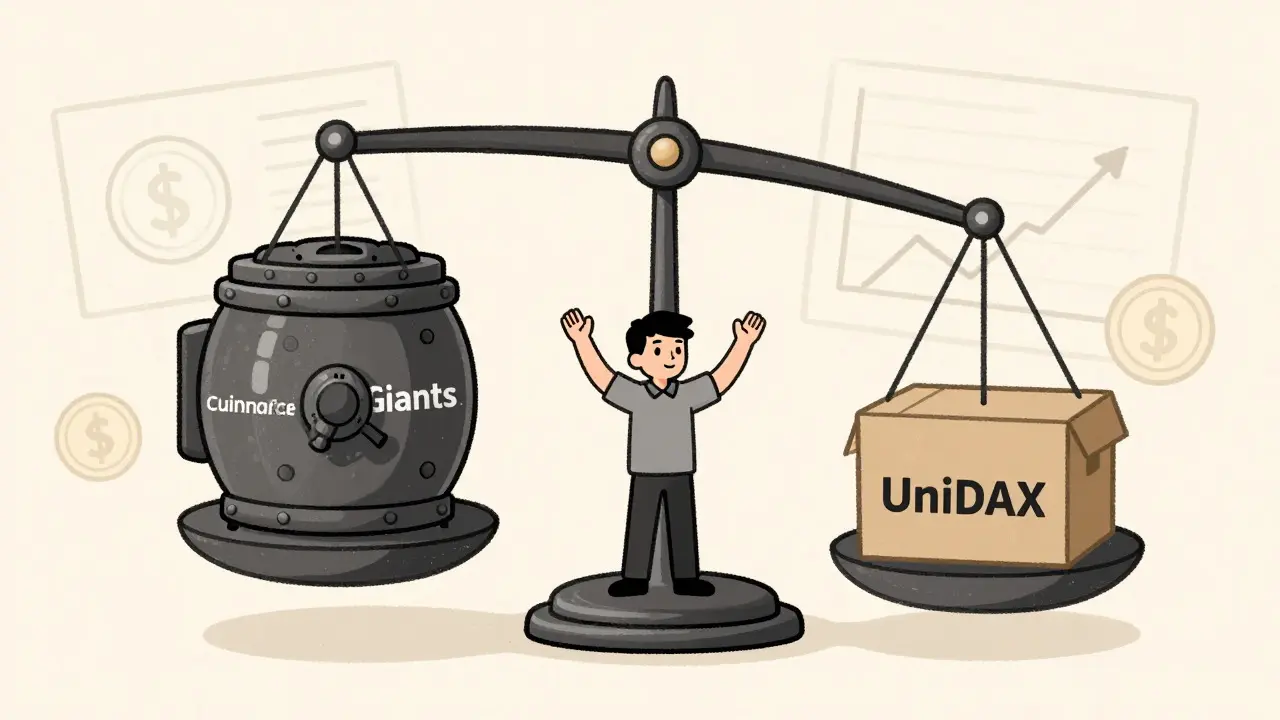
To understand where UniDAX fits, we must compare it to established alternatives. Let us look at three categories of competitors.
1. The Giants (Coinbase, Kraken): These platforms have massive liquidity, robust security, and clear regulatory standing. They charge higher fees for retail users but offer peace of mind. If safety is your #1 priority, stick with these names.
2. The Cost Leaders (Binance, Bybit): These exchanges offer ultra-low fees, especially for makers. They have complex interfaces and vast asset lists. If you are an active trader wanting to minimize costs, these are the benchmarks.
3. The Local Challengers (NDAX, Wealthsimple): For users in specific regions like Canada, local exchanges offer fiat on-ramps that are easier to use. NDAX, for instance, is fully regulated in Canada. If UniDAX is targeting a specific region, it needs to compete on ease of local bank transfers.
UniDAX tries to sit in the middle: simpler than Binance, potentially cheaper than Coinbase for small trades. But does it deliver enough unique value to justify switching?
Pros and Cons Summary
- Pros:
- Simple flat fee structure avoids confusion.
- Potentially lower barrier to entry for beginners.
- Minimalist interface may reduce cognitive load.
- Cons:
- Limited public information on security audits.
- Unclear regulatory compliance status.
- Lack of transparent leadership team.
- Potential liquidity issues due to smaller user base.
Verdict: Should You Use UniDAX in 2026?
If you are a seasoned trader looking for deep liquidity and advanced tools, UniDAX likely falls short. The lack of detailed security disclosures and regulatory clarity makes it risky for large portfolios.
However, if you are a beginner who wants a straightforward way to buy Bitcoin without navigating complex fee tiers, UniDAX offers a tempting simplicity. Just proceed with caution. Start small. Test the withdrawal process. Verify that your funds leave the platform as easily as they entered.
In the crypto world, transparency is currency. Until UniDAX publishes more data about its operations, security, and team, treat it as a secondary wallet, not your primary vault. Diversify your exchange usage. Never keep all your eggs in one basket, especially one with a thin online presence.
Is UniDAX safe for beginners?
Safety depends on security practices. While UniDAX offers a simple interface, the lack of public security audits and clear regulatory status introduces risk. Beginners should start with very small amounts to test reliability before trusting larger sums.
How much does UniDAX charge in fees?
UniDAX uses a flat fee model, meaning all users pay the same rate regardless of volume. Specific percentages should be checked on their official site, as they may change. This differs from tiered models where high-volume traders pay less.
Does UniDAX require KYC verification?
Most legitimate crypto exchanges require Know Your Customer (KYC) verification to comply with anti-money laundering laws. Given the lack of detailed public info, assume UniDAX requires ID verification for fiat deposits and withdrawals.
Can I withdraw my money easily from UniDAX?
Withdrawal ease is a key trust indicator. Before depositing large amounts, perform a test withdrawal. If funds are delayed or fees are unexpectedly high, consider alternative platforms with proven track records.
How does UniDAX compare to Coinbase or Binance?
UniDAX is much smaller and less documented than giants like Coinbase or Binance. Those platforms offer higher liquidity, better security proofs, and more regulatory oversight. UniDAX may appeal only to those seeking extreme simplicity in fee structures, accepting higher operational risk.