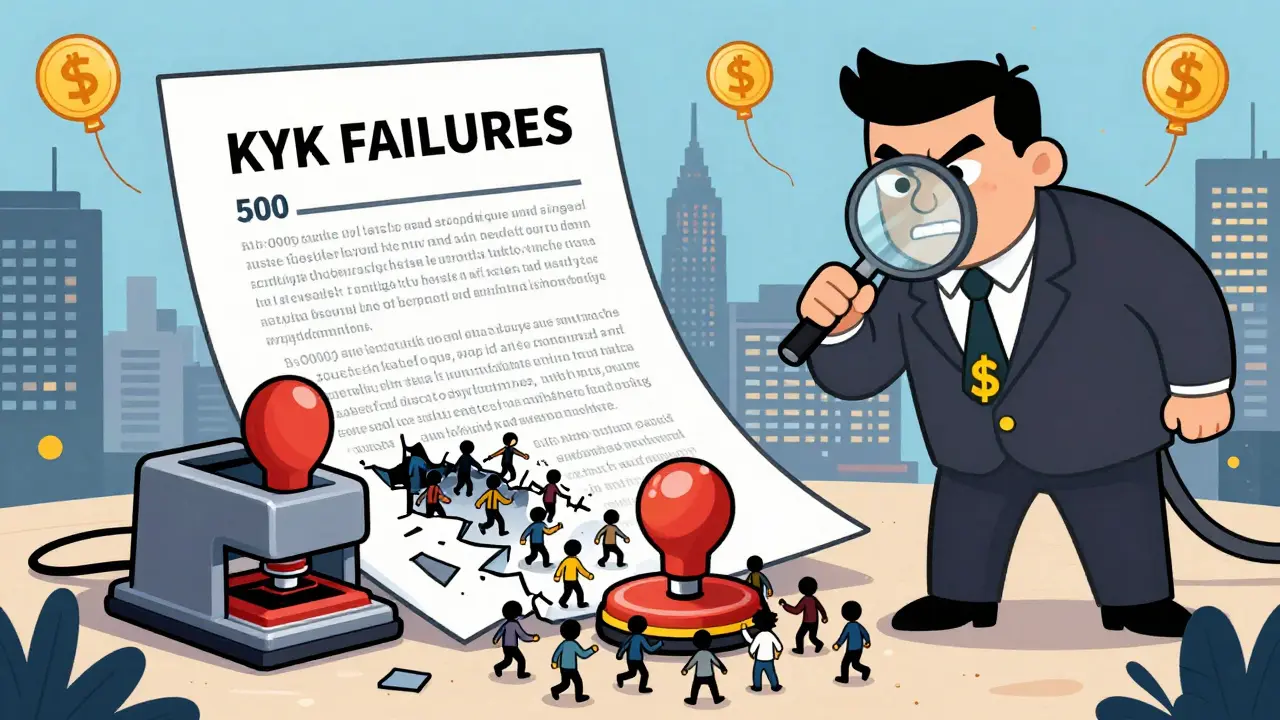
When South Korea’s Financial Services Commission (FSC) dropped the hammer on Upbit in early 2025, the crypto world held its breath. The exchange, responsible for nearly half of all cryptocurrency trading in the country, was staring down a potential fine of $34 billion - the largest regulatory penalty ever proposed against any crypto platform in history. This wasn’t a rumor. It was a formal notice. And it wasn’t about hacking, fraud, or market manipulation. It was about paperwork.
What Went Wrong? The KYC Breakdown
Upbit, launched in 2017 by Dunamu, grew into the sixth-largest crypto exchange globally. It handled over $8 billion in trades every single day. But behind the scenes, something was broken. During routine license renewal checks in late 2024, regulators found between 500,000 and 700,000 cases where customer identification documents were either missing, blurry, or outright fake. Pictures of users? Unclear. Government IDs? Altered. Some documents showed no face at all. Under South Korea’s Special Financial Transactions Act, every crypto exchange must verify the identity of every user - no exceptions. This is called Know Your Customer, or KYC. It’s not optional. It’s the foundation of anti-money laundering (AML) rules. The law says each violation can cost up to 100 million Korean won - about $68,500. Multiply that by half a million cases, and you get the $34 billion number. It’s a theoretical maximum, yes. But regulators didn’t just threaten it. They acted on it.What Happened After the Notice?
On January 20, 2025, Upbit got a preliminary suspension notice. They had ten days to respond. They did. Then, on January 21, the FSC confirmed the findings. By February 25, Dunamu, Upbit’s parent company, received the official letter. The punishment? Not the full $34 billion - but something worse: a partial shutdown. Upbit was blocked from accepting new deposits or withdrawals for three months. Existing users could still trade. But no new customers. No new money coming in. That’s a death sentence for any exchange that relies on growth. If Upbit had failed to fix its systems, regulators said they could have banned new registrations for up to six months. The message was clear: size doesn’t protect you. If you’re sloppy, you’re done.Why Did This Happen?
Upbit didn’t set out to break the law. Company officials said they struggled to verify overseas exchanges they traded with. Blockchain is global. Transactions cross borders. But South Korea’s rules don’t care about that. If you’re dealing with an unregistered foreign platform, you’re violating the law. And Upbit had been doing it - repeatedly. The real issue? Scale. As Upbit exploded in popularity, its compliance team didn’t scale fast enough. They hired staff. They bought software. But they didn’t build a system that could keep up with volume. They relied on manual checks. They trusted customer-submitted documents. And they didn’t audit themselves. When regulators showed up with a checklist, Upbit didn’t have the records.
What Does This Mean for Other Exchanges?
This wasn’t just about Upbit. It was a warning shot across the bow of every crypto platform in Asia - and beyond. In the U.S., exchanges like Coinbase and Binance already have robust KYC systems. But in places like Japan, Singapore, and even the Philippines, many smaller exchanges still rely on basic ID uploads. The Upbit case changed everything. Now, every compliance officer in Asia is asking: Are we next? Within weeks of the penalty announcement, exchanges from Indonesia to Thailand began upgrading their verification tools. Some started using AI to detect fake IDs. Others partnered with third-party identity providers like Jumio or Onfido. A few even hired former regulators to audit their systems. The cost? Millions. But it’s cheaper than a $34 billion fine.The Bigger Picture: South Korea’s Crypto Crackdown
Upbit’s case didn’t come out of nowhere. It was part of a broader crackdown. In February 2025, South Korean police rearrested a notorious crypto scammer known as “Jon Bur Kim,” who stole $48 million using a fake token called Artube. The same week, the government announced the creation of a dedicated crypto crime unit. They weren’t just talking about regulation anymore. They were building enforcement. The FSC was already drafting new crypto laws. By mid-2025, they planned to introduce the first comprehensive framework for digital assets in the country. Upbit’s violations gave them the political cover they needed. They could say: Look what happens when we don’t act. South Korea had been a crypto hotspot for years. It’s one of the few countries where retail investors dominate the market. But now, regulators were saying: We love innovation. But we won’t tolerate chaos.How Upbit Is Fixing Things
After the suspension, Upbit didn’t hide. They went public with their fix. They hired a former FSC compliance officer as their Chief Risk Officer. They overhauled their entire KYC system. They now use facial recognition, liveness detection, and real-time ID validation with government databases. They also stopped trading with any overseas platform unless it was officially registered with its home regulator. They even started publishing monthly compliance reports - something no other Korean exchange had ever done. It’s a gamble. But it’s working. By May 2025, they had cleared 98% of the flagged KYC cases. The suspension was lifted. They’re back in business. But they’re not the same.
What This Means for You
If you trade on a crypto exchange, especially one based in Asia, you should care about this. Why? Because your money is only as safe as the exchange’s compliance. Upbit’s story proves that even the biggest names can fall hard - not because of a hack, but because of a broken process. Exchanges that cut corners on KYC aren’t just risking fines. They’re risking your funds. If a platform can’t verify who you are, how can they stop a hacker from stealing your account? How can they prevent fraud? How can they protect you? This case shows that regulation isn’t the enemy. Bad regulation is. Good regulation - the kind that forces exchanges to verify users, track transactions, and report suspicious activity - is what keeps crypto safe. Upbit got slapped hard. But the industry got better because of it.Will Other Exchanges Be Targeted?
Almost certainly. South Korea’s regulators are watching. They’ve made it clear: no one is too big to fail. Bithumb, Gopax, Coinone - all are under renewed scrutiny. The FSC has started random audits across the top ten exchanges. And they’re not just checking KYC. They’re looking at transaction monitoring, cold storage practices, and internal audit logs. One insider told Reuters that the next target might be a major exchange that failed to report over $200 million in suspicious transfers. The pressure is mounting. And the bar for compliance has been raised permanently.Final Thoughts
The $34 billion penalty was never going to happen. No regulator in their right mind would destroy the country’s largest crypto exchange. But the threat? That was real. And it worked. Upbit changed. Others followed. And the entire market became safer. Crypto doesn’t need more rules. It needs better rules. And Upbit’s failure taught everyone what those rules look like: clear, strict, and enforced - no exceptions.Why was the fine $34 billion?
The $34 billion figure came from multiplying the maximum penalty allowed per violation - 100 million Korean won (about $68,500) - by the estimated 500,000 to 700,000 KYC failures found at Upbit. This was a theoretical maximum under South Korea’s Special Financial Transactions Act, not the actual fine imposed. Regulators never intended to bankrupt the exchange; the number was meant to show the severity of the violations.
Did Upbit get fined $34 billion?
No. Upbit was not fined anywhere near that amount. Instead, regulators imposed a three-month suspension on new deposits and withdrawals. The exchange was also required to overhaul its compliance systems. The $34 billion figure was a legal upper limit used to pressure the company into fixing its practices - not a final penalty.
What is KYC and why does it matter?
KYC stands for Know Your Customer. It’s a process where financial institutions verify the identity of their users to prevent fraud, money laundering, and terrorist financing. For crypto exchanges, this means checking government-issued IDs, verifying facial matches, and ensuring users aren’t operating under fake names. Without KYC, exchanges become easy targets for criminals - and regulators shut them down.
Is South Korea the only country cracking down on crypto?
No. The U.S., EU, Japan, and Singapore have all tightened rules in recent years. But South Korea’s approach is unique because it targets even the largest exchanges with extreme penalties. The Upbit case set a global precedent: no crypto company is too big to be held accountable.
How did Upbit recover after the suspension?
Upbit hired a former regulator as its Chief Risk Officer, upgraded its KYC system with AI and real-time ID verification, stopped trading with unregistered overseas platforms, and began publishing monthly compliance reports. These changes restored regulator trust. By mid-2025, the suspension was lifted, and Upbit resumed normal operations with stronger oversight.
Comments (14)
S F
March 14, 2026 AT 08:19
This is why America needs to stop letting foreign governments dictate crypto policy. $34 BILLION? That’s not regulation-that’s economic warfare. South Korea’s playing hardball because they’re scared of losing control. Meanwhile, US exchanges are actually building real systems. Stop crying, Upbit. You got lazy. Now fix it or get out of the game.
And don’t even get me started on how they let fake IDs slip through. That’s not incompetence-that’s negligence with a side of arrogance.
Anastasia Thyroff
March 15, 2026 AT 21:47
I just watched the FSC press conference live and honestly I cried
not because of the money but because someone finally said NO to the wild west of crypto
they didn’t just punish Upbit they told every exchange in Asia: you don’t get to be big and sloppy
and i’m not mad about it
shreya gupta
March 17, 2026 AT 07:26
Let me be clear: this was not a failure of technology. It was a failure of ethics. Upbit prioritized growth over compliance. They knew. They chose. And now they’re paying the price. No sympathy. No excuses. If you operate in a regulated space, you follow the rules. Period. The $34B figure wasn’t punitive-it was pedagogical. A lesson in humility.
Christopher Hoar
March 17, 2026 AT 19:06
bro they said 500k+ fake ids and still let people trade
like imagine signing up for a bank and they just take your selfie and say ‘cool’
then you rob a vault with a stolen id and they say ‘oops’
that’s not crypto thats a cartoon
Robert Kunze
March 19, 2026 AT 14:31
i dont care how big you are if your system cant verify a face with a government id then you dont deserve to exist
imagine being a user and realizing your funds are sitting on a platform that didnt even check if you were real
that’s not risk thats betrayal
upbit got lucky they only got a suspension
they should’ve been shut down for a year
Sarah Zakareckis
March 21, 2026 AT 00:27
This is actually one of the most constructive regulatory moments in crypto history. Upbit didn’t just get slapped-they got rebuilt. The fact that they hired a former FSC officer? That’s not PR. That’s institutional humility. They turned a crisis into a compliance revolution. Other exchanges should take notes: transparency isn’t weakness. It’s your new competitive advantage.
AI + real-time ID + public reports = trust you can’t buy. This is how you win long-term.
Heather James
March 21, 2026 AT 07:26
They didn’t fine them. They woke them up.
Sarah Hammon
March 22, 2026 AT 11:28
i think people are missing the real win here: upbit went from ‘we’ll fix it later’ to publishing monthly compliance reports
that’s like a casino suddenly putting its security footage online
it’s scary but also… kind of beautiful?
they’re not hiding anymore and that’s the first step to real safety
iam jacob
March 22, 2026 AT 21:58
i just feel so sad for the employees
they didn’t make the decisions
they were just trying to do their jobs
now their company’s in shambles
and the regulators didn’t even care
they just wanted blood
why does it always have to be this brutal?
Jesse Pals
March 24, 2026 AT 10:11
bro if you’re gonna run a crypto exchange you gotta have more than a google form for ID checks
upbit thought they were a startup but they were a national infrastructure
and now they’re playing catchup with AI and facial liveness detection
im impressed tbh 🤝
Graham Smith
March 25, 2026 AT 10:46
The $34 billion is a red herring. What matters is the structural shift: South Korea just weaponized compliance. This isn’t about Upbit-it’s about the end of the ‘move fast and break things’ era in crypto. The new paradigm? Audit everything. Document everything. Report everything. If you can’t scale compliance, you don’t scale. Simple as that.
Jerry Panson
March 26, 2026 AT 02:50
It is imperative to underscore that the regulatory action undertaken by the Financial Services Commission of the Republic of Korea was both proportionate and legally grounded under the Special Financial Transactions Act. The suspension of new user onboarding was not punitive per se, but rather a necessary remedial measure to ensure systemic integrity. The theoretical maximum penalty was a deterrent mechanism, not an execution target. One must not conflate symbolic magnitude with operational outcome.
Katrina Smith
March 26, 2026 AT 11:45
so let me get this straight… they fined them for bad selfies?
next they’ll jail people for using filter on their profile pic
lol
Anastasia Danavath
March 26, 2026 AT 21:58
this whole thing is just drama 😴💸