You’ve probably heard the horror stories. Someone loses a single string of words-a seed phrase-and their entire life savings vanishes into the digital void. Or maybe you tried to send your first crypto transaction and got stuck because you didn’t have enough ETH for "gas," even though you just wanted to buy a coffee with Bitcoin. These aren't user errors; they are design flaws in how traditional blockchain accounts work. Account Abstraction is the fix. It’s a shift that turns your rigid, key-controlled wallet into a smart, programmable account that behaves more like a modern banking app than a vault full of loose cash.
This isn't just theoretical hype. With the rollout of ERC-4337 on Ethereum, account abstraction is becoming the standard for how we interact with blockchains. If you’re tired of managing private keys like nuclear launch codes or worrying about running out of gas fees at the worst possible moment, this guide breaks down exactly what account abstraction is, how it works under the hood, and why it matters for your next transaction.
The Problem with Traditional Wallets
To understand why account abstraction exists, you have to look at the status quo: the Externally Owned Account (EOA). This is what most people use when they install MetaMask or Coinbase Wallet. An EOA is tied directly to a private key. That key is the only thing standing between your funds and the rest of the world. If you lose the key, you lose the money. There is no "forgot password" button. There is no customer support line. The blockchain doesn't care if you spilled coffee on your hardware wallet; it only cares that the signature matches the key.
This model has two massive pain points:
- Fragility: One mistake, one lost piece of paper, and your assets are gone forever.
- Rigidity: You can’t set rules. You can’t say, "Only allow transactions under $100 without approval," or "Require my spouse’s signature for anything over $1,000." Every transaction requires a manual signature from that single private key.
Traditional wallets are dumb pipes. They move value but don't think. Account abstraction changes that by allowing the account itself to be a smart contract, giving it logic, memory, and flexibility.
How Account Abstraction Actually Works
At its core, account abstraction separates the control of an account from the execution of transactions. In the old world, the private key controlled everything. In the new world, a smart contract controls the account. This smart contract can define who can sign transactions, how many signatures are needed, and even who pays for the network fees.
The current implementation on Ethereum relies on EIP-4337. Unlike previous attempts that required changing the core blockchain protocol (which is slow and risky), EIP-4337 works as a layer on top of existing infrastructure. It introduces a few new components that handle the heavy lifting:
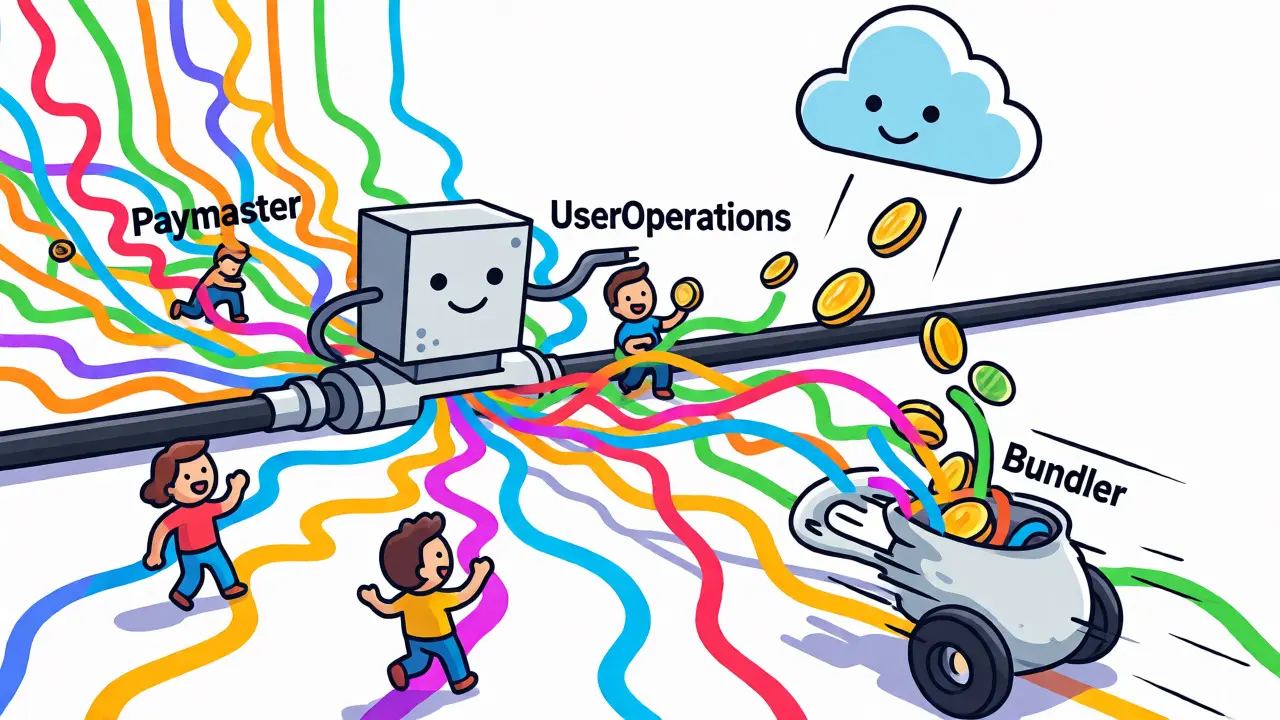
- UserOperations: Instead of sending standard transactions, users send "UserOperations." These are bundles of data that tell the network what you want to do, but they don't need to be signed by a private key in the traditional sense. They can be validated by custom logic.
- Bundlers: Since UserOperations aren't standard transactions, regular nodes don't pick them up immediately. Bundlers are specialized services that collect these operations from a separate mempool, bundle them together, and submit them to the blockchain as a single transaction.
- Paymasters: This is where the magic happens for user experience. A Paymaster is a smart contract that can pay the gas fees on behalf of the user. This enables "gasless" transactions, where a dApp or service covers the cost so you don't need to hold ETH just to interact with their platform.
- Entry Point Contract: This is the central hub that verifies all UserOperations before they are executed, ensuring security and consistency across the network.
Think of it like ordering food delivery. In the old model (EOA), you had to drive your own car, find parking, and pay for gas yourself. In the abstracted model, you just place an order (UserOperation). A driver (Bundler) picks it up, and sometimes the restaurant (Paymaster) covers the delivery fee (Gas).
Key Features That Change Everything
Once your account is a smart contract, you unlock features that were previously impossible or extremely difficult for average users. Here are the three biggest wins:
Social Recovery
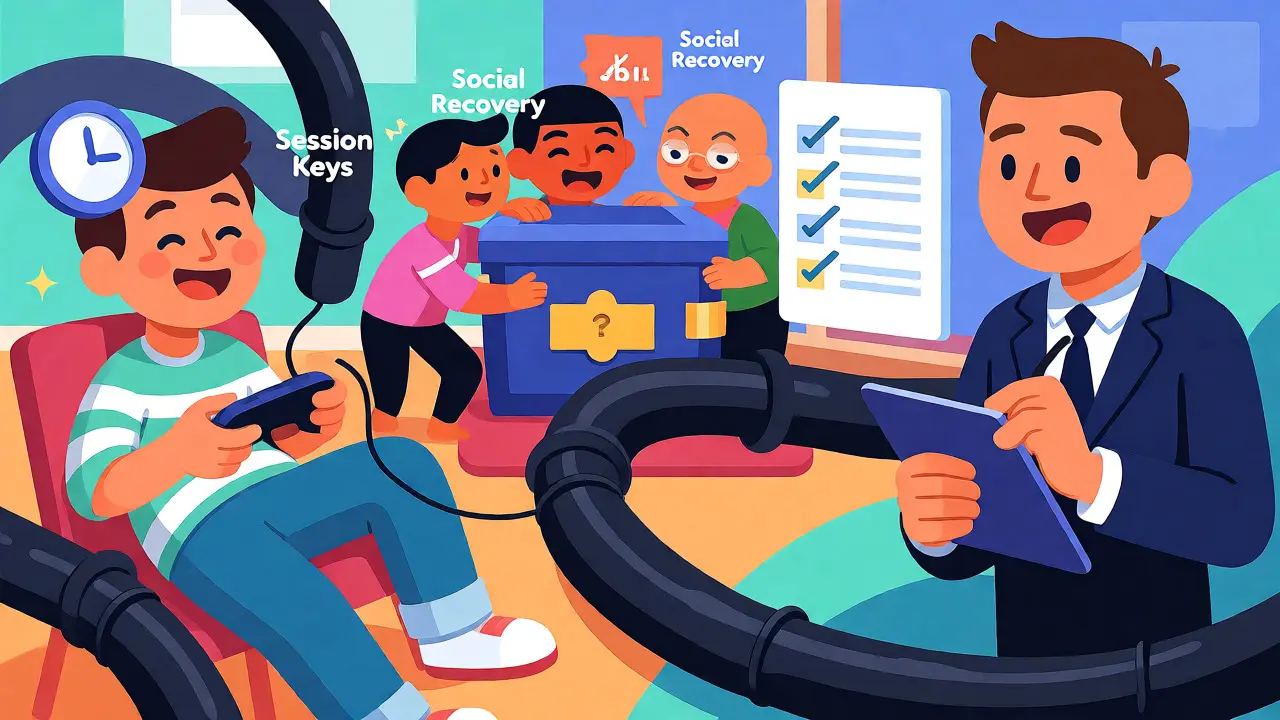
Losing your private key used to mean financial death. With social recovery, you designate trusted friends or family members as "guardians." If you lose access to your device or forget your password, you can initiate a recovery process. For example, you might set a rule that says, "If I haven't logged in for 30 days, any 3 of my 5 guardians can approve a reset of my access." No central authority needs to intervene. Your community protects your assets.
Session Keys
Imagine playing a blockchain game. Do you really want to sign a transaction every time you buy a sword or move your character? Session keys allow you to grant temporary, limited permissions. You can authorize a specific app to spend up to $5 worth of tokens for the next hour without asking for your signature every single click. When the session ends, the permission expires automatically. This makes Web3 apps feel like Web2 apps.
Gasless Transactions
One of the biggest barriers to entry for new users is understanding gas fees. Why do I need ETH to send USDC? Account abstraction solves this via Paymasters. Developers can sponsor gas fees for their users. This means a new user can download a wallet, create an account, and start using a decentralized exchange without ever buying cryptocurrency first. The developer absorbs the cost as a customer acquisition expense.
Ethereum vs. Solana: Different Paths, Same Destination
It’s worth noting that not all blockchains implement account abstraction the same way. Ethereum had to bolt it on via standards like ERC-4337 because its original architecture didn't support it natively. Solana, however, was built with account abstraction in mind from day one.
| Feature | Ethereum (via ERC-4337) | Solana (Native) |
|---|---|---|
| Implementation Method | Layer 2 / Protocol Standard added later | Built into core architecture since launch |
| Complexity | Requires Bundlers and Paymasters | Programs handle logic directly |
| Adoption Status | Rapidly growing, supported by major wallets | Standard practice for all developers |
| Primary Goal | Fix UX limitations of EOAs | Enable flexible state management |
On Solana, every account is essentially a storage bucket. Programs (smart contracts) can read and write to these buckets freely. This inherent flexibility means developers don't need complex bundling layers to enable things like batched transactions or sponsored fees-it's part of the base layer. However, the end-user benefit is similar: smoother interactions and better security options.
Why Enterprises Love Account Abstraction
While individual users care about convenience, businesses care about compliance and control. Account abstraction offers robust tools for corporate treasuries. Imagine a company holding $10 million in stablecoins. They don't want one intern with a laptop able to drain the account. With a smart contract wallet, they can enforce multi-signature policies. Perhaps any transaction over $50,000 requires approval from both the CFO and the CEO. Or maybe payments to vendors must match a pre-approved list of addresses.
Furthermore, automated compliance checks can be baked into the wallet logic. Before a transaction executes, the smart contract can verify that the destination address isn't on a sanctions list. This reduces risk and simplifies auditing, making blockchain finance viable for regulated industries.
Getting Started: What You Need to Know
If you're ready to try account abstraction, you won't find it in older versions of MetaMask by default, though support is expanding rapidly. Wallets like Argent, Safe (formerly Gnosis Safe), and thirdweb-powered wallets are leading the charge. These interfaces often hide the complexity behind familiar buttons. You might see "Recover Account" instead of "Sign Message," or "Sponsored Transaction" instead of "Pay Gas Fee."
For developers, the learning curve involves integrating with bundler services and understanding the lifecycle of a UserOperation. But thanks to platforms like thirdweb and Alchemy, much of the boilerplate code is handled for you. The key takeaway is that you no longer have to choose between self-custody and ease of use. You can have both.
Is account abstraction safe?
Yes, generally considered safer for most users. By enabling features like social recovery and multisig approvals, it reduces the risk of total loss due to human error (like losing a key) or theft (since one compromised key doesn't necessarily give full access). However, the smart contract logic itself must be secure, so always use reputable wallet providers.
Do I still need a private key?
Technically, yes, but you might never see it again. The underlying cryptographic principles remain, but account abstraction allows you to manage access through other methods, such as passkeys, biometrics, or email verification, depending on the wallet provider's implementation.
What is a Paymaster?
A Paymaster is a smart contract that can pay transaction fees (gas) on behalf of the user. This allows for "gasless" transactions where the application developer or a third party covers the network costs, removing the need for users to hold native tokens like ETH just to make transactions.
Can I switch my existing wallet to account abstraction?
Not directly. Traditional Externally Owned Accounts (EOAs) cannot be converted into smart contract wallets on-chain. You typically need to create a new smart contract wallet and transfer your funds to it. Some newer wallets offer migration tools to help streamline this process.
Does account abstraction increase transaction costs?
The computational cost of verifying smart contract logic can be slightly higher than simple signature checks. However, bundlers aggregate multiple UserOperations into a single transaction, which often offsets these costs. Additionally, Paymasters can absorb these fees entirely for the user, making the effective cost zero.