You see a coin with a catchy name like Realfinance Network (REFI) and wonder if it’s the next big thing or just digital dust. The honest answer? It’s mostly dust right now. If you’re looking for active trading volume, vibrant community discussions, or a fully functional DeFi platform, REFI will likely leave you scratching your head. This article breaks down what REFI actually is, why its price looks like it flatlined, and whether it’s worth your time in 2026.
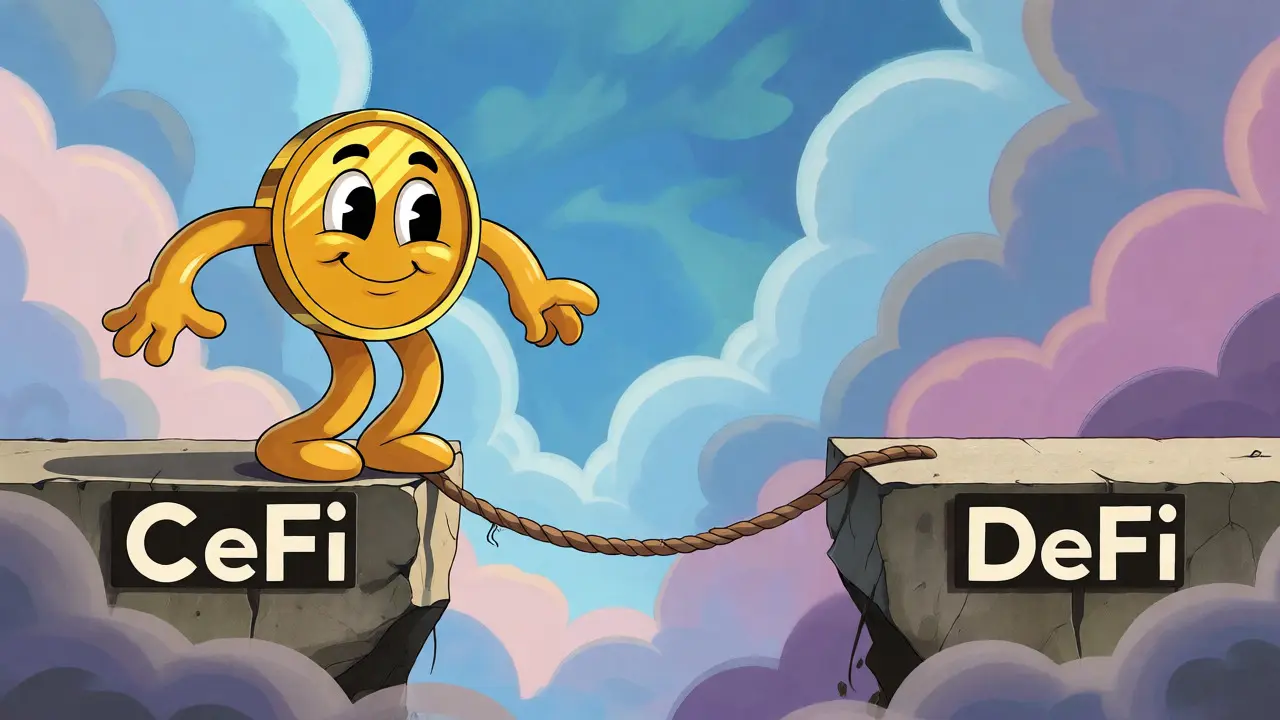
The Core Promise: Bridging CeFi and DeFi
Realfinance Network positions itself as a decentralized finance (DeFi) ecosystem designed to fix the gaps between traditional centralized finance (CeFi) and the wild west of DeFi. The idea was to give users more control over their assets while offering financial services that feel familiar yet decentralized. Think of it as trying to build a bank inside a blockchain, but without the heavy regulatory paperwork slowing things down.
The project operates on the Ethereum blockchain, according to major trackers like Coinpaprika, though some sources mention plans for Binance Smart Chain integration for swapping BEP20 tokens. The contract address is 0x641a6Dc991A49f7BE9Fe3C72c5d0FBb223eDb12f. While the mission sounds noble-enhancing financial inclusivity-the execution has struggled to keep pace with the ambitious roadmap.
Market Performance: Where Did the Value Go?
Let’s look at the numbers, because they tell a stark story. As of late 2025 and into 2026, REFI trades at fractions of a cent. We’re talking about $0.00000198 on Coinbase and similar micro-values on other platforms. That’s not a typo; there are five zeros after the decimal point before you hit a non-zero digit.
The decline from its peak is brutal. Depending on which data source you trust, REFI hit an all-time high (ATH) either around $0.006 or, more optimistically, $0.0497 back in April 2021. Today, it sits roughly 100% below those peaks. In practical terms, if you bought REFI at its highest point, you’d need a 10,000x return just to break even. That’s not investing; that’s holding a lottery ticket that stopped being printed years ago.
| Metric | Value / Status | Context |
|---|---|---|
| Current Price | ~$0.000002 USD | Extremely low valuation |
| All-Time High (Est.) | $0.006 - $0.0497 | Peaked in early 2021 |
| 24h Trading Volume | $0 - Minimal | Near-zero liquidity |
| Fully Diluted Valuation | ~$2.23 Million | Micro-cap territory |
The Liquidity Problem: Why You Can’t Trade It Easily
Here is the biggest red flag for any trader: liquidity. Multiple tracking platforms report $0 trading volume over 24-hour periods. When a coin has zero volume, it means no one is buying and no one is selling. It’s effectively dead in the water.
You might ask, "Why does volume matter so much?" Imagine trying to sell a house in a town where no one moves in or out. You can list it for a million dollars, but if no buyers exist, the price is theoretical. REFI faces this exact issue. Major exchanges don’t actively promote it, and smaller exchanges show minimal activity. DropsTab notes that the lack of accurate trading data suggests potential delisting or severe illiquidity. If you buy REFI today, exiting that position later could be nearly impossible without crashing the price further due to thin order books.
Platform Features: Promises vs. Reality
The Realfinance Network website promises features like farming, staking, and a swap platform. On paper, these are standard DeFi tools that attract users seeking yield. However, the reality check is harsh: many of these features remain incomplete or unverified by user experience.
- Farming & Staking: Listed on the roadmap, but documentation on actual yields and mechanisms is sparse.
- Swap Functionality: Planned for Binance Smart Chain integration, but evidence of a live, widely-used swap interface is lacking.
- User Interface: No clear getting-started guides or robust support systems are visible.
In the fast-moving crypto world, a platform that hasn’t updated its core features recently risks becoming obsolete. Competitors like Uniswap or PancakeSwap offer seamless swaps and deep liquidity pools. REFI’s failure to deliver a polished, accessible product makes it hard to justify switching from established alternatives.
Community and Expert Sentiment: Silence is Loud
Search for "Realfinance Network review" on Reddit or Twitter, and you’ll find crickets. There are no viral threads, no heated debates, and no influential analysts covering REFI in their daily newsletters. This absence of chatter isn’t neutral-it’s negative. Active projects generate noise through updates, bugs, fixes, and community governance votes.
Mainstream crypto analysis firms haven’t rated REFI. Why? Because institutional analysts focus on projects with market cap above certain thresholds and active development teams. REFI falls outside this scope. Without expert validation or community engagement, new investors have no social proof to rely on. You’re essentially flying blind, trusting only the whitepaper and the team’s original vision, which may have shifted since launch.

Is REFI a Good Investment in 2026?
If you’re asking this question, you’re likely looking for hidden gems. But in REFI’s case, the "hidden" aspect feels more like "abandoned." Here’s a quick decision framework:
- Do you need liquidity? If yes, avoid REFI. You won’t be able to exit easily.
- Are you betting on a comeback? Only if you have insider knowledge of upcoming developments, which are currently undocumented.
- Is the risk acceptable? With near-zero volume, the risk of total loss is high.
For most retail investors, REFI represents a speculative gamble rather than a solid investment. The broader DeFi sector has grown exponentially, with thousands of tokens competing for attention. REFI’s stagnation suggests it failed to capture market share during the bull run and hasn’t recovered in the bear markets that followed.
Alternatives to Consider
If you’re interested in DeFi ecosystems with similar goals but better execution, consider looking at established players. While REFI aims to bridge CeFi and DeFi, projects like Compound, Aave, or MakerDAO have proven track records, massive TVL (Total Value Locked), and active communities. They offer transparent lending rates, robust governance, and deep liquidity. Comparing REFI to these giants highlights how far behind it has fallen in terms of adoption and utility.
What is the current price of Realfinance Network (REFI)?
As of late 2025 and into 2026, REFI trades at approximately $0.000002 USD. Prices vary slightly across platforms like Coinbase and CoinMarketCap, but all reflect a micro-cap valuation with negligible trading activity.
Is Realfinance Network built on Ethereum or BSC?
Primary sources indicate REFI is an ERC-20 token on the Ethereum blockchain. However, some project documents mention plans for cross-chain functionality or swap platforms on the Binance Smart Chain (BEP-20). Always verify the contract address on the network you intend to use.
Why does REFI have zero trading volume?
Zero or near-zero trading volume indicates a lack of active buyers and sellers. This often results from low interest, delisting from major exchanges, or a project that has lost momentum. It makes entering and exiting positions difficult and risky.
Did Realfinance Network reach its All-Time High?
Yes, REFI reached its all-time high in early 2021, with estimates ranging from $0.006 to $0.0497 depending on the data provider. Since then, the value has declined by approximately 100%, reflecting a collapse in demand and market confidence.
Is Realfinance Network a scam?
There is no definitive evidence labeling REFI as a rug pull or outright scam, but its status as a "zombie project" is concerning. Lack of development updates, zero volume, and missing community engagement suggest it may be abandoned rather than maliciously fraudulent. Proceed with extreme caution.