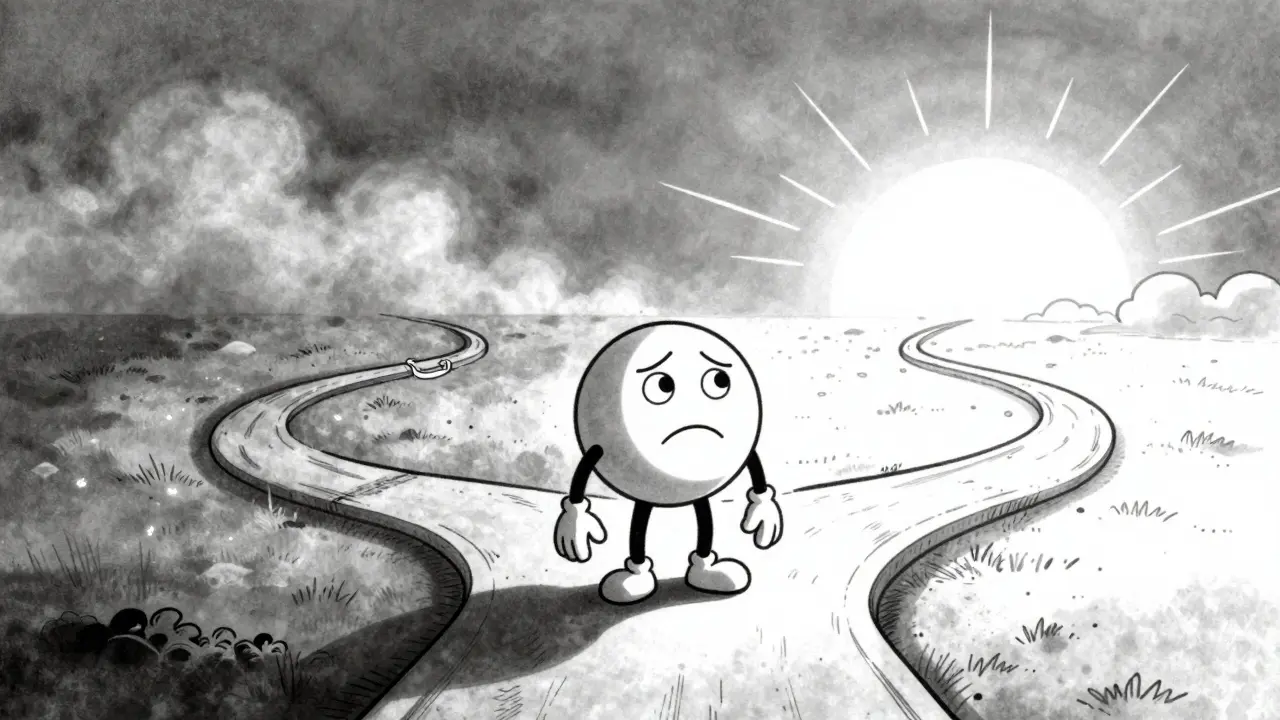
When you ask Terra (LUNA)a cryptocurrency project that underwent a catastrophic restructuring after a massive financial failure., you aren't asking about a single asset anymore. You're asking about a split personality. As we move through 2026, the crypto world remembers Terra not as one chain, but as two distinct realities living side by side. There is the original chain, known now as the legacy blockchain that preserved the original community and token supply following the split., which holds the scars of the past. Then there is the rebuilt blockchain launched after the hard fork, operating without the failed stablecoin mechanism., a fresh start designed to avoid the mistakes of history.
This isn't just technical jargon; it's a survival story. If you're holding tokens or considering buying in, understanding the difference between these two "Terras" is critical. One might give you exposure to high-risk community speculation, while the other offers a platform focused on governance and decentralized finance recovery. Let's break down exactly what each represents in the current market landscape.
The Great Divide: Understanding the 2022 Hard Fork
To make sense of where Terra is today, you have to look back at May 2022. That was the month the original ecosystem collapsed. The mechanism that powered the first Terra was an algorithmic stablecoin called UST (TerraUSD). It was supposed to stay pegged 1:1 to the US dollar. When confidence broke, the peg snapped, and within days, roughly $40 billion in value vanished from the market. This wasn't a slow decline; it was a sudden death spiral that erased portfolios overnight.
In response to this disaster, the community voted for a hard fork on May 28, 2022. This split the blockchain into two separate paths. The original chain kept the name Terra Classic (symbol LUNC) and continued running the code that had already failed. Meanwhile, the developers and a faction of the community launched Terra 2.0 (symbol LUNA) on a completely new blockchain. This new chain dropped the algorithmic stablecoin entirely. Why does this matter to you? Because investing in LUNA today means betting on a team trying to rebuild trust, whereas investing in LUNC often involves hoping for a speculative resurrection of a broken model.
| Feature | Terra 2.0 (LUNA) | Terra Classic (LUNC) |
|---|---|---|
| Purpose | Governance, Staking, DeFi | Legacy Token, Community Speculation |
| Stablecoin | None (Mechanism removed) | USTC (Unpegged, unstable) |
| Current Price Baseline (2025) | ~$0.22 | ~$0.00006 |
| Circulating Supply | ~1.12 Billion | ~6.49 Trillion |
Deep Dive: What Makes Terra 2.0 Work?
Terra 2.0 operates differently than almost any other Layer-1 blockchain because it was built specifically to avoid the volatility trap of its predecessor. Its native token, LUNA, functions primarily as a governance token. This means holders of LUNA get to vote on proposals regarding the future of the network. It also serves as the medium for transaction fees and staking rewards. If you stake your coins, validators process transactions and pay you out in LUNA for helping secure the network.
Technically, the protocol runs on a modified version of the software development kit enabling developers to build blockchains using Go programming language.. This is significant because it makes Terra compatible with the a standard for allowing different blockchains to communicate and send assets to each other.. In practical terms, you can move assets from the Cosmos Hub to Terra 2.0 seamlessly. By 2025, the network was processing around 1,000 transactions per second (TPS). While that sounds impressive compared to older systems like Bitcoin, it still trails behind competitors like Solana, which hits much higher throughput. The ecosystem focuses heavily on DeFi apps and non-fungible tokens (NFTs), aiming to bring liquidity back without the leverage risk of pegged stablecoins.
The Ghost Chain: Navigating Terra Classic (LUNC)
You can't ignore Terra Classic simply because it existed before 2.0. It remains active, but it occupies a very different niche in the crypto world. With a circulating supply of over 6 trillion tokens, it acts more like a meme coin driven by community sentiment rather than utility. Many users hold LUNC hoping for buyback schemes or burn mechanisms that could artificially inflate the price, though these strategies lack the robust economic backing of a functioning payment layer.
While Terra 2.0 tries to legitimize the brand through technology, Terra Classic often trades on nostalgia or extreme volatility plays. Some analysts describe it as a high-risk bet on the community's ability to organize large-scale burns. However, the price remains a fraction of a penny. If you are researching Terra purely for investment potential, distinguishing between the "hopeful" speculation of LUNC and the "functional" development of LUNA is crucial to managing your portfolio risk.
Market Position and Competitors in 2026
Entering 2026, Terra 2.0 faces a crowded marketplace. When comparing it to giants like the leading smart contract platform hosting most DeFi applications globally. or a high-performance blockchain known for fast transactions and low fees., the gaps are clear. Ethereum has over 1,240 verified enterprises using its infrastructure. Solana boasts hundreds of thousands of daily active addresses. In contrast, Terra 2.0 supports a much smaller developer base-estimated around 350 active developers compared to Cardano's 2,300+. Despite this, user growth tells an interesting story. Individual wallet addresses on Terra 2.0 grew by over 650% between January 2024 and May 2025, suggesting that retail interest is returning even if institutional adoption lags behind.
Regulatory headwinds also shape the landscape. The GENIUS Act, enacted earlier in 2025, tightened rules on unbacked tokens and interest-bearing stablecoins. Interestingly, this regulation benefits Terra 2.0 indirectly because they removed their own risky stablecoin years ago. Competitors still experimenting with similar mechanisms face legal uncertainty that Terra 2.0 dodged by design.

Roadmap and Future Upgrades
Terra 2.0 isn't standing still. The roadmap released in late 2024 set ambitious targets for 2025 and beyond. The 'Aurora' upgrade, scheduled for the latter half of 2025, aims to implement EVM compatibility. This is a game-changer. EVM stands for Ethereum Virtual Machine, meaning developers who currently build Ethereum apps can port their projects to Terra 2.0 with minimal changes. Following that, the 'Nexus' protocol planned for early 2026 targets increasing transaction speed significantly, pushing towards 5,000 TPS. These milestones are vital; if executed successfully, they could bridge the gap between Terra's recovery status and a top-tier blockchain contender.
Is Terra Safe for Your Portfolio?
Safety is subjective in crypto, but here are the metrics to watch. Trustpilot reviews related to the ecosystem average around 2.3 out of 5, reflecting lingering trauma from the 2022 crash. Do Kwon, the original founder, was arrested on fraud charges, casting a long shadow over the brand. However, the community has largely separated itself from him, focusing on community governance instead. If you choose to invest, you are betting on the resilience of the open-source community, not the vision of a single individual.
Can I buy Terra Classic (LUNC) on Terra 2.0?
No, you cannot. Terra Classic (LUNC) and Terra 2.0 (LUNA) are two entirely separate blockchains with their own wallets, tokens, and markets. You cannot convert one directly into the other without selling one and buying the other on an exchange.
Does Terra 2.0 have a stablecoin?
Terra 2.0 currently does not have an integrated algorithmic stablecoin. The original UST mechanism was intentionally removed to prevent another collapse. Users rely on external stablecoins like USDC or USDT integrated via the IBC protocol.
How do I stake LUNA?
You can stake LUNA using wallets like Keplr or Ledger. Most wallets allow you to delegate your tokens to a validator directly from the interface. Rewards are typically distributed daily, but you may face unbonding periods if you want to withdraw your funds later.
Will Do Kwon lead the new Terra project?
No. Terra 2.0 transitioned to a community-led governance model shortly after the hard fork. Former leadership has no official role in the decision-making process of the new chain.
Is Terra Classic dead?
Not dead, but dormant in utility. Terra Classic still functions technically and has an active community driving burn campaigns, but it lacks the development pipeline and interoperability features of Terra 2.0.
Comments (15)
Nicolette Lutzi
March 28, 2026 AT 19:50
The hard fork was obviously planned by insiders to save their skins while dumping value on retail investors who trusted the original peg mechanism without question.
Sam Harajly
March 29, 2026 AT 14:22
From a structural perspective, the separation of LUNA from LUNC mitigates systemic risk significantly for those willing to analyze the underlying blockchain architecture rather than just price charts.
Pradip Solanki
March 31, 2026 AT 04:41
validator uptime is critical now staking rewards matter more than peg stability which is gone now really the code does not lie about the economic model anymore
YANG YUE
April 1, 2026 AT 12:53
It feels like we are mourning the ghost of what the coin used to be instead of building the new reality that exists right in front of us today.
Mohammed Tahseen Shaikh
April 1, 2026 AT 22:54
Stop holding onto the old token expecting magic burns happen and realize the community power shift is the real game changer here.
Kayla Thompson
April 2, 2026 AT 16:56
most people here still don't understand why keeping the legacy chain active is basically digital hoarding and nothing else matters anymore.
Florence Pardo
April 2, 2026 AT 21:49
I truly believe that understanding the emotional weight of the crash helps everyone manage their expectations better when looking at the chart today.
We need to acknowledge that the pain was real for those who lost life savings overnight during that May event.
It is important to recognize how the community rebuilt trust brick by brick after such a massive betrayal of confidence.
Seeing the growth in active wallets shows resilience that goes beyond just simple financial speculation or hype cycles.
Many individuals have found renewed purpose in participating in governance proposals that shape the future development path.
We should all consider how the removal of the stablecoin changes the fundamental utility of holding the asset class now.
There is a quiet dignity in watching a network recover without relying on external bailouts or rescue packages.
The developers working behind the scenes deserve credit for navigating the regulatory headwinds that threatened to shut things down completely.
Trust is fragile but the current trajectory indicates a slow steady climb back toward legitimate adoption metrics.
We must remain patient as the ecosystem matures and attracts quality projects that prioritize security over speed.
Ignoring the lessons of the past would be a disservice to the history of the entire Terra ecosystem evolution.
Every transaction processed is a vote of confidence in the new design choices made by the validators group.
The focus on interoperability through the Inter Blockchain Communication protocol opens doors we thought were permanently closed.
People often forget that open source software allows for continuous improvement that centralized systems simply cannot achieve effectively.
We should celebrate the small wins like increased throughput and lower latency even if institutional money hasn't returned fully yet.
Ultimately the survival of the chain proves that decentralized networks possess a form of immortality that traditional finance lacks entirely.
Alicia Speas
April 3, 2026 AT 21:47
We should encourage the new developers focusing on the EVM compatibility update coming soon next year to ensure cross-chain liquidity flows smoothly.
Mike Yobra
April 5, 2026 AT 01:45
Oh great because governance tokens always solve the issue of trust after billions vanish into thin air without a single warning sign.
Tony Phillips
April 6, 2026 AT 15:04
There is genuine progress in the TPS numbers compared to where ethereum sits currently and it is nice to see some traction.
Abhishek Thakur
April 8, 2026 AT 03:11
IBC protocol integration allows for asset movement without bridges that hack often occur on standard centralized exchange models.
Jackie Crusenberry
April 8, 2026 AT 19:25
I feel drained reading about how this project keeps getting second chances nobody else gets in this cutthroat market environment.
Shelley Dunbrook
April 10, 2026 AT 12:03
At least now we know who is actually responsible for the code running today versus the past failures that defined the previous era.
Aman Kulshreshtha
April 11, 2026 AT 05:14
curious if the burn rate on classic is actually affecting the price action yet or just noise in the market signals.
manoj kumar
April 11, 2026 AT 21:45
Only those who respect market mechanics will survive the volatility ahead.