You’ve probably stumbled upon Transcodium while scrolling through a list of obscure cryptocurrencies or perhaps saw it mentioned in a forum discussing low-cap gems. The ticker symbol is TNS, and on paper, it promises to be something revolutionary: a peer-to-peer platform for file editing, transcoding, and distribution. But if you are looking for a reliable investment or a functional tool for your digital workflow, the reality is quite different from the hype.
As of mid-2026, Transcodium sits in a very specific corner of the cryptocurrency world-the one where projects go to fade into obscurity. It is an ERC-20 token built on Ethereum, meaning it relies entirely on the Ethereum network for security and transactions. However, unlike major tokens like Uniswap or Chainlink that have active ecosystems, TNS appears to be a ghost town. Understanding what this coin actually is requires looking past the marketing speak and examining the hard data: market cap, liquidity, development activity, and real-world utility.
The Promise vs. The Reality of TNS
According to its profile on major tracking sites like CoinMarketCap, Transcodium aims to solve a real problem: the need for decentralized file processing. In theory, this sounds impressive. Imagine uploading a video file, having it automatically converted (transcoded) into different formats by a distributed network of computers, and then distributing it without a central server taking a cut. That is the pitch.
However, there is a massive gap between the concept and the execution. When you dig into the technical documentation, you find very little. The project description on CoinMarketCap is often truncated, hinting at "high quality and reliable services" but failing to explain how those services work today. There is no public dashboard showing active transcoding jobs. There are no case studies of companies using TNS for their media workflows. In the crypto world, a product without users is just code sitting on a server-and often, even that code stops being updated.
The lack of transparency is a red flag. Established projects in the decentralized storage space, such as Filecoin (FIL) or Arweave (AR), publish regular reports on network capacity, active miners, and data retrieval speeds. Transcodium does not. This silence is deafening when you consider that the decentralized infrastructure sector grew to billions of dollars in value by 2025. If TNS were capturing even a fraction of a percent of that market, we would see news about it. We don’t.
Technical Specifications: Just Another ERC-20 Token
From a technical standpoint, Transcodium is straightforward because it is unremarkable. It operates as an ERC-20 token on the Ethereum blockchain. This means it doesn’t have its own blockchain; it lives inside Ethereum’s ledger. For users, this has two implications:
- Security: You benefit from Ethereum’s robust security model. Your TNS tokens are safe from hacks targeting the TNS protocol itself because there isn’t really a separate protocol to hack. The risk lies in smart contract vulnerabilities or phishing, which applies to all ERC-20 tokens.
- Costs: Every time you send or receive TNS, you must pay Ethereum gas fees. If Ethereum network congestion is high, sending $10 worth of TNS could cost you $5 in gas. This makes micro-transactions-essential for a file-sharing utility-economically unviable.
The total supply of TNS is fixed at approximately 85.9 million coins. Unlike inflationary tokens that mint new coins to reward validators, TNS has a static supply. This should theoretically create scarcity, but only if people want the token. Without demand, scarcity means nothing. The token contract address is standard for ERC-20 assets, and it can be stored in any wallet that supports Ethereum, such as MetaMask, Trust Wallet, or the multi-asset Noone wallet mentioned in some older listings.
There is no evidence of Layer-2 scaling solutions, sidechains, or unique consensus mechanisms associated with TNS. It is a passive asset. It does not earn yield. It does not secure a network. It simply exists as a number in a database, waiting for someone to buy or sell it.
Market Performance and Liquidity Crisis
If you try to trade Transcodium today, you will quickly encounter its biggest flaw: illiquidity. As of late 2025 and early 2026, TNS ranks outside the top 5,000 cryptocurrencies on most aggregators. On CoinMarketCap, it hovers around rank #6,314, while other trackers like LiveCoinWatch place it even lower, near #46,000. These discrepancies highlight how few data points exist for the token.
| Metric | Value / Status |
|---|---|
| Blockchains | Ethereum (ERC-20) |
| Total Supply | 85,900,000 TNS |
| Market Cap Rank | #6,314+ (Highly volatile ranking) |
| Trading Pairs | ~5 markets (Extremely limited) |
| Liquidity | Negligible (High slippage risk) |
| Development Activity | Inactive / Abandoned |
Let’s talk about what "negligible liquidity" means for you. Imagine you want to buy $100 worth of TNS. Because there are so few buyers and sellers, your order might push the price up by 10% or more instantly. You pay a premium just to enter the position. Now, imagine you want to sell. There may be no one willing to buy at the current price. You might have to drop your price significantly to find a buyer, losing half your value in the process. This is known as high slippage, and it is common in dead or dying tokens.
The trading volume is virtually nonexistent. Major exchanges like Binance, Coinbase, or Kraken do not list TNS. You will likely only find it on smaller, less regulated platforms or decentralized exchanges (DEXs) with thin order books. This isolation protects you from mainstream volatility but traps you if you need to exit. According to a 2024 study by the University of Cambridge Crypto Asset Project, over 87% of tokens ranked below #5,000 become completely illiquid within 18 months. TNS fits this profile perfectly.

Comparing TNS to Decentralized Storage Leaders
To understand why TNS struggles, we need to look at who is winning in its theoretical category: decentralized storage and computing. The sector is dominated by giants that have spent years building infrastructure, securing partnerships, and engaging communities.
| Token | Primary Use Case | Market Presence | Active Ecosystem? |
|---|---|---|---|
| Filecoin (FIL) | Decentralized Storage | Top 100 | Yes (EBs of data stored) |
| Arweave (AR) | Persistent Web Archiving | Top 100 | Yes (Web3 websites hosted) |
| Storj (STORJ) | Encrypted Cloud Storage | Top 200 | Yes (Enterprise clients) |
| Transcodium (TNS) | File Editing/Transcoding | Bottom 1% | No (No verified usage) |
Filecoin, for instance, processes exabytes of data monthly. It has a clear economic model where users pay FIL to store data, and providers earn FIL for storing it. There is a circular flow of value. Arweave has revolutionized permanent web hosting. Storj competes directly with AWS S3 for enterprise clients.
Transcodium has none of this. Its claimed niche-file editing-is technically complex. Editing a file in a decentralized environment requires significant computational power and coordination. Without a working demo, API documentation, or SDK for developers, the claim remains empty. Investors and users flock to projects that solve problems *today*, not ones that promise to solve them *someday*.
Risks and Red Flags for Investors
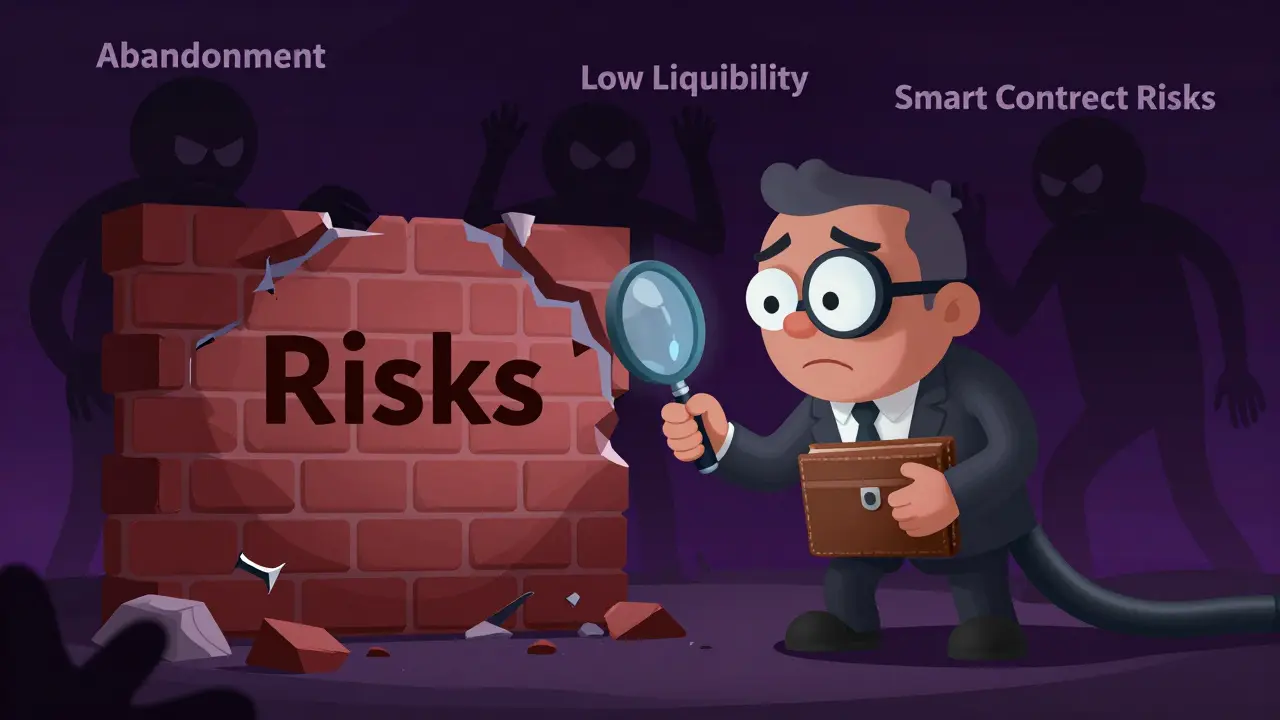
If you are considering buying TNS, you need to understand the risks. This is not a stock; it is a highly speculative digital asset with all the characteristics of an abandoned project.
- Abandonment Risk: There are no recent code commits on GitHub. No announcements on Twitter or Telegram. The team behind TNS has effectively gone silent. In crypto, when the devs leave, the token usually dies.
- Regulatory Uncertainty: As an ERC-20 token with no clear utility, TNS could be classified as a security by regulators like the SEC. While its small size makes it a low priority for enforcement now, any sudden surge in interest could attract scrutiny that shuts down trading.
- Smart Contract Risk: Even though it uses Ethereum’s base layer, the TNS token contract itself could have vulnerabilities. Since there are no public audits from reputable firms like CertiK or OpenZeppelin, you are trusting the anonymous creators’ code integrity.
- Opportunity Cost: Money tied up in an illiquid token cannot be used elsewhere. If you hold $1,000 in TNS, you might lose 90% of its value due to market decay, whereas that same money in a diversified portfolio could grow steadily.
Expert analysis of TNS is virtually nonexistent. Why? Because analysts follow volume and innovation. There is neither here. The absence of negative reviews is not a good sign; it means no one cares enough to criticize it. The average user sentiment, inferred from market abandonment, is neutral-to-negative because users simply move on to better options.
How to Handle TNS If You Already Own It
If you already hold Transcodium, here is a practical guide on what to do next. First, check your wallet. Ensure you are using a reputable non-custodial wallet like MetaMask or Ledger. Do not leave TNS on a shady exchange that might delist it overnight. If the exchange delists TNS, you may lose access to your funds if you cannot withdraw them to a private wallet.
Next, evaluate your entry price. If you bought in during the early days, you might still be profitable on paper. Consider selling a portion to recoup your initial investment. This is called "free riding." If the token goes to zero, you lose nothing. If it miraculously pumps, you still have skin in the game.
If you are trying to sell large amounts, expect slippage. Break your sells into small chunks over several days. Monitor the order book on whatever DEX lists TNS. If there are no buy orders, you may have to wait for a buyer or accept a steep discount. Be patient, but realistic. The likelihood of a massive recovery is statistically close to zero.
Conclusion: Is TNS Worth Your Time?
Transcodium (TNS) represents a cautionary tale in the cryptocurrency space. It started with an ambitious idea-decentralized file editing-but failed to deliver a working product, build a community, or maintain development momentum. Today, it is a zombie token: alive on the blockchain, but dead in terms of utility and relevance.
For beginners, TNS is a perfect example of what to avoid. Look for projects with transparent teams, active GitHub repositories, and verifiable use cases. For experienced traders, TNS offers only extreme speculation with high risk and low probability of reward. The decentralized storage and computing sectors are vibrant and growing, but TNS is not part of that growth story. It is better to invest in established leaders like Filecoin or emerging innovators with clear roadmaps than to chase the ghosts of abandoned projects.
Cryptocurrency is about trustless systems and verifiable truth. With TNS, the verification leads to a dead end. Proceed with extreme caution, or better yet, look elsewhere.
Is Transcodium (TNS) a scam?
While there is no definitive proof of fraudulent intent, Transcodium exhibits many characteristics of abandoned projects. It lacks active development, user adoption, and transparency. Investing in such tokens carries high risk similar to scams, as funds can become trapped with no way to recover value.
Where can I buy Transcodium (TNS)?
TNS is not listed on major centralized exchanges like Binance or Coinbase. It may be available on smaller decentralized exchanges (DEXs) or obscure platforms. Due to extremely low liquidity, buying and selling can result in significant losses due to price slippage.
What blockchain is Transcodium on?
Transcodium is an ERC-20 token built on the Ethereum blockchain. This means it requires Ethereum gas fees for transactions and can be stored in any Ethereum-compatible wallet like MetaMask or Trust Wallet.
Does Transcodium have any real-world use?
Currently, there is no evidence of real-world usage. The project claims to offer decentralized file editing and transcoding, but no functional platform or active user base has been verified. It functions primarily as a speculative asset rather than a utility token.
Why is the price of TNS so low?
The price is low due to a lack of demand, negligible liquidity, and perceived abandonment by the development team. With millions of tokens in circulation and almost no buyers, the market value has collapsed to fractions of a cent.
Comments (14)
Jay Sharma
June 26, 2026 AT 20:00
They tell us it is a ghost town but I bet the team is still sitting on millions of TNS in cold storage waiting for a pump to dump on retail. It is always the same script with these ERC-20 zombies. The silence is not accidental; it is strategic obfuscation designed to let the early insiders exit while we chase liquidity that does not exist. Wake up sheeple.
Trent Erman1
June 28, 2026 AT 10:53
The philosophical implication here is profound because it highlights the fragility of trust in decentralized systems when there is no underlying utility to anchor value. We are essentially betting on hope rather than engineering which is a precarious foundation for any financial instrument. If the code does not serve a function then the token is merely a digital artifact of failed ambition.
Maurice Flynn
June 29, 2026 AT 16:41
I just sit back and watch these things fade away like old paint peeling off a wall. There is nothing wrong with letting dead projects die naturally without trying to revive them with hype. Just accept the loss and move on to something that actually works.
Fiona Ellis
July 1, 2026 AT 14:10
Oh darling, have you checked your wallet permissions lately? 🚨 Because if you are holding this garbage you might as well be handing your private keys to the first scammer who DMs you. It is absolutely tragic how many people ignore basic security hygiene. Please do not reply with excuses because I know exactly what you did wrong. 😘
nancy jarecki
July 1, 2026 AT 21:07
This article is pedestrian at best. Any competent analyst would have identified the lack of GitHub activity months ago. The fact that you are even discussing TNS suggests a fundamental misunderstanding of market dynamics and tokenomics. Read some whitepapers from actual top-tier projects before wasting bandwidth on this dross.
Rebecca Shoniker
July 3, 2026 AT 15:40
Let me educate you on the concept of illiquidity traps because clearly your cognitive faculties are impaired by greed. When slippage exceeds ten percent you are not trading; you are donating to whoever holds the other side of the order book. It is elementary economics yet so many of you fail to grasp the basic mechanics of market depth. Stop acting like victims when you voluntarily walk into a bear trap.
Scott Miller
July 4, 2026 AT 07:50
You need to stop making excuses for why you bought this trash! Cut your losses right now and get out before you lose everything else. Do not wait for a miracle because miracles do not happen in crypto unless you create them by moving fast. Sell it all today!
Mélanie Boulay
July 4, 2026 AT 12:27
It is quite interesting to observe the disparity between the theoretical promise of decentralized transcoding and the stark reality of an inactive development repository, especially when one considers that the broader ecosystem has moved significantly forward in terms of technical sophistication and user adoption metrics over the past few years alone. The absence of regular updates or transparent communication channels from the original founders creates a significant barrier to entry for any potential new investors who might otherwise be interested in exploring the nuances of file-based utility tokens within the Ethereum network structure.
ross harris
July 5, 2026 AT 15:42
The entire narrative of TNS is a rotting carcass picked clean by vultures of speculation. It is a beautiful disaster of wasted potential where the code sits like a tombstone for dreams that never materialized. You can smell the decay in the order books.
Sajjad Ghorbani Moghaddam
July 7, 2026 AT 15:32
Hey everyone, just wanted to share that I used to hold this too but realized the gas fees alone were eating my profits alive. It is better to look at established protocols like Filecoin if you want real utility. Hope you guys find better gems out there.
Rob Morton
July 9, 2026 AT 09:44
What fascinates me is the psychological aspect of holding onto a zombie token. Why do we cling to assets that have no future? Is it sunk cost fallacy or genuine belief in a resurrection that will never come? Perhaps we need to rethink our relationship with digital scarcity.
Routh Middaugh
July 9, 2026 AT 20:34
I think we should all just agree that this project is done and move on peacefully. There is no need for drama or conspiracy theories; the data speaks for itself. Let us focus on positive investments instead.
Ryan Peters
July 11, 2026 AT 09:10
Typical foreign garbage token trying to ride the coattails of American innovation. These offshore devs launch a coin, vanish, and leave US taxpayers with the regulatory cleanup. We need stricter laws against these digital parasites bleeding our economy dry.
Robert Hundley
July 11, 2026 AT 11:46
Just sold my last bit. Feel good about getting out. Keep your head up folks.