Imagine holding a coin that promises to be the next big thing in decentralized finance, only to watch its value evaporate by over 99% in just three years. That is the reality for many holders of ULTRON, known by its ticker symbol ULX. As of August 2026, this asset sits in the murky waters of the micro-cap cryptocurrency market, trading at fractions of a cent with daily volumes that would barely cover a coffee run. Yet, beneath the dismal price action lies a technically distinct project: an EVM-compatible, leaderless Proof-of-Stake Layer-1 blockchain designed for privacy and cross-chain interoperability.
If you are wondering what makes ULX different from the thousands of other tokens cluttering the exchange listings, or if it’s worth your attention despite the red charts, you are in the right place. This guide breaks down the technology, the tokenomics, and the hard truths about its current market position. We will look at how it works, who built it, and why its price has taken such a dramatic turn since its launch in 2022.
The Core Identity: What Exactly is ULX?
At its heart, ULX is the native utility coin of the Ultron Blockchain, serving functions similar to Ether on Ethereum by securing the network through staking and paying transaction fees. The project was launched in 2022 by the Ultron Foundation, which brands itself with the tagline “Crypto for the people.” The goal is straightforward: create a fast, low-cost, and private environment for decentralized applications (dApps) to thrive without the high gas fees associated with major networks like Ethereum.
Unlike some projects that rely on complex voting mechanisms or centralized leaders to validate blocks, Ultron uses a leaderless Proof-of-Stake protocol combined with an asynchronous Byzantine Fault Tolerant (aBFT) consensus mechanism. In simple terms, validators reach agreement on the state of the ledger without a single node calling the shots. This design aims to reduce attack vectors and improve liveness, ensuring the network stays up and secure even if some nodes fail or act maliciously. For users, this translates to a stable backbone for their transactions, though the real test is whether enough developers and users actually show up to use it.
Technical Architecture: Privacy and Interoperability
What sets Ultron apart from standard EVM chains is its focus on privacy and cross-chain capability. Most blockchains are public ledgers where anyone can see every transaction detail. Ultron limits the sharing of transaction details to only the parties involved, offering a layer of financial privacy that appeals to users tired of total transparency. This feature is rare among Layer-1 competitors, most of which prioritize full auditability over user discretion.
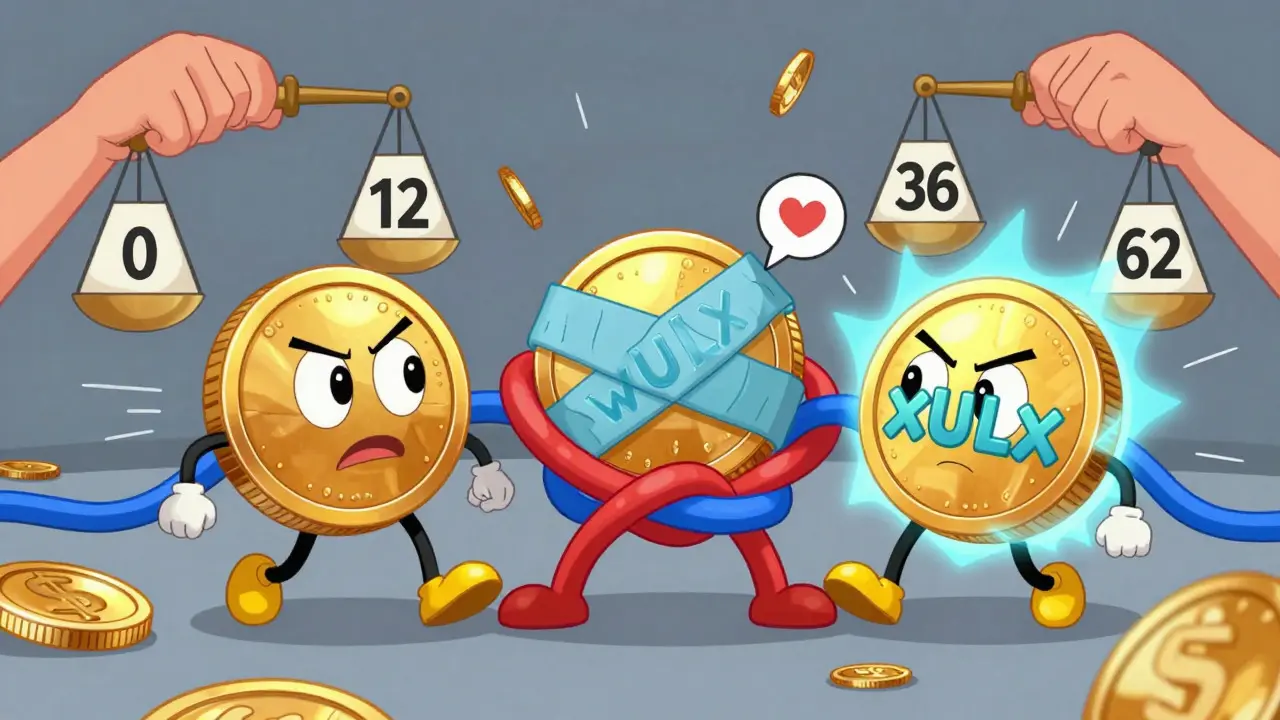
Furthermore, the network supports cross-blockchain data transfer. This means digital assets and standard tokens can move between Ultron and other EVM-compatible chains. This functionality is crucial because it allows ULX to exist in multiple forms. You might encounter wULX, a wrapped version of the token used on BNB Chain, or xULX, a reward token earned from staking. This multi-token structure adds complexity but also flexibility, allowing the ecosystem to tap into liquidity pools on larger networks like Binance Smart Chain.
| Feature | Ultron (ULX) | Ethereum (ETH) | Polygon (MATIC) |
|---|---|---|---|
| Consensus Mechanism | Leaderless PoS + aBFT | Casper FFG (PoS) | PoS (Proof of Stake) |
| Privacy Feature | Selective Transaction Sharing | Public Ledger | Public Ledger |
| Max Supply | 50 Billion | ~120 Million (No Hard Cap) | 10 Billion |
| Daily Volume (Aug 2026) | < $6,000 | $10+ Billion | $100+ Million |
| Primary Use Case | Niche dApps & Staking | DeFi, NFTs, L2 Settlement | Scalability for Ethereum |
Tokenomics and Supply Confusion
Here is where things get tricky for investors. If you check different tracking sites, you will see wildly different numbers for ULX’s supply. TokenInsight and RootData list a total supply of 4.78 billion ULX against a maximum supply of 50 billion. However, BitMart lists a total supply of only 74 million, while Coinranking shows 110 million. Why the discrepancy? It largely comes down to which version of the token you are looking at. The 4.78 billion figure likely refers to the native mainnet supply, whereas the lower figures often reflect the wrapped BEP-20 version circulating on BNB Chain or specific exchange reserves.
This structural ambiguity is a significant risk factor. With a maximum supply of 50 billion, ULX is a high-supply coin. Historically, high-supply coins require massive demand to maintain a high per-unit price. Given that ULX trades at roughly $0.000013 as of mid-2026, the market capitalization is minuscule. Gate.io reports a market dominance of just 0.000065%, meaning ULX accounts for a negligible fraction of the total global crypto market cap. For context, even small altcoins typically hold dominance in the 0.01% range. ULX is far below that threshold, signaling extreme niche status.
The Price History: From Hype to Drawdown
To understand the current sentiment, we have to look at the journey. When ULX debuted in 2022, it started around $0.028. By August 2023, during a period of renewed interest in new Layer-1s, the price had surged to $0.1433, representing a gain of over 400%. At that time, articles from outlets like BeInCrypto described Ultron as a promising newcomer gaining momentum. The narrative was strong: low fees, privacy, and high staking rewards were attracting early adopters.
However, the crypto market is notoriously fickle. Between late 2023 and 2026, the price collapsed. By November 2024, it had dropped to around $0.0017. By April 2025, it was hovering near $0.01, showing some volatility but no sustained recovery. Fast forward to August 2026, and the price sits between $0.000013 and $0.0003 depending on the exchange and snapshot date. This represents a decline of over 99.7% from its peak. Such a drawdown usually indicates a loss of investor confidence, lack of organic adoption, or both. While technical features remain intact, the economic engine driving the token seems to have stalled.
Liquidity Risks and Trading Realities
One of the biggest hurdles for any potential buyer of ULX is liquidity. Daily trading volumes are shockingly low. On August 19, 2026, CoinGecko reported a 24-hour volume of just $98.24. Even on days with higher activity, like August 7, the volume peaked at around $5,600. Compare this to Ethereum, which sees tens of billions in daily volume. What does this mean for you? Slippage. If you try to buy or sell a large amount of ULX, you could significantly move the price against yourself because there aren’t enough buyers or sellers on the order books.
Most trading happens on decentralized exchanges like Uniswap V4 on BSC, where the primary pair is ULX/BSC-USD. Centralized exchanges like Gate.io and BitMart list the token, but their volumes are similarly thin. For a trader, this creates a high-risk environment. You might enter a position easily, but exiting with a substantial profit could be difficult without waiting for better liquidity conditions. This illiquidity also makes the token highly susceptible to manipulation, where a few large holders can dictate price movements with minimal capital.

Staking and Ecosystem Utility
Despite the poor price performance, the utility of ULX remains defined by its role in the network. Users can stake ULX to participate in consensus validation, earning rewards in the form of xULX. This staking mechanism is central to the security of the Ultron blockchain. Without sufficient stakers, the network becomes vulnerable to attacks or downtime. The Ultron website even includes calculators that assume a default price of 0.10 ULX per USDT, a figure that is currently more aspirational than realistic given market prices. This disconnect between internal marketing assumptions and external market reality is a common pitfall in smaller crypto projects.
The ecosystem of dApps built on Ultron is still developing. Because the chain is EVM-compatible, developers can port existing Ethereum smart contracts with minimal changes. This lowers the barrier to entry for builders. However, until these dApps attract significant user traffic, the demand for ULX as a gas token will remain limited. The cross-chain capabilities offer a path to growth by bridging users from other ecosystems, but so far, the volume of cross-chain activity hasn't been enough to reverse the downward price trend.
Is ULX Worth Your Attention in 2026?
So, should you invest in ULX? The answer depends entirely on your risk appetite. ULX is not a safe harbor for your portfolio. It is a high-speculative, micro-cap asset with a history of severe drawdowns and very low liquidity. The technology-leaderless PoS, privacy features, and cross-chain support-is sound on paper and offers genuine differentiation from mainstream competitors. If you believe that privacy-focused Layer-1s will see a resurgence in adoption, ULX could be a candidate for a high-risk, high-reward play.
However, for the average investor, the risks outweigh the benefits. The conflicting supply data, the 99%+ price drop, and the negligible daily volume all point to a project struggling to find product-market fit. Unless you are deeply interested in the specific technical aspects of aBFT consensus or have a direct connection to the Ultron Foundation's development roadmap, ULX may not offer the stability or growth potential you are looking for. Keep an eye on developer activity and cross-chain volume metrics; those are the leading indicators that might signal a change in trajectory before the price chart reacts.
What is the current price of ULX coin?
As of August 2026, ULX trades at approximately $0.000013 to $0.0003 USD, depending on the exchange and time of day. Prices fluctuate significantly due to low liquidity, so always check real-time data on aggregators like CoinMarketCap or CoinGecko before trading.
How is Ultron different from Ethereum?
While both are EVM-compatible Layer-1 blockchains, Ultron uses a leaderless Proof-of-Stake consensus with aBFT for faster finality and lower fees. Additionally, Ultron incorporates selective transaction privacy, limiting who can see transaction details, whereas Ethereum is fully transparent. Ultron also has a much higher maximum supply (50 billion vs. ~120 million).
Where can I buy ULX?
ULX is available on several centralized exchanges like Gate.io and BitMart, as well as decentralized exchanges like Uniswap V4 on BSC. Due to low liquidity, buying on DEXs may result in higher slippage. Always verify the contract address to avoid fake tokens, especially when using DEXs.
What is the difference between ULX, wULX, and xULX?
ULX is the native coin on the Ultron mainnet. wULX is a wrapped version of ULX used on other chains like BNB Chain for cross-chain compatibility. xULX is a reward token that users earn when they stake ULX to secure the network. They represent different facets of the same ecosystem's economy.
Is ULX a good investment for long-term holding?
ULX carries high risk due to its micro-cap status, low liquidity, and historical price decline of over 99% since 2023. While the technology has unique features like privacy and leaderless consensus, adoption remains limited. Long-term holding requires belief in the project's future development and broader market shifts toward privacy-focused L1s.
Comments (11)
Sarah Hafner
August 21, 2026 AT 14:29
Oh my, this article really puts things into perspective! :D It is so hard to watch a project you believed in just fade away like that. The liquidity numbers are honestly the scariest part for me. If you can't even sell your coffee money's worth without moving the price, how do you hold? I feel like the privacy feature is cool but maybe too niche for the mainstream crowd right now. It reminds me of all those other L1s that promised the world and delivered silence. At least the tech stack looks solid on paper, though. Sometimes good engineering just isn't enough if the community dies out. I hope they find their footing eventually, but it feels like a long shot. :/ What do you all think about the wrapped versions? Do they help at all or just add more confusion?
Susan Kiley
August 22, 2026 AT 04:50
Finally, someone writes with actual substance rather than the usual hype-bait drivel. 😒 The 'micro-cap' label is an understatement; it is practically a ghost town. Most retail investors don't even have the vocabulary to understand what aBFT consensus implies, let alone care about it. They want moonshots, not Byzantine fault tolerance. The fact that the supply data is inconsistent across trackers is a massive red flag that the elites know but ignore. It’s a testament to the sheer incompetence of the average crypto holder who buys based on Twitter memes. One must look beyond the price chart to see the structural rot. Truly, only the discerning few should bother analyzing such a fractured ecosystem. 🙄
alex fordy
August 22, 2026 AT 17:30
I’ve been following this space for a while now, and the decline of ULX is a perfect case study in narrative fatigue. 🧐 When a project relies heavily on technical differentiation without a corresponding user base, the math simply doesn't work out. The leaderless PoS mechanism is elegant, sure, but elegance doesn't pay bills. We often forget that adoption is a social phenomenon, not just a technical one. If developers aren't building, users won't come. And if users don't come, the gas token has no demand. It’s a classic chicken-and-egg problem that many L1s fail to solve. The privacy angle was its best card, but privacy coins have had a rough decade due to regulatory headwinds. Still, the cross-chain potential remains interesting if executed well. But execution is the key word here. 💡
Nia Franklin
August 24, 2026 AT 17:26
ohh wow!! i never realized how bad the liquidity was!!! 😱 its kinda scary to think about how easy it is to get stuck in these coins... i love the idea of privacy tho?? its so important in this surveillance era!!! but yeah... 99% drop is brutal!! 😢 i think the wrapped tokens thing is super confusing for newbies... why do we need three different symbols for the same coin?? it feels like they are trying to overcomplicate things instead of making it simple... i guess thats just how crypto works though... 🤷♀️ anyway... keep us posted if anything changes!! i am rooting for the underdogs!! 🌟✨💖
Mohamed Shoaeb
August 26, 2026 AT 11:18
interesting read. i think the main issue is timing. launching a privacy-focused L1 in 2022 was tough. by the time the tech matured, the market had shifted to AI and RWA narratives. the low volume is a natural consequence of that. still, the tech is there. if they can attract even a small dev community, the story could change. i remain cautiously optimistic about niche chains finding their audience. sometimes it takes years. 🚀
Sonia Gomez Gomez
August 28, 2026 AT 06:15
You people need to stop pretending this is a viable investment. It's a scam waiting to happen. Anyone holding this is either delusional or running a pump-and-dump scheme. Look at the volume! $98?! That's less than what I spend on lunch. The foundation clearly abandoned ship and left holders to rot. It's morally bankrupt to keep marketing this as 'crypto for the people' when the people are losing everything. Wake up! Stop chasing ghosts and buy real assets. This is exactly why regulation is needed to save us from ourselves. 😠📉
SHIV SHANKAR KANTA
August 30, 2026 AT 04:43
The tragedy of Ultron is not the price. It is the soul. We sold our souls for tokens that promised utopia. Now we sit in the digital wilderness wondering where the light went. Is it not ironic that a chain built on trust requires so little of it? The silence of the order books speaks louder than any whitepaper. We are all just shadows dancing in the void of liquidity. 🌑
Daniel Brown
August 30, 2026 AT 14:11
Let's be real here. The US regulators are going to crush any privacy coin that tries to gain traction again. The SEC doesn't like secrets. So even if the tech is good, the legal environment in the States makes it nearly impossible for something like this to scale organically without massive compliance costs. That's the real killer, not the code. You can have the best consensus mechanism in the world, but if you can't list on major US exchanges because of privacy concerns, you're dead on arrival. Just my two cents.
Marco Maldonado
August 31, 2026 AT 01:29
YEAH ABOUT THAT! 🇺🇸 THIS IS WHY WE NEED TO SUPPORT AMERICAN INNOVATION NOT THESE FOREIGN CHAINS! LOOK AT THE VOLUME! ITS PATHETIC! IF THEY WANT TO PLAY IN OUR MARKET THEY BETTER FOLLOW OUR RULES! NO MORE HIDDEN STUFF! TOTAL TRANSPARENCY OR BUST! I DONT CARE ABOUT BYZANTINE FAULT TOLERANCE I CARE ABOUT JOBS AND GROWTH! LETS MAKE CRYPTO GREAT AGAIN! 🦅📈
Darren Moon
August 31, 2026 AT 20:02
One must observe the systemic inefficiencies inherent in such micro-cap instruments. The slippage metrics suggest a severe lack of market depth, rendering arbitrage opportunities largely theoretical. Furthermore, the divergence in supply data indicates a failure in fundamental accounting practices, a hallmark of under-regulated entities. While the aBFT consensus offers theoretical security benefits, the practical application in a low-adoption environment is negligible. It is, quite frankly, a speculative artifact of a previous bull cycle. The liquidity crisis is not merely a trading inconvenience; it is a structural impediment to value discovery. One would expect better governance from a project touting 'leaderless' efficiency. Yet, here we are, witnessing the inevitable entropy of neglected networks. A sobering reminder that technology does not guarantee economic viability. 📉🏛️
Gary Straiton
September 1, 2026 AT 02:11
HA! Another dead horse being beaten! Who even reads this stuff anymore? The chart is flatlined! It’s basically digital dust! I bet the founders are sipping champagne in Dubai while we’re stuck holding bags worth less than a gumball machine! This is a total disaster! No wonder nobody trades it! It’s embarrassing! Get rid of it before it goes to zero completely! Don’t say I didn’t warn you! 😤🔥