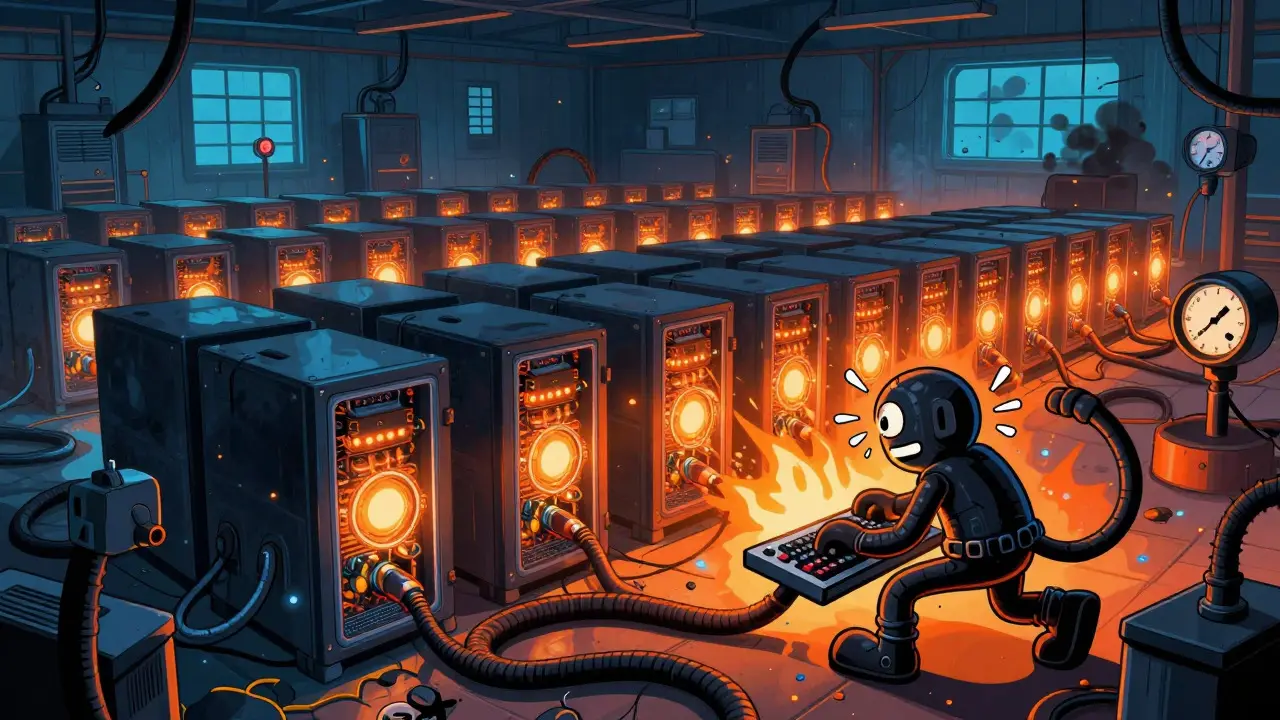
Imagine a world where securing a global financial network doesn't require a warehouse full of humming servers and a six-figure electricity bill. That is the promise of Proof of Stake, or PoS, a consensus mechanism that swaps computational brute force for economic commitment. For years, Bitcoin set the standard with Proof of Work (PoW), where miners raced to solve complex math problems. But this model comes with a heavy price tag: massive energy consumption and specialized hardware. Staking changes the rules entirely. Instead of competing on speed, participants compete on ownership. If you hold the coin and lock it up, you get a chance to secure the network. This shift isn't just a technical tweak; it’s a fundamental rethinking of how trust is established in decentralized systems.
The Core Difference: Energy vs. Economics
To understand why staking is replacing mining, you have to look at what actually happens when a new block is created. In a traditional PoW system like Bitcoin, miners use powerful computers to guess a specific number that solves a cryptographic puzzle. The first one to find it adds the block and gets rewarded. It’s a race against physics. The more power you have, the better your odds. This creates an arms race for hardware efficiency and cheap electricity, often leading to centralized mining farms in regions with low energy costs.
In contrast, Staking removes the puzzle-solving step. There is no race. Validators are selected by the network based on how much cryptocurrency they have locked up as collateral. Think of it less like a sprint and more like a lottery where your ticket count depends on your net worth in that specific asset. You don’t need a supercomputer; you need a stable internet connection and a wallet holding the native token. This eliminates the need for expensive ASICs (Application-Specific Integrated Circuits) and drastically reduces the environmental footprint of the network. The barrier to entry shifts from capital expenditure on hardware to liquidity in the asset itself.
How Validator Selection Actually Works
You might wonder: if everyone can stake, how does the network decide who validates the next block? It’s not simply "biggest stake wins." That would lead to extreme centralization. Most modern PoS networks use a combination of stake amount and randomization. The algorithm looks at the total stake across all validators and picks a winner using a pseudo-random process. However, the probability of being picked is weighted by your share of the total stake. If you control 1% of the total staked supply, you have roughly a 1% chance of being selected for any given slot, adjusted for other factors like uptime history.
This method ensures that those with the most skin in the game are most likely to be responsible for maintaining the ledger. It also introduces a layer of unpredictability that makes it hard for bad actors to predict exactly when they will be active, reducing the window for coordinated attacks. In networks like Ethereum, this selection process happens continuously, ensuring that validation duties are distributed fairly among thousands of participants rather than concentrated in a few hands.
Economic Incentives and the Slashing Mechanism
Mining rewards come from creating new coins and collecting transaction fees. Staking works similarly but adds a crucial twist: the risk of loss. When you stake, you are essentially posting a bond. If you do your job correctly-keeping your node online and validating transactions honestly-you earn rewards. These rewards are usually paid out in the native cryptocurrency, proportional to your stake. It acts as a form of passive income, similar to interest on a savings account, but generated by network utility rather than debt.
However, the incentive structure includes a penalty known as slashing. If your validator node goes offline for too long, or worse, if you sign two conflicting blocks (double-signing), the network punishes you by taking a portion of your staked funds. This economic penalty aligns the interests of validators with the health of the network. In PoW, if a miner goes offline, they just lose potential earnings. In PoS, they lose actual capital. This makes reliability a financial priority, not just a technical one. To attack a PoS network effectively, a malicious actor would need to own enough tokens to influence the majority of validators, which is often more expensive and harder to hide than buying mining rigs.
| Feature | Proof of Work (Mining) | Proof of Stake (Staking) |
|---|---|---|
| Primary Resource | Computational Power & Electricity | Cryptocurrency Holdings (Stake) |
| Hardware Requirements | Specialized ASICs or High-End GPUs | Standard Computer or Cloud Server |
| Energy Consumption | Very High | Low |
| Entry Barrier | High Capital Expenditure + Ongoing Costs | Asset Ownership + Technical Setup |
| Punishment Mechanism | Lost Opportunity Cost | Slashing (Loss of Principal Stake) |
Solo Staking vs. Delegated Pools
Not everyone wants to run their own validator node. Running a solo validator requires technical expertise, consistent uptime, and often a significant minimum stake. For example, on Ethereum, a solo validator must lock up exactly 32 ETH. If you fall short, or if you aren’t comfortable managing server infrastructure, you have options. Many users choose delegated staking through pools or exchanges. In a pool, multiple users combine their stakes to meet the minimum requirement, and the rewards are distributed proportionally. This democratizes access to validation rewards, allowing anyone with a small amount of crypto to participate in securing the network without becoming a professional operator. While you might pay a small fee to the pool manager, you gain simplicity and reduced risk of slashing due to downtime.

Real-World Adoption and Network Security
The transition from mining to staking isn't theoretical. Major networks have already made the switch. Ethereum, the second-largest cryptocurrency by market cap, completed its migration to PoS, eliminating millions of miners and shifting security to validators. Other prominent chains like Cardano, Polkadot, and Solana were built on PoS from the start or migrated early. These networks demonstrate that staking can secure billions of dollars in value without the energy drain of mining. The security model relies on the cost of acquiring tokens versus the reward for attacking the chain. As long as the market value of the token remains high, the economic cost of launching a successful 51% attack remains prohibitive. This has led to a trend where new blockchain projects launch directly with PoS consensus, skipping the mining phase entirely to save energy and reduce initial complexity.
Frequently Asked Questions
Is staking safer than mining?
Both models have different risk profiles. Mining risks include hardware failure and rising electricity costs. Staking risks include slashing penalties and smart contract bugs. Generally, PoS is considered more sustainable and less prone to hardware obsolescence, but it introduces financial risk through slashing. For most users, the lower operational risk of staking outweighs the minor risk of slashing, especially when using reputable validators or pools.
Do I need to keep my coins in a cold wallet to stake?
No. To stake, your coins must be accessible to the validator node so it can sign blocks. This means they are technically "hot" while staked. However, many platforms offer non-custodial staking solutions where you maintain control of your keys while delegating to a validator. Once unstaking begins, there is often a waiting period before you can move your funds, so plan your liquidity needs accordingly.
What happens if a validator goes offline?
If a validator misses a block proposal or attestation, they may incur a small penalty. If they remain offline for an extended period, the network may slash their stake. The severity depends on the specific network's rules. In Ethereum, missing a single attestation results in a tiny fine, while double-signing results in a larger slash. Consistent uptime is critical for maximizing returns and avoiding penalties.
Can I stake on any cryptocurrency?
Only cryptocurrencies that use a Proof of Stake consensus mechanism allow staking. Bitcoin, for instance, still uses Proof of Work, so you cannot stake BTC. However, major assets like Ethereum, Solana, Cardano, and Polkadot support staking. Always check the official documentation of a specific token to confirm if staking is available and what the requirements are.
Does staking make the network more centralized?
This is a common concern. Since larger holders have higher chances of being selected, wealth concentration can influence validation. However, because selection is randomized and weighted, it is difficult for a single entity to dominate unless they control a massive percentage of the total supply. Additionally, the ability to delegate staking allows smaller holders to participate, distributing the power somewhat. Compared to PoW, where large mining farms can control huge hashrates, PoS often offers a more transparent and accessible path to participation.